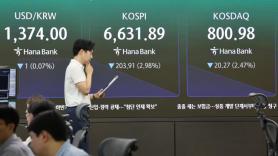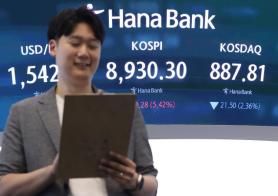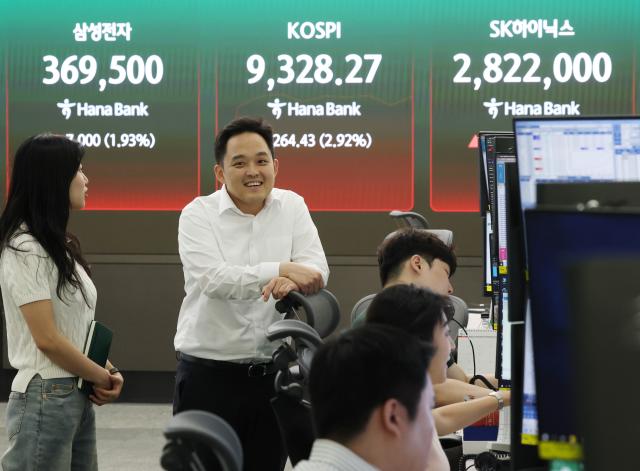
The KOSPI stood at 9,371.8, up 307.9 points, or 3.4 percent intraday while the Nikkei traded at 71,632.4, up 578.9 points, or 0.8 percent.
Both rallies traced to the same source: SK hynix and Samsung Electronics in Seoul, and Japan's chip-equipment makers in Tokyo, all riding a semiconductor memory supercycle fed by AI compute demand.
The KOSPI opened at a record 9,288.8 and surged to 9,331.5 shortly after the open, clearing the 9,200 and 9,300 levels in succession.
The combined market capitalization of the KOSPI and KOSDAQ reached 8,160 trillion won, the first time on record above 8,000 trillion won.
The pace is accelerating. The combined figure first crossed 6,000 trillion won on April 27, then 7,000 trillion won eight sessions later on May 11. Thursday's 8,000 trillion won milestone came 26 sessions after that.
SK hynix climbed 4.9 percent to 2,818,000 won ($1,834), pushing its market cap to 2,008 trillion won, the second single stock above 2,000 trillion won in Korean history, after Samsung. The stock touched 2,850,000 won ($1,853) intraday, a record.
Samsung Electronics rose 1.6 percent to 368,500 won ($239.52), with a market cap of 2,154 trillion won. It hit 374,500 won ($243.42) intraday, also a record.
The gap between the two has narrowed to about 146 trillion won. SK hynix's market cap now equals 93 percent of Samsung's.
SK hynix's first-quarter 2026 revenue surpassed 50 trillion won for the first time in the company's history, at an operating margin of 72 percent, the earnings power behind the move.
In Tokyo, the Nikkei opened at 71,551.03 and peaked at 71,952.99, a record intraday high, before easing. The index closed Wednesday at 71,053.49 after a 1.65 percent gain.
Japan's rally has been propelled by an interim US-Iran agreement to reopen the Strait of Hormuz, a relief for an economy dependent on Middle East energy, alongside strength in technology names including Lasertec, Tokyo Electron, and SoftBank Group.
Japan's May exports grew at their fastest pace in more than three years, beating estimates, as chip demand soared, reinforcing the case for further buying in the country's semiconductor supply chain.
The risk is concentration. With Samsung and SK hynix accounting for roughly 28 and 26 percent of the KOSPI's market cap, the index now lives and dies by memory pricing. The KOSDAQ underscored the split, falling 2.10 percent to 979.96 even as the main board set records.
In Seoul, individuals were net buyers of 5,793 billion won as of mid-morning, while foreigners sold 4,313 billion won and institutions offloaded 1,258 billion won. The won traded at 1,538.50 per dollar, weaker by 0.50 won on the day.
A reversal in memory expectations, or a sharper Fed move, would hit both indices disproportionately. For now, the chip trade is carrying two of Asia's biggest markets to records on the same session.
Copyright ⓒ Aju Press All rights reserved.