

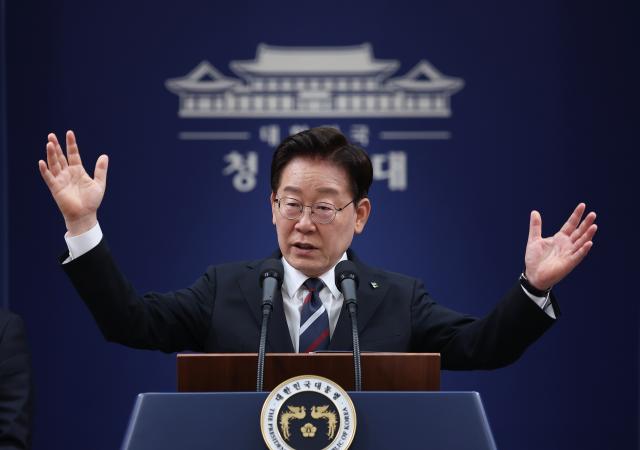
He also addressed domestic issues, including conflicts between the government and the ruling party and the shortage of ballots reported by the National Election Commission.
During the briefing at the Blue House, President Lee emphasized, "All of this is possible thanks to the support of the people." This was his first separate briefing outside of commemorative events or in-flight discussions since taking office.
From June 9 to June 17, President Lee visited Belgium, Italy, and the Vatican, followed by participation in the G7 summit held in Évian-les-Bains, France.
He noted that discussions with the European Union centered on shared values of peace, prosperity, solidarity, and cooperation, and that there was a consensus on major international issues, including the situation in the Middle East and peace on the Korean Peninsula.
Regarding changes to the EU's steel tariff system, President Lee stated, "I conveyed our firm position to the EU that the reduction of South Korea's steel quotas should not become a trade barrier."
On June 15, during a meeting with Pope Leo XIII at the Vatican, President Lee requested the Pope to visit South Korea for the World Youth Day next year, including a visit to the Demilitarized Zone (DMZ) and potentially North Korea. He reported that the Pope responded, "I will actively consider and pursue this."
When asked about his approach to North Korea, President Lee lamented, "Unfortunately, all communication channels with North Korea are currently severed," and emphasized the need for dialogue led by the United States, stating, "We must work to create such conditions."
He described North Korea's stance as viewing South Korea as "not a national community, but two hostile states," noting that communication lines and emergency contacts have been cut off, and that construction of barriers along the military demarcation line continues year-round.
President Lee attributed the breakdown in dialogue to North Korea's provocations, which he said aimed to declare a state of emergency through physical conflict, resulting in significant damage and worsening conditions.
He remarked, "It has become difficult for South Korea to pave the way for peace and coexistence on the Korean Peninsula," adding that North Korea perceives the United States as crucial to its regime's security.
During the G7 summit, President Lee had multiple meetings with President Donald Trump, including discussions on the Korean Peninsula during the official dinner, where Trump repeatedly stated that North Korea should have taken realistic measures before developing nuclear weapons, adding, "Now it is too late. It is no longer possible to physically stop it."
President Lee also noted that the ongoing war between Russia and Ukraine has complicated the situation, diminishing the effectiveness of sanctions against North Korea due to military cooperation between Russia and North Korea.
Addressing concerns about the tensions between the Blue House and the ruling Democratic Party following the recent local elections, President Lee remarked, "The relationship between the party and the government is both unified and separate. It can encourage each other and point out mistakes. While it may seem there is significant conflict, I believe it is a process for improvement."
He emphasized the importance of a healthy party-government relationship, stating, "The party can provide necessary criticism to the government. I do not believe we should only speak positively."
President Lee concluded that politics should gather supporters and be inclusive, noting that while a minority party must rally its base to survive, the ruling party's stance changes once in power.
Regarding the ballot shortage issue, he expressed disbelief, stating, "It is quite absurd," and suggested that if there is consensus between the ruling and opposition parties, a one-point constitutional amendment regarding the Election Commission may be necessary.
He pointed out, "We have no authority for control, oversight, or checks," adding, "We do not even have formal appointment rights for the Election Commission chairperson."
On the possibility of a cabinet reshuffle, President Lee indicated that he is considering it but has not yet deeply thought about which departments might be involved. He noted, "A year has passed since the government was launched, and the nature of governance now appears different from before."
He described the past year as a period focused on stabilizing a chaotic administration while also addressing urgent economic issues, stating, "The important thing is that if we focus on reforming the tangled issues, the upcoming period will likely be one for properly advancing new initiatives."
* This article has been translated by AI.
Copyright ⓒ Aju Press All rights reserved.