

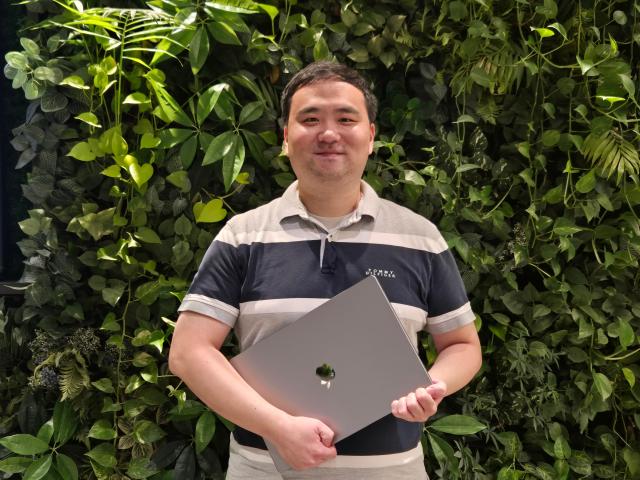
"In terms of screen development, a task that would take me a month can be completed by AI in just one hour," said Choi Byung-jun, a developer at SK Telecom's Air Service Team, during an interview on June 18 at the SKT T Tower in Seoul. He explained how AI has significantly increased productivity in development, transforming its role from a simple tool to a collaborative partner for developers.
According to SKT, Choi participated alone in the company's AI hackathon held in May and reached the finals. This was his third time competing; in previous contests, he had participated as part of a team. "AI has advanced so much in the last year or two, and I was curious if I could develop alone. I ended up achieving better results than when I participated as a team," he said.
In his daily work, Choi utilizes various AI tools: Google's AI coding tool, 'Anti-Gravity,' for development; SKT's internal AI platform, 'A-dot Biz,' for planning; and Anthropic's 'Claude' for document creation. He noted, "I worked with multiple AI agents simultaneously, similar to how I would distribute tasks among team members. While one AI was working, I communicated with another and reviewed the results afterward."
This experience naturally led to his hackathon project. Choi's entry, 'T-Care,' is an AI service designed to assist digitally vulnerable individuals with smartphone usage.
The idea emerged during a support task related to a SIM card information leak incident last year. Choi observed many customers asking basic questions about using smartphones, such as how to use KakaoTalk. "I thought it would be helpful if AI could guide them through these processes," he explained.
T-Care allows users to verbally request features, and the AI analyzes the smartphone screen to find the necessary menus. Unlike traditional methods that rely on capturing screen images for analysis, this service extracts data such as button locations and function information, enabling it to explore hidden menus and areas below the scroll. Choi elaborated, "If a user says they want to find real-time usage fees, the AI determines which button to press and repeats the process on the next screen until it reaches the desired menu."
AI utilization has also yielded results in the service development process. Choi particularly noted improvements in productivity within frontend development. He stated, "There was a task to internalize a partner company's website that would have taken me over a month, but AI completed it in just 1 to 2 hours. AI is now better than humans at screen layout and device optimization."
However, not all tasks can be entrusted to AI. Choi emphasized that backend development, which involves handling customer data and service logic, still requires human verification. "I don't fully trust AI in the backend area yet. The role of developers to conduct final checks will continue to be necessary," he remarked.
The growing adoption of AI is expected to impact the developer job market as well. Choi predicts that the entry barriers for new developers may increase. "As AI takes over coding, the importance of basic implementation skills is diminishing. However, the ability to validate and modify results will become even more crucial," he noted.
With the expansion of AI usage in companies, security concerns have also emerged as a significant issue. Choi prefers internal AI platforms over general-purpose AI due to their security and better understanding of the company's work environment and terminology. He expressed concern that inputting source code into general-purpose AI could lead to the leakage of company assets. "In the future, closed AI environments that are separate from the internet or dedicated AI models for businesses will likely become more prevalent," he added.
* This article has been translated by AI.
Copyright ⓒ Aju Press All rights reserved.