

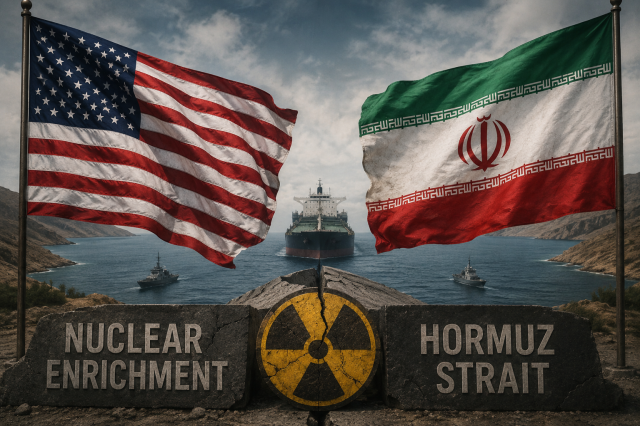
Iranian state media reported that the nuclear issue was not discussed during the follow-up negotiations on the U.S.-Iran peace agreement. While the U.S. views limiting Iran's nuclear program as a key agenda item, Iran claims that the initial talks prioritized the Lebanon issue and the implementation of the peace agreement.
On June 21, Iranian state broadcaster IRIB reported that no negotiations regarding Iran's nuclear program took place during the first meeting held at the Bürgenstock resort near Lucerne, Switzerland. The meeting, which lasted 80 minutes, was conducted in a four-party format with the participation of mediators from Pakistan and Qatar.
IRIB stated, “This negotiation focused primarily on the Lebanon issue and discussed the implementation of Article 13 of the Islamabad Agreement.” The Islamabad Agreement appears to refer to the recent memorandum of understanding (MOU) signed between the U.S. and Iran.
Iran is reportedly demanding the stabilization of clashes between the Iran-aligned militant group Hezbollah and Israel, as well as the release of frozen assets. In contrast, the U.S. insists that discussions should first address limitations on Iran's nuclear program, the resumption of inspections by international organizations, and the stability of navigation in the Strait of Hormuz.
After the meeting, the Iranian delegation reportedly entered into separate bilateral talks with the Qatari representatives. IRIB noted that it remains unclear whether the four-party talks will resume or be suspended.
Iran's state-run Press TV reported that the Iranian delegation officially protested to the U.S. regarding recent military threats made by President Donald Trump. Trump has warned that if Iran continues to support groups like Hezbollah, the U.S. may respond with stronger airstrikes.
Prior to the talks, U.S. Vice President J.D. Vance stated publicly that if Iran ceases actions that escalate tensions in the Middle East and expresses a willingness to abandon nuclear weapons in the long term, the U.S. could fundamentally change its relationship with Iran.
This meeting marks the first high-level follow-up negotiations since the signing of the peace MOU between the U.S. and Iran. However, the differing priorities regarding the nuclear issue and the Lebanon situation have already highlighted significant gaps in perspectives, suggesting that future negotiations may face challenges.
* This article has been translated by AI.
Copyright ⓒ Aju Press All rights reserved.