

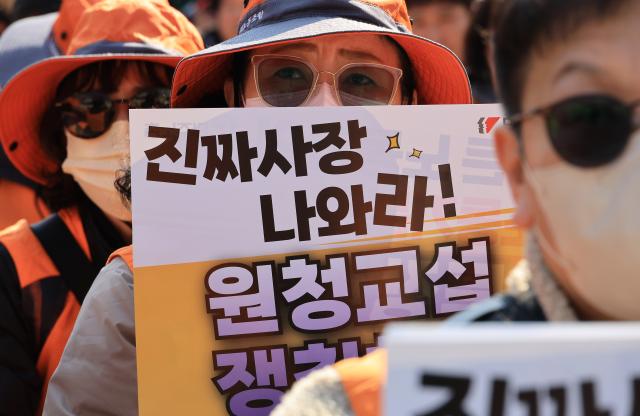
According to the Ministry of Employment and Labor, from the law's implementation date on March 10 to June 19, secondary contractors submitted negotiation requests to 439 primary contractor workplaces, involving 1,161 unions with a total of 164,000 members. Of these, 249 workplaces (56.7%) were in the private sector, while 190 (43.3%) were in the public sector.
The requests for negotiations from secondary contractors were concentrated in the early days of the law's implementation. In the first month, from March 10 to 31, 363 primary contractor workplaces received negotiation requests, but this number dropped to 42 in April, 23 in May, and just 11 from June 1 to 19.
The government believes that after the initial surge, the situation has stabilized. However, the determination of employer status remains a key issue in the transition from negotiation requests to actual negotiations.
Out of the 439 workplaces that received negotiation requests, only 42 announced the requests voluntarily without going through the labor committee's determination process. A total of 141 primary contractors are undergoing labor committee procedures regarding employer status, with determinations completed for 113 of them. Employer status was recognized for 103 workplaces, while 10 were denied.
Among the 103 workplaces where employer status was recognized, 32 have not received their decision documents. Of the remaining 71, 54 are proceeding with the negotiation window unification process based on labor committee decisions. Thirteen workplaces are undergoing a re-examination process by the Central Labor Relations Commission, while four are reviewing subsequent procedures. Including those that did not go through the labor committee, a total of 96 workplaces are currently in process.
However, only a limited number of workplaces have entered into substantive negotiations. Of the 96 that have progressed, 51 have completed the negotiation window unification process and are currently discussing negotiation agendas and schedules. Among these, 10 workplaces, including Incheon Medical Center, have begun substantive negotiations.
In contrast, 256 primary contractors have not taken any follow-up actions after receiving negotiation requests. Notably, in the private sector, the construction industry accounts for 85 of these cases. This reflects the initial situation where tower crane unions made negotiation requests and filed for corrective measures with the labor committee but have since adopted a wait-and-see approach. In the public sector, discussions within the labor-management consultative bodies have influenced the concentration of negotiation requests in areas such as care services and waste management.
Debate continues over the separation of negotiation units. To date, the labor committee has made decisions on the separation of negotiation units for 29 primary contractors. Of these, separation was recognized for 12, with 9 for business sector separation, 2 for higher-level organization separation, and 1 for union separation.
The Ministry of Labor maintains that experiences from the initial negotiation procedures and labor committee determinations are being accumulated in the field. As the targets, scope, and units for negotiations become clearer, indiscriminate splitting of negotiations or explosive demands have not emerged. A ministry official stated, "Within a broad framework, negotiations are progressing with mutual respect between labor and management," adding that communication is actively ongoing within the labor-management consultative bodies in the public sector.
However, there are concerns in the field regarding uncertainties surrounding the scope of negotiations by agenda and the responsibilities of primary contractors. There are indications that employer status may be recognized even for indirect support tasks centered on industrial safety and working conditions. In this regard, the ministry explained, "We are assessing whether there is a position to effectively dominate and manage industrial safety and working conditions."
Labor authorities plan to support the orderly progression of negotiations between primary and secondary contractors. Minister of Labor Kim Young-hoon stated, "We are calmly preparing for negotiations according to the procedures set by law," urging the business community to actively engage in negotiations once labor committee determinations are made, and encouraging unions to focus on resolving practical issues and achieving negotiation outcomes centered on agendas that primary contractors can effectively dominate and decide.
* This article has been translated by AI.
Copyright ⓒ Aju Press All rights reserved.