

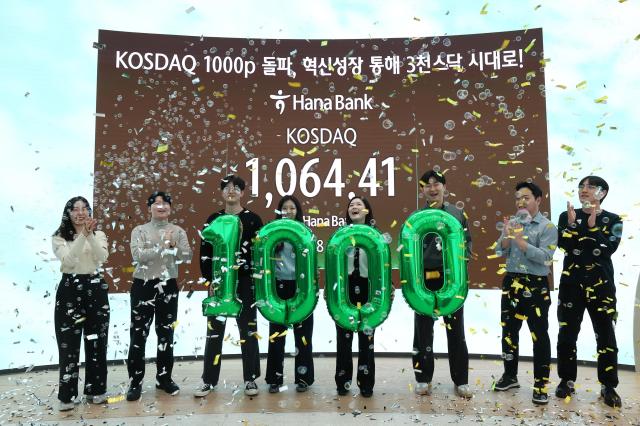
The KOSDAQ market, which celebrates its 30th anniversary this year, remains mired in poor performance. After peaking at 1,229 in April, the index has fallen back to the 900s, starkly contrasting with the KOSPI, which has surpassed 9,000.
Market analysts point out that "the KOSDAQ is currently an unattractive market for investment." With few appealing companies, both capital and investors are leaving the KOSDAQ. Daily trading volume has dropped by over 40% compared to last year. As investors exit, the index continues to decline, creating a vicious cycle. This year, seven out of ten KOSDAQ-listed companies have seen their stock prices fall. The question remains: how long will the KOSDAQ's slump continue?
KOSPI Soars While KOSDAQ Only Rises 4%
According to the Korea Exchange, the KOSPI has risen 144% over the past year, while the KOSDAQ has only increased by 4.4%. This minimal growth places it at the bottom among major global stock markets. The performance of individual stocks is equally dismal. Compared to the first trading day of the year on January 2, a total of 1,230 KOSDAQ stocks have seen their prices decline. This represents 71.18% of the 1,728 total stocks, excluding special purpose acquisition companies (SPACs) and preferred shares.
With far more declining stocks than rising ones, the market's overall size has stagnated. The KOSDAQ's market capitalization expanded from 404 trillion won at the end of June last year to 662 trillion won by the end of April this year, even reaching 670 trillion won earlier last month. However, it has since reversed course, dropping from 586 trillion won on the 1st of this month to around 562 trillion won by the 18th.
Trading Volume Down 40% as Investors Depart
As the market's appeal diminishes, investors are increasingly leaving the KOSDAQ. This is evident from the sharp decline in trading volume. From the beginning of this month until the 19th, the average daily trading volume on the KOSDAQ was 667.44 million shares, a 39.68% decrease from the same period last year (1.1 billion shares). While trading value has increased, the average daily trading value rose from 5 trillion won last August to over 15 trillion won by early May this year. However, the significant drop in trading volume this month has dampened investor sentiment. The funds entering the KOSDAQ are primarily concentrated in a few large-cap stocks. The proportion of foreign investors has also increasingly focused on large-cap stocks.
"Bad Stocks Drive Out Good Ones: Structural Issues"
Experts highlight that the fundamental reason the KOSDAQ cannot escape its current predicament is the overwhelming presence of poor-performing companies. The abundance of failing firms adversely affects even the strong companies that could be considered "good stocks."
The financial health of KOSDAQ-listed companies is concerning. According to the Korea Exchange, among the 1,203 KOSDAQ companies, 511 reported net losses based on their consolidated financial results for last year, indicating that 42.48% are loss-making firms. The market capitalization of companies valued under 100 billion won is also troubling. While the number of such companies was projected to decrease from 970 (57.67%) at the end of Q4 2024 to 925 (53.13%) by the end of 2025, it has instead increased to 999 (57.17%) this year. Despite a 42.52% rise in the KOSDAQ index since the end of 2024, the number of large companies capable of leading the market has not grown.
The issue of low-priced stocks remains a chronic problem. Stocks priced under 1,000 won have decreased from 177 (10.17%) at the end of last year to 148 (8.47%) currently, yet they still account for one in twelve KOSDAQ-listed companies.
'Measures' Proposed, But Concerns Arise
To revive the KOSDAQ, financial authorities plan to strengthen delisting criteria for low-priced stocks and introduce a tiered system starting in July. However, the effectiveness of these measures remains uncertain. Some companies are reportedly resorting to superficial tactics, such as stock consolidations, to evade the stricter delisting criteria. There is also significant industry pushback against the proposed tiered system.
Particularly in the venture sector, there are concerns that the introduction of a tiered system will exacerbate hierarchies within the KOSDAQ and increase stigma against certain companies. A securities industry representative stated, "The delisting of low-priced stocks and the introduction of a tiered system essentially mean the exit of poorly performing listed companies. While there is considerable industry resistance, if we do not take action now, the KOSDAQ may become nearly impossible to revive."
* This article has been translated by AI.
Copyright ⓒ Aju Press All rights reserved.