

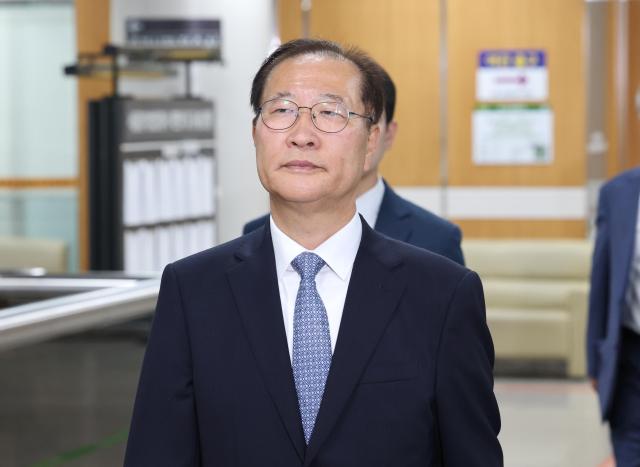
Park Seong-jae, the former Minister of Justice, was sentenced to 25 years in prison and taken into custody following a ruling by the Seoul Central District Court on charges of insurrection and abuse of power related to the December 3 martial law.
On June 22, the court's Criminal Division 33, led by Judge Lee Jin-kwan, found Park guilty of significant involvement in insurrection and abuse of authority. The special prosecutor's team had previously sought a 20-year sentence during the closing arguments in April.
The court recognized all charges against Park, including insurrection and abuse of power. It ruled that the declaration of martial law by former President Yoon Suk Yeol and subsequent actions to control the National Assembly and the National Election Commission clearly constituted acts of insurrection as defined under Article 87 of the Criminal Act.
The court stated, "This incident represents an insurrection led by Yoon, an elected official, and his followers, who disregarded the Constitution and laws, denying the fundamental order of democracy. Such forms of insurrection pose a significant threat to the public's belief in democracy and the rule of law."
It further admonished, "Given the democratic progress that South Korea has built over the past 50 years, we cannot lightly apply the standards of past insurrection cases that dealt with uprisings from below."
Although the martial law was lifted within 10 hours and there were no casualties, the court attributed this to the efforts of citizens who defended the National Assembly and the reluctance of some military and police officials to comply with unconstitutional orders.
The court also noted that the December 3 insurrection was not a spontaneous decision but rather a systematically prepared plan evident from notes and memos of those involved dating back to around 2023. It emphasized that Park's role was a critical condition for the success of the insurrection.
According to the ruling, Park directed officials within the Ministry of Justice to prepare for the enforcement of martial law, including establishing a team to monitor individuals violating the martial law decree, securing detention space in correctional facilities, and coordinating the dispatch of prosecutors to the joint investigation team of the martial law command.
During the trial, Park's defense claimed he had not issued such directives and had no intention of undermining the Constitution. However, the court rejected these claims, citing consistent and credible testimonies from relevant officials.
The court found the testimony of Bae Sang-uk, the former head of the Immigration and Foreign Policy Bureau, particularly credible. Bae initially hesitated to testify truthfully due to fears of retaliation after the change of government but later provided consistent accounts of receiving directives from Park, which were supported by evidence of staff being called in for duty outside their regular hours.
Additionally, the court determined that the report prepared by Shin Yong-hae, the former head of the Correctional Bureau, regarding the capacity of detention facilities in the metropolitan area was made possible by specific orders from Park to faithfully implement directives from the presidential office.
The court stated, "As the Minister of Justice, Park held the most significant duty to uphold the rule of law and human rights. However, he chose to participate in the insurrection, believing it might succeed, and his actions to suppress political opposition and obstruct the National Assembly's calls for lifting martial law are serious offenses."
Even after the insurrection failed, Park abused his authority by having officials draft documents justifying the legitimacy and necessity of the martial law, exacerbating national division. While the court acknowledged Park's 30 years of service as a public official and the absence of prior illegal acts, it did not consider these factors favorably in sentencing.
Conversely, the court dismissed the charges against Park related to violations of the Anti-Corruption Act.
Park was indicted by the special prosecutor for allegedly receiving a request from Kim Geon-hee to investigate the circumstances surrounding the formation of a dedicated prosecution team for a luxury handbag bribery case in May 2024.
However, the court ruled that the charges were too temporally distant from the December 3 insurrection, with a gap of about 10 months, and that their legal nature was entirely different, making it difficult to regard them as related under the special prosecutor's law. The court emphasized that expanding the scope of investigation based solely on evidence found on a phone seized by a warrant would violate constitutional principles of due process and criminal procedure.
After the sentencing, the court ordered Park to be taken into custody, citing concerns about potential evidence tampering. Park argued that he had never refused to attend court proceedings, but his claims were not accepted.
Meanwhile, the court dismissed perjury charges against Lee Wan-kyu, the former head of the Legislative Affairs Office, ruling that the special prosecutor lacked the authority to investigate or prosecute in this case.
Lee was accused of providing false testimony regarding the nature and attendees of a presidential residence gathering before the National Assembly's Legislative and Judiciary Committee. The special prosecutor had sought a three-year prison sentence for Lee during the closing arguments.
The court found insufficient evidence to classify the gathering as related to insurrection or foreign crimes under the special prosecutor's law, thus ruling that Lee's perjury could not be subject to investigation by the special prosecutor.
Additionally, Lee's request for a constitutional review was dismissed due to the lack of a basis for the trial following the dismissal of charges.
* This article has been translated by AI.
Copyright ⓒ Aju Press All rights reserved.