

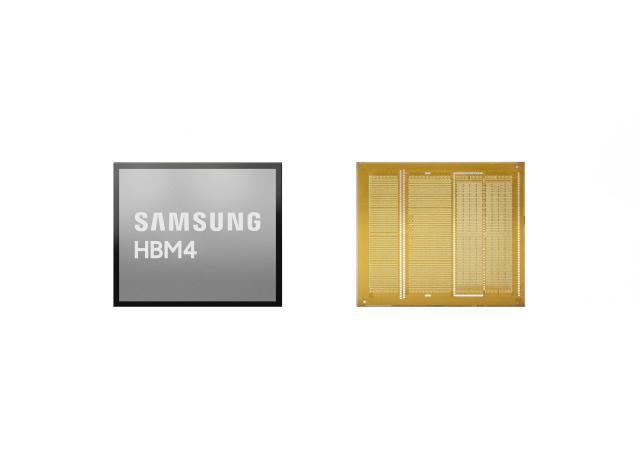
Samsung Electronics has surpassed $1 billion in sales of its sixth-generation high-bandwidth memory (HBM4) just four months after starting mass production. As the AI semiconductor market expands beyond graphics processing units (GPUs) to include application-specific integrated circuits (ASICs), demand for next-generation HBM is growing faster than expected.
According to industry sources on June 23, Samsung's cumulative sales of HBM4 recently exceeded $1 billion, equivalent to approximately 1.54 trillion won. This milestone was achieved about four months after the company began mass production on February 12, marking the world's first shipment of HBM4.
By the end of this month, cumulative sales are expected to surpass $1.2 billion. Given the pace of supply expansion, some industry analysts predict that HBM4 sales could reach $10 billion by the end of the year.
The surge in demand is attributed to investments in AI infrastructure. As the data processing requirements for large-scale AI models increase, HBM has become a critical component for AI accelerators. Notably, major global tech companies are accelerating their development of proprietary AI chips, leading to a rapid rise in HBM demand for ASICs.
Industry experts believe that the demand for HBM is not limited to the GPU market dominated by NVIDIA but is also spreading to proprietary AI chips from major tech firms such as Google, Amazon, Microsoft, and Meta. This diversification of clients could be a turning point for Samsung's market rebound.
Samsung is expanding its HBM supply partnerships not only with major GPU manufacturers but also with ASIC-based hyperscaler clients. With a broader customer base, Samsung's HBM sales are projected to more than triple compared to the previous year.
The company's technological competitiveness is also coming to the forefront. Samsung's HBM4 utilizes a 4-nanometer process on its base die, enhancing performance and production stability. The data processing speed is approximately 46% faster than the industry standard, reaching 11.7 Gbps, while data transfer capabilities have improved by about 2.7 times compared to the previous generation. Power efficiency has also seen a roughly 40% enhancement.
Samsung emphasizes its strengths as a comprehensive semiconductor company that integrates memory, foundry, logic, and packaging capabilities. As the advancement of HBM technology requires simultaneous optimization of memory design, foundry processes, and packaging, its one-stop supply capability is seen as a differentiating factor.
An industry insider stated, "As HBM4 supply increases rapidly, the potential for Samsung to expand its HBM market share is also growing. Samsung is expected to take the lead in establishing dominance in the next-generation AI memory market with HBM4 and HBM4E."
* This article has been translated by AI.
Copyright ⓒ Aju Press All rights reserved.