

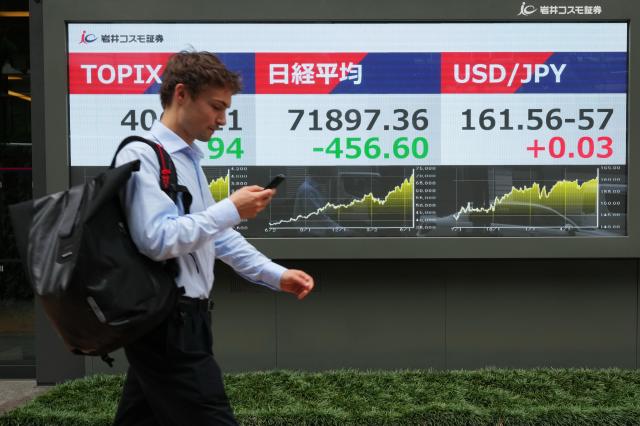
The value of the yen has fallen to nearly 162 yen per dollar, approaching its lowest level in 39 years. On June 22, the yen briefly rose to 161.93 per dollar in the New York foreign exchange market, nearing the peak of 161.96 yen from July 2024, when the Japanese government and the Bank of Japan intervened to buy yen. If the yen falls below this threshold, it would reach its lowest level since December 1986.
According to the Nihon Keizai Shimbun (Nikkei), on June 22, the yen traded between 161.55 and 161.65 per dollar, marking a rise of 0.25 yen from the closing price on June 18, before the Japanese financial market closed for three consecutive days. After reaching 161.93 yen, the yen's value dropped sharply to 161.06 yen following news of an online meeting between Japan's Finance Minister Shunichi Suzuki and U.S. Treasury Secretary Janet Yellen. Market speculation suggested that Japanese authorities may have conducted a small-scale yen-buying intervention or a preliminary 'rate check' to assess the exchange rate.
The 161.96 yen level serves as a de facto defense line for Japanese authorities. If this level is breached, there is no clear resistance level visible on the charts. The last time the yen remained around this level was in 1986, during a period of rapid appreciation following the Plaza Accord. As a result, market participants are particularly sensitive to the possibility of intervention from Japanese authorities near this threshold.
On the morning of June 23, Suzuki spoke with reporters at the Ministry of Finance, confirming that he discussed global financial markets and the situation in the Middle East with Yellen the previous night. When asked if they discussed currency intervention, he stated, "Japan and the U.S. have agreed to take decisive action whenever necessary, and there is no wavering on that point." This statement marked a shift from his previous comments, where he refrained from making specific remarks, indicating a heightened alert regarding potential intervention.
Despite Suzuki raising the alert level for intervention, the yen's rebound has been limited. On June 23, the yen fluctuated in the mid-161 range against the dollar in the Tokyo foreign exchange market. While there were yen-buying and dollar-selling actions in response to potential intervention, there were also yen-selling and dollar-buying actions based on expectations that the interest rate differential between the U.S. and Japan would not narrow, according to Nikkei. The yen's depreciation is largely driven by factors from the U.S. rather than domestic issues in Japan.
The U.S. dollar index (DXY), which measures the dollar's value against major currencies, surpassed 101 on June 22, reaching its highest level in over a year since May 2025. Nikkei attributed this to a shift from 'emergency dollar buying' due to instability in the Middle East to a broader 'normal dollar buying' driven by optimism about the U.S. economy and expectations of interest rate hikes.
The strong dollar is supported by expectations of U.S. interest rate hikes. The Federal Reserve indicated the possibility of raising rates later this year in its recent policy outlook. As of the evening of June 22, the probability of the Fed raising rates at least once this year approached 90%, a significant increase from less than 60% a week earlier. On the same day, U.S. long-term interest rates rose, leading to expectations of a widening interest rate differential between the U.S. and Japan, which contributed to yen selling and dollar buying.
Market attention is now focused on the U.S. personal consumption expenditures (PCE) price index for May, set to be released on June 25. If the core index, excluding energy and food, exceeds expectations, it could heighten the outlook for interest rate hikes, further strengthening the dollar and increasing pressure on the yen. Sean Osborne, chief foreign exchange strategist at Scotia Capital, stated, "The core index is expected to rise moderately, supporting the strength of the dollar."
In contrast, interest rates in Japan are moving slowly. The Bank of Japan raised its policy interest rate to 1% during its monetary policy meeting on June 16. Deputy Governor Shinichi Uchida expressed that interest rate hikes would continue, but the market anticipates that any additional hikes will occur at a gradual pace of about once every six months. With the likelihood of further rate hikes increasing in the U.S., expectations of a widening interest rate differential are fueling further yen weakness.
Japanese authorities have previously engaged in large-scale interventions. From April 28 to May 27, they conducted yen-buying interventions totaling over 11 trillion yen, yet the current exchange rate remains lower than it was just before the intervention on April 30. While Suzuki has reiterated the need for 'decisive action,' Nikkei noted that the fundamental cause of the yen's depreciation lies in expectations of U.S. interest rate hikes and a strong dollar, placing Japan in a challenging position against the tide of 'normal dollar strength.' Masashi Hashimoto, a senior researcher at the International Monetary Institute, also observed that Japan is not in an economic crisis due to yen depreciation, making coordinated intervention with the U.S. more difficult.
* This article has been translated by AI.
Copyright ⓒ Aju Press All rights reserved.