

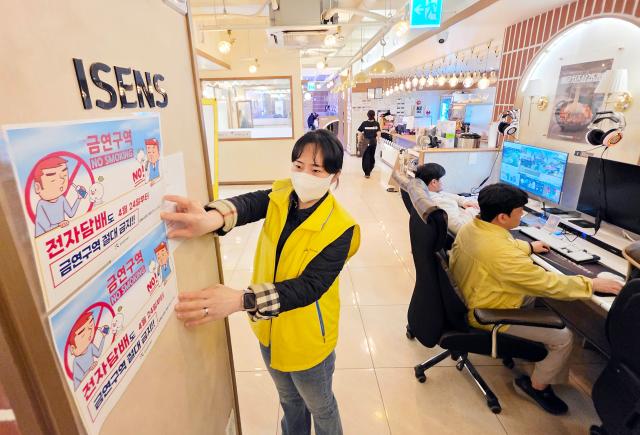
The use of flavored e-cigarettes, once prevalent in public spaces, will face strict enforcement under new regulations. Starting June 24, synthetic nicotine e-cigarettes will be treated the same as traditional cigarettes, meaning users caught smoking them will incur fines under a zero-tolerance policy.
The Ministry of Health and Welfare announced on June 23 that, in accordance with the revised Tobacco Business Act enacted in April, it will conduct focused inspections in collaboration with local health offices nationwide from June 24 to July 15 to ensure compliance with the new regulations.
This initiative is a response to shifting smoking trends in South Korea. According to the 2025 Community Health Survey, the smoking rate for traditional cigarettes dropped to 17.9%, while the use of heated tobacco products (6.3%) and e-cigarettes (4.5%) increased. Notably, the usage rate of e-cigarettes surged by 73.1% over the past seven years, rapidly attracting new smokers.
In response, the government has significantly broadened the definition of "tobacco" under the Tobacco Business Act. Previously, only products made from tobacco leaves were classified as tobacco; the revised law now includes all inhalable products containing natural or synthetic nicotine.
As a result, synthetic nicotine e-cigarettes will now fall under the strict regulations of the National Health Promotion Act, which prohibits their use in non-smoking areas, restricts tobacco advertising, mandates warning labels, and limits vending machine placements. The Ministry will end the two-month grace period that began on April 24 and start imposing penalties on June 24.
The key aspect of this enforcement is the "zero-tolerance policy." The fundamental purpose of designating non-smoking areas is to protect non-smokers from harmful exposure to smoke. The Ministry warned, "It is impossible for inspectors to immediately identify the ingredients of e-liquids, so any form of smoking device used in non-smoking areas will initiate a violation process."
Violators will face fines of up to 100,000 won. However, fines may be waived if the user can prove that the inhalation product contains no tobacco or nicotine or if it was stockpiled before the law took effect on April 24.
Regulations on tobacco vending machines will also be significantly tightened to prevent access by minors. E-cigarette vending machines can only be installed in very limited locations, such as areas restricted to those 19 and older, and must be equipped with age verification devices. Violating these rules will result in heavy fines of up to 5 million won for improper placement and up to 3 million won for failing to install age verification devices.
Kim Han-sook, Director of the Health Policy Bureau at the Ministry of Health and Welfare, stated, "Defining synthetic nicotine products as tobacco is a significant change aimed at protecting public health and aligning domestic regulations with international standards. We urge everyone to familiarize themselves with and comply with the new obligations to ensure swift implementation of these regulations."
The Ministry of Health and Welfare announced on June 23 that, in accordance with the revised Tobacco Business Act enacted in April, it will conduct focused inspections in collaboration with local health offices nationwide from June 24 to July 15 to ensure compliance with the new regulations.
This initiative is a response to shifting smoking trends in South Korea. According to the 2025 Community Health Survey, the smoking rate for traditional cigarettes dropped to 17.9%, while the use of heated tobacco products (6.3%) and e-cigarettes (4.5%) increased. Notably, the usage rate of e-cigarettes surged by 73.1% over the past seven years, rapidly attracting new smokers.
In response, the government has significantly broadened the definition of "tobacco" under the Tobacco Business Act. Previously, only products made from tobacco leaves were classified as tobacco; the revised law now includes all inhalable products containing natural or synthetic nicotine.
As a result, synthetic nicotine e-cigarettes will now fall under the strict regulations of the National Health Promotion Act, which prohibits their use in non-smoking areas, restricts tobacco advertising, mandates warning labels, and limits vending machine placements. The Ministry will end the two-month grace period that began on April 24 and start imposing penalties on June 24.
The key aspect of this enforcement is the "zero-tolerance policy." The fundamental purpose of designating non-smoking areas is to protect non-smokers from harmful exposure to smoke. The Ministry warned, "It is impossible for inspectors to immediately identify the ingredients of e-liquids, so any form of smoking device used in non-smoking areas will initiate a violation process."
Violators will face fines of up to 100,000 won. However, fines may be waived if the user can prove that the inhalation product contains no tobacco or nicotine or if it was stockpiled before the law took effect on April 24.
Regulations on tobacco vending machines will also be significantly tightened to prevent access by minors. E-cigarette vending machines can only be installed in very limited locations, such as areas restricted to those 19 and older, and must be equipped with age verification devices. Violating these rules will result in heavy fines of up to 5 million won for improper placement and up to 3 million won for failing to install age verification devices.
Kim Han-sook, Director of the Health Policy Bureau at the Ministry of Health and Welfare, stated, "Defining synthetic nicotine products as tobacco is a significant change aimed at protecting public health and aligning domestic regulations with international standards. We urge everyone to familiarize themselves with and comply with the new obligations to ensure swift implementation of these regulations."
* This article has been translated by AI.
Copyright ⓒ Aju Press All rights reserved.