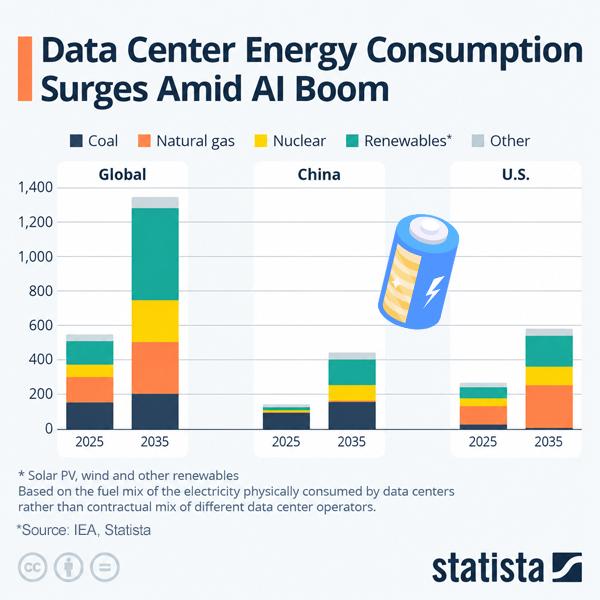
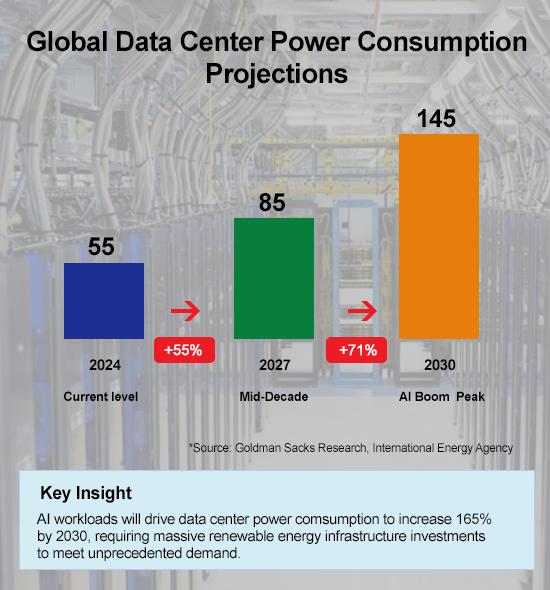
Global electricity demand from data centers is set to roughly double to about 945 terawatt-hours by 2030 and reach around 1,200 TWh by 2035, the International Energy Agency said in its Energy and AI report. Half of that growth is expected to come from renewables.
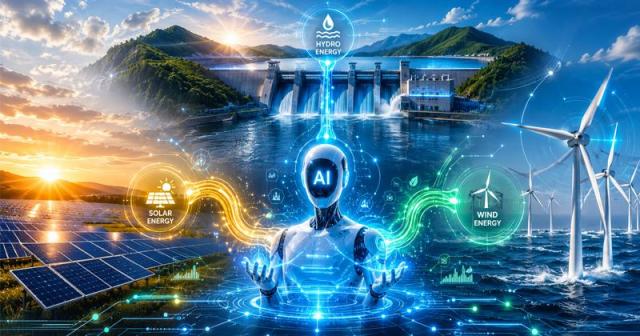
The appeal of solar and wind is easy to prove through numbers. Onshore wind and solar are now the cheapest sources of new electricity on the planet, costing about $34 and $43 per megawatt-hour, respectively, compared with more than $100 for new gas generation. A solar farm can be switched on within months, while a nuclear reactor can take a decade to build.
But the traits that make renewables fast also make them fickle. Solar output vanishes at night, wind dies when the air goes still, and for a data center that must run flat out around the clock, that intermittency is a structural mismatch.
And it is beginning to bite.
Nowhere is the strain clearer than in China.
Power demand from Chinese data centers is projected to surge by 300 billion to 500 billion kilowatt-hours between 2026 and 2030, accounting for about 18 percent of the country's total electricity demand growth, according to Pei Shanpeng, a director at State Power Investment.
"From what we understand, they cannot really adjust power consumption load much. GPUs are very expensive, so once they are purchased, operators want to use them as quickly and as intensively as possible," Pei said at an industry conference in Beijing, according to Reuters.
The United States, by contrast, is reaching for firmer power, leaning on nuclear energy to backstop the surge. On Wednesday, the Energy Department unveiled $17.5 billion in loans to bulk-buy long-lead reactor components and shave up to three years off construction timelines.
Elsewhere in Asia, the strain is landing hardest where demand is rising fastest.
In Japan, data centers are expected to account for more than half of all electricity demand growth through 2030, and with renewables projected to supply only about 17 percent of power, Tokyo is accelerating the restart of idled nuclear reactors.
Singapore and Malaysia's Johor have lured hyperscalers with cheap land and electricity, but the tropics exact a penalty: cooling alone can consume up to a third of a facility's energy use, while coal still underpins much of the power supply. India faces a similar dilemma.
South Korea sits in the same bind, but from the opposite direction.
Here, the renewables exist; the market does not let them flow.
On Tuesday, four solar and wind industry groups rallied outside the Korea Power Exchange in Naju to demand a sweeping overhaul of market rules they say continue to favor coal and gas.
In the renewables-rich southwestern Jeolla and Jeju regions, the grid is so frequently oversupplied on sunny afternoons that the exchange orders generators to shut down, leaving operators with electricity they cannot sell.
Under its 11th Basic Plan, Seoul aims to quadruple renewable capacity to about 122 gigawatts by 2038 from 30 GW in 2023. Yet the market rules meant to carry that power have not kept pace.
That is the paradox of the AI energy boom.
The world is no longer constrained by how quickly it can build renewable power. It is constrained by how slowly it can move it.
The cheapest and fastest electricity on Earth is arriving faster than grids can absorb it. Unless transmission networks, storage systems and market rules are rebuilt alongside AI infrastructure, a growing share of clean energy will continue to be generated only to be switched off.
The race, in other words, is no longer about adding more solar panels or wind turbines. It is about building grids smart enough to carry them.
In the AI era, electricity is becoming digital infrastructure — and the bottleneck is no longer generation, but the wire itself.

Copyright ⓒ Aju Press All rights reserved.