

[Editor’s Note] The heated first half of 2026 is coming to a close. The stock market has surged, and the market has cheered. However, the outcomes are divided. Behind the smiles of those benefiting from massive investment gains are those shedding tears over misguided bets. The same goes for listed companies. Stock prices reflect the image of companies in the market. Even within the same industry, fortunes fluctuate. Who are the winners and losers? We evaluate the performance of various sectors in the first half of the year based on stock market metrics.
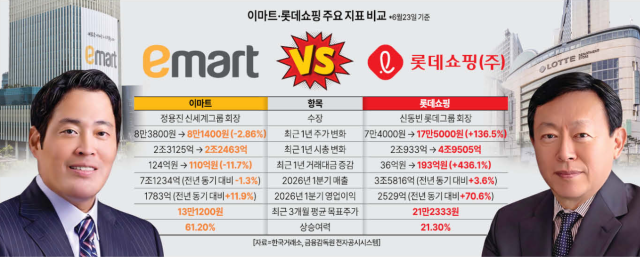
Shinsegae Group and Lotte Group are rivals in South Korea's retail industry, competing fiercely in key sectors such as discount stores and department stores. E-Mart and Lotte Mart dominate the domestic discount market, while Lotte Department Store and Shinsegae Department Store vie for the top two positions in the industry. As the leaders of these two retail giants, Shinsegae Chairman Chung Yong-jin and Lotte Chairman Shin Dong-bin, who emerged victorious in the first half of this year?
We compared the stock prices of E-Mart and Lotte Shopping, both of which are listed on the KOSPI. Until last year, E-Mart led in market capitalization and stock price, but the situation has completely reversed in just one year. Lotte Shopping's stock price has more than doubled, making it the leading retailer in the market.
Retail Leader Reversed in One Year
According to the Korea Exchange on June 24, E-Mart's stock price fell from 83,800 won on June 23, 2025, to 81,400 won on June 23, 2026, a decrease of 2.86%. In contrast, Lotte Shopping's stock price rose from 74,000 won to 175,000 won during the same period, marking a 136.5% increase. This trend is reflected in the changes in market capitalization. As of June 23 last year, E-Mart's market capitalization was 2.3125 trillion won, surpassing Lotte Shopping's 2.093 trillion won.
However, as of June 23 this year, Lotte Shopping's market capitalization increased to 4.9505 trillion won, while E-Mart remained at 2.2463 trillion won. Consequently, the market capitalization gap between the two companies widened to over 2.7 trillion won, reversing their corporate values that were similar just a year ago.
“The Pace of Performance Recovery Was Different”
Analysts attribute the divergent stock price trends to differences in the pace of performance recovery. In the first quarter of this year, E-Mart's revenue was 7.1234 trillion won, a 1.3% decrease compared to the same period last year, while its operating profit rose by 11.9% to 178.3 billion won. In contrast, Lotte Shopping reported a revenue increase of 3.6% to 3.5816 trillion won, with operating profit soaring by 70.6% to 252.9 billion won.
Notably, Lotte Shopping's operating profit growth rate was six times that of E-Mart. Strengthening competitiveness in the department store sector, cost efficiency, and expectations for asset value reassessment have been cited as factors driving Lotte Shopping's performance improvement and stock price increase.
Investor Interest Shifts to Lotte Shopping
Investor interest has also shifted toward Lotte Shopping. E-Mart's daily trading volume decreased from 12.4 billion won last year to 11 billion won this year, a drop of 11.7%. In contrast, Lotte Shopping's trading volume surged from 3.6 billion won to 19.3 billion won, an increase of 436.1%. There were also differences in supply and demand. While foreign investors were net buyers of E-Mart last year, they have shifted to net selling this year. Institutional investors have reversed from net selling to net buying, but this has not led to a rebound in stock prices.
Conversely, individual investors have significantly increased their buying of Lotte Shopping, with net purchases rising from 1.2 billion won last year to 5.3 billion won this year, more than quadrupling. Expectations for asset value reassessment and shareholder return policies have stimulated investor sentiment.
E-Mart Has Higher Target Stock Price
However, future stock price outlooks differ. Analysts believe that E-Mart has greater potential for stock price increases. Over the past three months, the average target stock prices set by securities firms are 131,200 won for E-Mart and 212,333 won for Lotte Shopping. The potential for stock price increases compared to current prices is 61.2% for E-Mart and 21.3% for Lotte Shopping. This is because E-Mart's stock price has fallen more significantly compared to its target price.
A securities industry official stated, “While Lotte Shopping's stock price has steadily risen due to ongoing performance improvements centered around department stores, E-Mart has faced a downturn due to poor discount store conditions and overall performance decline, compounded by various recent issues. Despite lowering target prices, the actual decline in stock price has been greater, leading to an expanded gap.”
He added, “E-Mart's target price may be further adjusted based on future performance trends, while Lotte Shopping is expected to maintain a relatively favorable trajectory due to ongoing performance improvements in its department store sector.”
* This article has been translated by AI.
Copyright ⓒ Aju Press All rights reserved.