

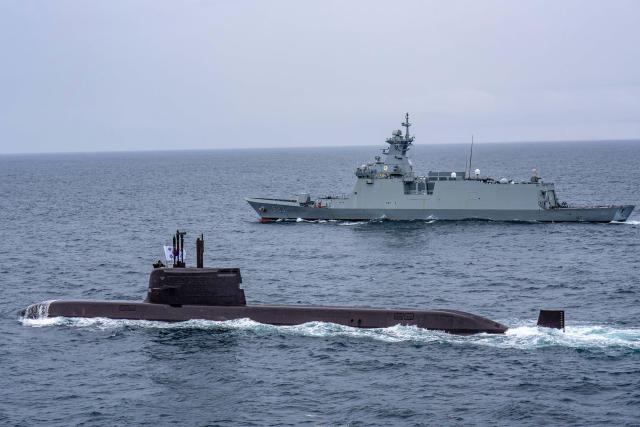
The emerging labor crunch is raising questions over how Ottawa will staff two specialized submarine maintenance hubs planned for the Atlantic and Pacific coasts, just as it prepares to choose between South Korea's Hanwha Ocean and Germany's ThyssenKrupp Marine Systems, or TKMS, for one of its largest-ever defense contracts.
Training institutions are currently supplying less than half of the workers needed to meet future demand, according to the Canada-based Conference of Defence Associations Institute.
The challenge underscores that selecting a submarine builder may be the easiest part of the project.
Each coastal maintenance facility is expected to require between 450 and 650 permanent workers to support six submarines, excluding additional government employees and contractors. The facilities will depend heavily on marine pipefitters, hull fabricators and engineers capable of maintaining sophisticated combat and electronic systems.
Such expertise cannot be developed quickly, raising the risk that the submarine program will compete directly with existing naval shipbuilding projects for talent.
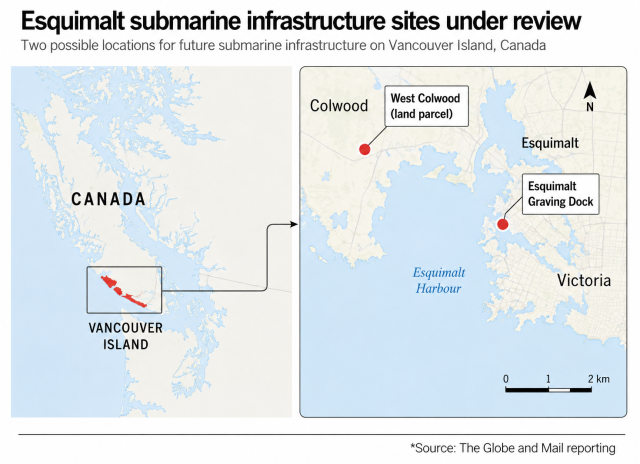
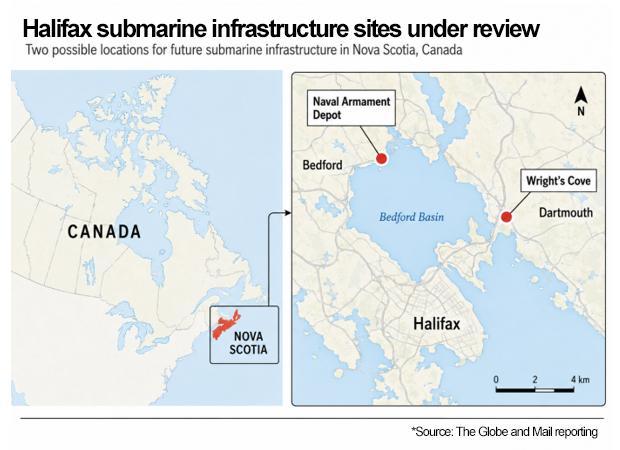
On the East Coast, officials are reviewing Wright's Cove in Dartmouth and the Naval Armament Depot in Bedford, a military facility that has supported the Royal Canadian Navy since World War II.
The submarines themselves are expected to cost between 60 billion and 80 billion Canadian dollars ($42 billion to $56 billion). Once maintenance infrastructure and decades of operations are included, total lifecycle costs could exceed 100 billion Canadian dollars, according to the CDA Institute.
British Columbia Premier David Eby has already warned that the province's limited pool of skilled tradespeople poses a "severe constraint" for upcoming maritime projects.
The labor issue is particularly sensitive around Halifax, where Irving Shipbuilding is building 15 River-class destroyers for the Royal Canadian Navy.
Irving has cautioned that a submarine maintenance facility could siphon workers from the destroyer program, with both projects drawing from the same limited pool of specialized tradespeople.
Ottawa said workforce development efforts under its National Shipbuilding Strategy have expanded to help meet future demand.
But time is tight.
Canada plans to retire its four Victoria-class submarines beginning in 2036, leaving less than a decade to build support infrastructure, establish supply chains and train the workforce needed to sustain a new fleet.
Jeffrey Collins, director of the Palmer Canadian Leadership Institute and a former Canadian Defense Department policy analyst, likened the technical complexity of submarine support to sustaining crewed spacecraft.
Regardless of whether Ottawa adopts a government-owned, contractor-operated model or relies more heavily on private operators, he said, staffing pressures will remain unavoidable.
"Canada's acquiring a dozen submarines and they're going to need a lot of people to sustain them," Collins said to the Canadian media outlet. "Whether it's a government-owned, contractor-operated model or a complete private sector equivalent, that's going to be a pressure already."
Canada's submarine race is evolving beyond a contest between South Korean and German technology into a test of whether the country can build and sustain a 12-vessel industrial ecosystem.

Copyright ⓒ Aju Press All rights reserved.
