
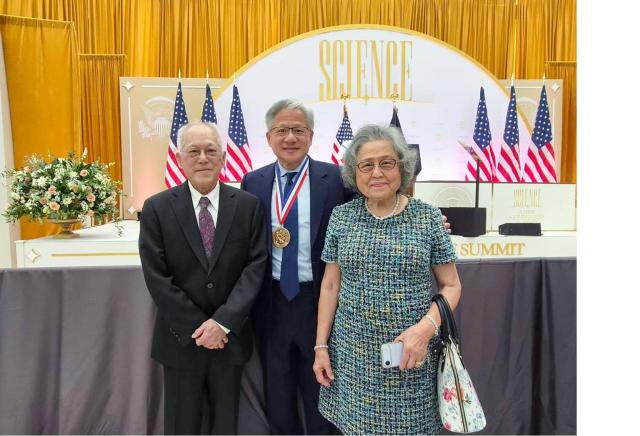
President Donald Trump presented the medal at the “Science: A New Golden Age” summit in Washington.
The White House honored Huang "for advancing the graphics processing unit into a general-purpose computing architecture," citing his chip and software designs.
"Our next recipient is a man whose determination laid the foundations for the explosion of superintelligence and put America at the front of the race," Trump said, adding that "the entire world is now running on Nvidia."
GPUs were designed to render video game graphics, but their knack for running many calculations at once proved ideal for scientific computing and AI.
Nvidia’s CUDA platform, launched in 2006, let researchers harness that power for work from drug discovery to deep learning.
Huang, who was born in Taiwan and co-founded Nvidia in 1993, was honored alongside Elon Musk, Google co-founder Sergey Brin and AMD CEO Lisa Su.
Michael Dell and Microsoft CEO Satya Nadella received the National Medal of Technology and Innovation.
Nvidia, an industry partner in the Energy Department-led Genesis Mission, also announced commitments valued at $1 billion over five years for AI and quantum computing research in the United States.
"President Trump's Genesis Mission is launching a new golden age of American discovery," Huang said in a statement.
AJP Takeaways
- Nvidia CEO Jensen Huang received the U.S. National Medal of Science from President Donald Trump on Oct. 8, 2026, at the “Science: A New Golden Age” summit in Washington.
- The White House cited Huang for turning the graphics processing unit into a general-purpose computing architecture, the basis of today’s AI and scientific computing.
- Nvidia pledged about $1 billion over five years to the Genesis Mission on the same day. The company had agreed in October 2025 to supply more than 260,000 AI chips to South Korea.
Kim Dong-young
Kim Dong-young is a bilingual journalist at AJU Press (AJP), covering Korean tech, energy, and bio/pharma.
He reports from the field at events like CES and APEC, runs AJP's YouTube channels,
and is pursuing a master's at Sogang's MOT program.
Copyright ⓒ Aju Press All rights reserved.
Related News
-
 Lisa Su gets a head start on Nvidia as AMD brings AI rivalry to Seoul
Lisa Su and Jack Huynh speak at AMD Gamer Day in Seoul/ AJP Candice Kim SEOUL, October 07 (AJP) - AMD Chair and CEO Lisa Su had her own Jensen Huang moment in Korea on Wednesday, hosting a day for gamers and rubbing shoulders with the country’s science minister and business tycoons. Su appeared alongside Jack Huynh, AMD’s senior vice president and general manager of its Computing and Graphics Group, at AMD Gamer Day in Seoul’s Yongsan district, meeting Korean gamers and outlining the company’s vision for gaming and artificial intelligence. Her second visit this year, following a March trip, came a month before Nvidia brings AI Day Seoul 2026 to COEX in southern Seoul on Nov. 9 and 10 — putting the two U.S. chip giants’ rivalry on Korean soil. Nvidia’s two-day event is expected to draw around 2,000 developers, startup representatives, researchers and industry officials, with Samsung Electronics and SK hynix among the participating partners. Nvidia CEO Jensen Huang, however, is not expected to attend, according to an industry official familiar with the matter. The back-to-back events underscore South Korea’s growing importance to a contest that extends beyond AI accelerators to the memory chips, supply chains and technology partnerships needed to support them. Asked by AJP whether competition between AMD and Nvidia was increasingly becoming a race to secure high-bandwidth memory, or HBM, from South Korean suppliers, Su pointed to surging AI demand across the industry. “The main thing that we see in the market today is that the demand for AI compute continues to go up,” Su said. “When I speak to all of our partners across the supply chain and across the industry, everyone is racing to satisfy that demand.” “As the demand continues to increase, we’re continuing to work all kinds of avenues to increase our overall supply,” she added. South Korea sits at the center of that race as home to Samsung Electronics and SK hynix, two of the world’s dominant suppliers of HBM, the advanced memory used in AI accelerators. Su repeatedly emphasized the importance of both chipmakers during Wednesday’s media session. “We very much rely on the Korean supply chain,” she said. “Samsung, SK hynix are great partners of ours and very key for us to accomplish our broad ambition in data center.” She also described Samsung as one of AMD’s “most strategic partners” across memory technologies, including DDR4, DDR5 and HBM. Close coordination with suppliers has become increasingly important as demand rises across AI, gaming and consumer computing, she said. AMD is seeking to expand its AI accelerator business and challenge Nvidia’s market dominance, making access to HBM increasingly important. Su described a “very tight supply environment” and said AMD was encouraging its memory partners to expand capacity “as fast as possible.” AMD is already ramping up systems based on its next-generation MI455 accelerator and HBM4, she said. “We have gotten great support from both Samsung and SK hynix, and we view the partnerships on HBM not just one generation but really multiple generations,” Su said. AMD CEO Lisa Su talks to reporter at a press event/ AJP Candice Kim “We’re very happy with HBM4. I think HBM4 is doing extremely well, and we’re ramping it up right now.” The Korean contest extends beyond memory. Su said she met Korean AI startups earlier Wednesday and reaffirmed AMD’s plan to establish an AI “center of excellence” in the country while expanding ties with startups and universities. She named Upstage, MangoBoost and Moreh among Korean companies already working closely with AMD and said she had met additional startups interested in joining its open AI ecosystem. “We are very much committed to expanding our startup engagements and expanding our university engagements because we think that Korea is really an excellent place for AI development,” Su said. Asked why she had returned to South Korea after just seven months, Su said the country’s importance to AMD went beyond securing near-term chip supplies. “The Korean ecosystem is extremely important for both from a supply standpoint as well as from a partnership standpoint,” she said, adding that AMD was planning with partners over the next three to five years. Su also confirmed that she had met SK hynix during the trip and planned to meet Samsung, saying close communication had become essential as the AI industry moved at an unprecedented pace. “Semiconductors is a team sport,” she said. “The more we communicate with our partners, the better we are going to be to service the overall market.” For AMD and Nvidia, that team increasingly includes the same Korean players. Su has put AMD’s gaming ambitions, AI plans and chip partnerships on display in Seoul this week. Next month, Nvidia gets its turn — with Korea’s technology companies courted by both sides.
-
 South Korea Aims to Become a Global AI Powerhouse
South Korea is racing toward becoming one of the world’s top three AI powers. The government has prioritized AI data centers, proprietary AI models, and physical AI as national projects, accelerating efforts to secure GPUs, build data centers, and integrate AI into manufacturing. The budget proposal for the Ministry of Science and ICT for 2027 allocates 9.4 trillion won for AI, while the Ministry of Trade, Industry and Energy has outlined plans for significant financial investments in manufacturing AI transformation, semiconductors, and industrial automation.Investment is flowing, and companies are mobilizing. However, simply having large investment amounts does not guarantee success in the AI sector.Jeon Byeong-seo, head of the China Economic and Financial Research Institute, recently pointed out in an article titled "The Dream of Becoming an AI Powerhouse Worth 1,500 Trillion Won: The Model is Third, but Electricity, Talent, and Money are at the Bottom" that South Korea's AI strategy is hindered by a lack of sustainable national strategy beyond electricity, talent, money, and market. While enhancing the performance of a single AI model is important, it is crucial that the power supply, computing infrastructure, industrial sites, and talent work in unison; otherwise, the notion of becoming an AI powerhouse could crumble like a sandcastle.I resonate with this perspective and wish to take it a step further.If South Korea truly aspires to be among the top three AI powers, the question must shift from "How much will we invest?" to "Where will we consolidate all of this into a single industry?" Looking at a map of South Korea, the vast area of Saemangeum, adjacent to the Yellow Sea, stands out.Understanding the structure of the AI industry is rarely as straightforward as Jensen Huang of NVIDIA's description of the "AI five-layer cake." At the bottom is energy, followed by semiconductors and computing infrastructure, then cloud and data centers, with AI models operating above, and finally applications used by humans and businesses at the top. No single layer can be strong enough to make a country an AI powerhouse; if the lower layers collapse, all upper layers will be affected.I would like to add one more strength of South Korea at the top of these five layers. The moment these layers connect in the real world to power cars, enable robots to walk, and operate factories, ships, and agricultural machinery is precisely what physical AI represents. Rather than viewing physical AI as an additional layer on the five-layer cake, it is more accurate to see it as a complete AI where all layers—from energy to semiconductors, data centers, models, and applications—embody themselves in the real world.So, what lies at the very bottom layer?Electricity.When discussing AI, we often think of NVIDIA's GPUs, SK Hynix's HBM, and Samsung's semiconductors, but first, we need power plants, transmission networks, substations, and cooling systems. AI data centers are the new factories that consume electricity and produce intelligence, and as the number of GPUs increases, so does the demand for power. No matter how advanced the AI models and GPUs are, without a stable power supply 24/7, data centers cannot operate.The heart of AI is semiconductors, but the blood that keeps it pumping is electricity.This is where we need to reconsider Saemangeum. Saemangeum has a vast industrial site, potential for renewable energy and hydrogen industries, and industrial infrastructure such as ports, roads, and railways being gradually established. However, having solar and wind facilities does not immediately resolve the power issues for AI data centers. Renewable energy is variable, so energy storage systems, stable backup power sources, transmission networks, and cooling systems must be designed together. Therefore, the first national project for the Saemangeum physical AI initiative should not be about constructing flashy AI buildings but rather about designing a power grid that will support the AI industry for decades.Above electricity are HBM and GPUs. South Korea holds significant competitive advantages in high-bandwidth memory, a critical bottleneck in the global AI industry, and must evolve from being a semiconductor-exporting nation to one that produces "intelligence" domestically by utilizing those semiconductors in cars, robots, shipbuilding, and precision manufacturing to re-enter the global market.This experiment is already underway in Saemangeum.The Hyundai Motor Group has announced plans to invest approximately 9 trillion won in stages to establish a hub for AI, robotics, and hydrogen energy on a 1.124 million square meter site in Saemangeum. The plan includes 5.8 trillion won for an AI data center, 400 billion won for a robotics manufacturing and parts cluster, 1 trillion won for a 200 MW electrolysis plant, 1.3 trillion won for GW-scale solar power, and 400 billion won for an AI hydrogen city. The AI data center is expected to be equipped with computational power equivalent to 50,000 GPUs, while the robotics manufacturing facility aims for an annual production capacity of 30,000 units.These figures should not be taken lightly.This is not just a single data center project. It involves a massive brain for training AI, a robotics factory that gives AI a body, and the energy and hydrogen industry to power it all, all within one space. If the intelligence created in the data center transfers to robots, and the data generated by robots working in factories returns to the data center to train AI, a physical AI industrial ecosystem unlike anything seen in South Korea could emerge.The reason Hyundai Motor Group has acquired Boston Dynamics should also be viewed in this context. At CES 2026, Hyundai presented its AI robotics strategy, gradually introducing the humanoid robot "Atlas" into manufacturing sites, with plans to deploy Atlas at the Georgia Meta Plant in the U.S. starting in 2028 and to expand its use in more complex assembly processes by 2030.Hyundai is no longer just a car manufacturer. It is transitioning into a massive mobility and physical AI company that connects cars, robots, autonomous driving, AI, logistics, and smart factories. If the manufacturing sites of Hyundai and Kia, the parts technology of Hyundai Mobis, the logistics of Hyundai Glovis, and the robotics technology of Boston Dynamics are all integrated with AI, a unique manufacturing data ecosystem could be created.Factories will become schools for AI.Robots will be the students of these schools, picking up countless objects, failing, trying again, and accumulating real-world data. This data will feed back into AI models, and the smarter models will return to the robots. This is the so-called data flywheel. The competitiveness of physical AI will likely be determined more by how quickly and extensively this cycle can be turned rather than by the flashy movements of a single robot.At this point, it is essential to consider China.Ignoring China's movements while discussing physical AI in South Korea is akin to overlooking the world's largest manufacturing experiment. According to the International Federation of Robotics, China is expected to install approximately 354,000 industrial robots by 2025, accounting for 59% of the global new installations, with around 2 million industrial robots currently operating in Chinese manufacturing sites.However, the more significant change lies beyond industrial robots.China is now pushing humanoids and what is termed "embodied intelligence" as the next-generation industry. The Ministry of Industry and Information Technology and the State-owned Assets Supervision and Administration Commission of China have outlined plans to deploy humanoids and embodied intelligence in factories, services, and specialized work sites for training, creating over 100 high-value application scenarios and developing capabilities for field applications of over 10,000 units.In Shanghai, humanoids from Chinese robotics companies like AgiBot are performing actual manufacturing tasks such as inspection and material handling on electronics production lines, turning automotive and electronics industries into vast learning grounds for robots. According to statistics from Chinese authorities for the first half of 2026, the number of completed humanoid products developed in China has exceeded 400.China's strength lies not merely in the number of robotics companies but in its vast manufacturing base, supply chain, numerous factories, and countless operational scenarios. If a humanoid fails while moving parts in an automotive factory, data is generated; if it makes an error while inspecting in an electronics factory, data is also generated. When thousands or tens of thousands of robots begin to operate in the real world, that experience becomes a massive data asset for training AI.In physical AI, the size of the factory can equate to the size of the data.This is why China is formidable.However, we should not view China solely as a source of fear. We must compete where necessary, learn where we can, and collaborate where it makes sense. If the U.S. excels in AI models, GPUs, and software platforms, and China moves rapidly in manufacturing scale and supply chains, South Korea must find its own path by integrating semiconductors, automobiles, batteries, shipbuilding, and precision manufacturing with AI.This is where the geopolitical significance of Saemangeum comes into play.In front of Saemangeum lies the Yellow Sea. Across the Yellow Sea is China's vast manufacturing belt, while to the east and south are South Korea's semiconductor, automotive, shipbuilding, and machinery industries. If we consider Saemangeum the western edge of South Korea, it may seem remote, but when we spread out the map of Northeast Asia, it can be read as a strategic junction of the Yellow Sea economic zone.The sea is both a barrier and a network.South Korea must connect its AI and GPU ecosystem with its HBM, automotive, shipbuilding, and battery industries while competing with China's massive physical AI industry and collaborating where necessary. Saemangeum is positioned to look out over that Yellow Sea.This is why Saemangeum should not be viewed merely as a regional development project.From 2026 to 2030, a physical AI research and development project worth 1.4131 trillion won is also being pursued in North and South Jeolla provinces. In North Jeolla, technologies for autonomously connecting entire factories and developing manufacturing site technologies using digital twins and AI are being advanced. The key is to view Hyundai's 9 trillion won investment, the government's physical AI research and development, and Saemangeum's energy, universities, research institutes, and transportation infrastructure as interconnected rather than separate projects.The 2027 government budget proposal is therefore crucial. The AI budget proposal from the Ministry of Science and ICT is 9.4 trillion won, while the Saemangeum Development Agency's budget proposal is 222.2 billion won. The national budget proposal related to North Jeolla has exceeded 10 trillion won for the first time, totaling 10.2349 trillion won. The government proposal includes 17.5 billion won for long-term lease land development in the Saemangeum industrial complex, 8 billion won for the production and demonstration of AI-based special-purpose robot platforms, 500 million won for a joint logistics center for the robotics parts cluster, 5 billion won for a 5G specialized network-based M.AX demonstration platform at the Gunsan shipyard, and 3 billion won for standardization of agricultural AI robots and on-demand autonomous manufacturing platforms.However, this budget has not yet been finalized by the National Assembly.This is precisely why it is important.We must protect the seed budget included in the government proposal during the National Assembly review process and reinforce any missing links, such as power grids, data centers, robot demonstrations, and talent development. This should not be approached from the perspective of how much more can be given to one region in North Jeolla. It should be viewed from the national strategy perspective of how South Korea will create a new industry of physical AI between the U.S. and China.Here, I recall Ulsan from over 60 years ago.Today, when we look at Ulsan's automotive factories, shipyards, and petrochemical complexes, it feels as if a world-class industrial city has always existed there, but that was not the case at the beginning. The government set the direction, built ports and roads, and companies established factories, attracting technicians and workers. One factory called for another, parts suppliers gathered, and universities and research institutes followed. Over decades, this accumulation created the industrial ecosystem known as Ulsan.The miracle of Ulsan was not the success of a single factory.It was the success of an ecosystem.Saemangeum is no different. Hyundai's 9 trillion won investment should not be viewed merely as a single corporate investment. If an AI data center with the capacity of 50,000 GPUs and a robotics manufacturing system producing 30,000 units annually are actually established, it is essential to ensure that robotics parts companies, sensor firms, battery manufacturers, AI startups, research institutes, and universities follow suit. Saemangeum must be opened up as a massive testbed for real-world trials of cars, robots, autonomous vehicles, drones, autonomous ships, and smart agriculture.Therefore, I propose the establishment of a "Saemangeum Physical AI National Special Zone."This should not be a traditional special zone offering a few tax incentives but rather a national experimental site where Jensen Huang's AI five-layer cake is actually built in one space.At the bottom is energy. By combining Saemangeum's renewable energy, hydrogen, energy storage systems, and the national power grid, we can create a stable energy foundation for the AI era. Above that, we place the computing infrastructure connecting South Korea's HBM with global GPUs. Then, we establish an AI data center with tens of thousands of GPUs operating, learning from the real-world data generated in automotive, robotics, shipbuilding, and agriculture. Finally, we enable humanoids, autonomous vehicles, autonomous ships, drones, smart factories, and smart agriculture to operate in reality.When all five layers connect, Saemangeum will transform from a mere industrial complex into a massive AI factory and physical AI city.However, a city cannot be built solely with factories and data centers. People must come. The most challenging bottleneck in the physical AI era may be people rather than electricity. Power plants can be built with money, and GPUs can be purchased, but world-class researchers and engineers cannot be created overnight.We must connect Chonbuk National University, KAIST, major engineering colleges, and research institutes of domestic and international AI and robotics companies to create a massive campus for industry-academia-research collaboration in Saemangeum. Students should not only study AI or mechanical engineering in isolation. They must learn about AI and machinery, AI and electricity, AI and automobiles, AI and shipbuilding, and AI and agriculture together. Students should not just read papers in classrooms; they should actively engage with humanoids, drive autonomous vehicles, and gather data from smart factories.We must also attract young researchers from around the world.If we create an environment where the world's best physical AI research can be conducted without having to go to Seoul, where cutting-edge humanoids can be tested without traveling to Silicon Valley, and where robots can be manufactured and demonstrated without going to Shenzhen or Shanghai, people will come. When people come, companies will follow, and when companies come, more people will arrive.Ultimately, an industrial ecosystem is a human ecosystem.Thus, the 2027 budget should be a beginning, not an end. We need a national roadmap that looks beyond 2028, 2029, and 2030, considering the next ten years.The AI industry will outlast a five-year presidential term. Building power plants, laying power grids, establishing data centers, nurturing talent in universities, and gathering companies and research institutes will take 10 to 20 years. If the government changes and the AI strategy is rewritten each time, or if the priorities of regional projects are flipped, South Korea will not be able to keep pace with the U.S. and China.The most important task for a president with a five-year term in the AI era is not to complete everything within their term.It is to lay down the tracks for the next president to run on.What matters is not who started it but what is left behind. It is more important to consider where South Korean youth will work in 20 years and which global companies will come to South Korea than who cuts the ribbon at the completion ceremony.And at the end of physical AI, there must always be humanity.The purpose of creating robots is not to eliminate humans. It should be to have machines take over dangerous, repetitive, and physically harmful tasks, allowing humans to spend more time on creative work, judgment, culture, and life. We should not only ask how much smarter AI will become than humans.We must ask how much more human AI can make us.We need to question whether technology enhances human dignity, whether industries revitalize regions, whether the fruits of growth are concentrated in a few companies and metropolitan areas, and whether energy and industry can coexist with nature.Therefore, I want to condense the philosophy of Saemangeum's physical AI into three words.Human, Culture, Nature.It should be AI for humanity, an industry that enriches culture, and growth that coexists with nature. Only then can Saemangeum become not just another massive industrial complex but a testing ground for a new industrial civilization of the 21st century.A monumental change is coming after a century. The steam engine transformed human muscle into machines, electricity turned night into day, and automobiles expanded human mobility. Computers changed calculations, the internet transformed information and communication, and smartphones brought the world into the palm of our hands.And now, AI is merging human intelligence with machines.That AI is gaining a body.It is acquiring the arms and legs of robots, the wheels of cars, the wings of drones, the steering of ships, and beginning to operate the machines in factories.That is physical AI.The U.S. possesses immense power in AI models and GPUs. China has one of the world's largest manufacturing ecosystems, industrial robots, and a rapidly growing humanoid industry.So, what will South Korea compete with?We have HBM and semiconductors. We have automobiles and batteries, shipbuilding and steel, electronics and communications, and extensive experience in manufacturing. Hyundai and Boston Dynamics are here, and now, a 9 trillion won project, including an AI data center with the capacity of 50,000 GPUs and a robotics manufacturing system producing 30,000 units annually, is beginning to take shape in Saemangeum.The government's physical AI research and development has also commenced.Seeds have been planted in the 2027 budget.The puzzle pieces are already on the table.Now, the task is to fit those pieces together into a single picture.Reflecting on Jensen Huang's AI five-layer cake, at the bottom is electricity, above that are HBM and GPUs, then data centers, followed by data and AI models, and finally applications that connect industries and humans.When all of this is interconnected, it will enable robots to walk, cars to drive, and factories, ports, and farms to operate, completing the vision of physical AI.Where will South Korea build all five layers simultaneously?I am focusing on Saemangeum.Across the Yellow Sea lies China, the world's largest manufacturing nation, and across the Pacific is the U.S., leading in AI. In between, South Korea has semiconductors, automobiles, batteries, and shipbuilding.And there is the space of Saemangeum.If Ulsan created a miracle of industrialization in South Korea, then Saemangeum can become a new experimental ground for AI industrialization in South Korea.That is why the 2027 budget is crucial.We must protect the seeds. We need to fill in the necessary budgets and, above all, lay down the power grid and attract companies, research institutes, and universities. We must look not just five years ahead but 10 or 20 years into the future.The heart of AI is semiconductors, but the blood that keeps it pumping is electricity.When electricity flows, GPUs operate, and when GPUs operate, data transforms into intelligence. When that intelligence gains a body in robots, factories operate, cars drive, ships sail, and new industries are born.And the ultimate purpose of that industry must be humanity.Technology for humans, industries that revitalize culture, and growth that coexists with nature.Human, Culture, Nature.Saemangeum must no longer be seen as merely the western edge of South Korea.It should become a new starting point that faces China's vast manufacturing ecosystem across the Yellow Sea and connects U.S. AI technology with South Korea's manufacturing capabilities, attracting global capital, businesses, and young AI talent.If the miracle of industrialization began in Ulsan over 60 years ago, it is now time to start a new history of AI industrialization in Saemangeum.Let Saemangeum become the holy land of South Korea's physical AI.* This article has been translated by AI.
-
 Chipflation hastens Korea's decline as a gaming powerhouse
Customers browse at a video game shop in the Yongsan Electronics Market in Seoul, where Nintendo Switch 2 consoles and PlayStation products are on display. AJP Joonha Yoo SEOUL, October 02 (AJP) - South Korea is on course to become the fourth country to reach $1 trillion in annual exports, powered by chips that accounted for nearly half its $121 billion in overseas shipments last month alone. But the boom comes with a cost for consumers. As memory makers devote more production capacity to the giant cloud operators and advanced processors driving the AI buildout, supplies for everyday electronics are tightening. The resulting price pressure has acquired a name: “chipflation.” Its effects are becoming visible at Yongsan Electronics Market in central Seoul, where vendors barely glance up at the occasional customer. “Window shopping is all we have these days,” one vendor said. Once Korea’s undisputed mecca for electronics shopping, Yongsan helped nurture the market for the graphics chips that made Nvidia a household name. Jensen Huang visited its merchants to pitch the company’s early products long before becoming one of the most powerful figures in technology. Today, much of the market’s old bustle survives only in memory. “Business is slow,” said the owner of a game shop. “Game consoles themselves have become so expensive. How can you expect people to keep coming?” “Even the customers who do come mostly just look around and leave.” The pressure on those shop counters begins far beyond Yongsan. A sign for Etland, also known as Electronics Land, is seen atop a building at the Yongsan Electronics Market in Seoul. AJP Joonha Yoo The rapid expansion of AI infrastructure has sent demand soaring for high-bandwidth memory and other data-center products. Manufacturers are directing more advanced production capacity toward those markets, leaving consumer electronics makers competing for a tighter supply of memory. Research firm TrendForce expects conventional DRAM contract prices to rise another 10 to 15 percent quarter-on-quarter in the fourth quarter, while NAND flash prices are forecast to increase 15 to 20 percent. Suppliers continue to favor high-performance server products as AI demand keeps the broader memory market undersupplied. Morgan Stanley warned in June that this inflationary pressure was spreading beyond data centers into the wider economy. Electronics manufacturers face a familiar but increasingly difficult choice: absorb higher component costs or pass them on to customers who may decide to postpone a purchase. Boxes of MSI GeForce RTX 5080 Gaming Trio OC Edition graphics cards are displayed at a shop in the Yongsan Electronics Market in Seoul.AJP Joonha Yoo For gamers, one of the most visible examples sits on Yongsan’s store shelves. Sony’s standard PlayStation 5 now carries a recommended Korean retail price of 948,000 won, or about $700, compared with 628,000 won at its November 2020 launch. The digital edition costs 858,000 won, up from 498,000 won. The latest prices took effect May 1. That puts the standard console’s price about 51 percent above its launch level and the digital edition more than 72 percent higher. Sony attributed its latest increase to persistent pressure across the global economic environment. The company did not assign the increase solely to memory costs, but the price tags illustrate the growing expense of a hobby long associated with falling hardware costs and improving performance. Visitors walk past electronics shops in an arcade at the Yongsan Electronics Market in Seoul. AJP Joonha Yoo For Han Sang-il, a 31-year-old office worker who lives in Itaewon, the calculation has become personal. Han regularly visits Yongsan during his lunch break to check game prices and consider whether to upgrade his PC. Increasingly, however, he comes to browse. “Graphics cards have become so expensive, and consoles are expensive as well,” he said. “AI has made some parts of life more convenient, but for someone like me whose hobby is gaming, it almost feels like bad news. Technology is advancing so quickly, but it also feels like everything has become more expensive.” A banner for Medikingdom, a K-pharmacy and K-beauty store, hangs on the exterior of the Electronics Land building at the Yongsan Electronics Market in Seoul. AJP Joonha Yoo Han increasingly buys used games, although even the secondhand market no longer feels particularly cheap. He hopes to replace his console ahead of a game’s release in November, but a PlayStation approaching 1 million won gives him pause. “A PlayStation being around 1 million won is a burden,” he said. “So I end up mostly just looking.” Merchants say that hesitation persists even when cheaper alternatives are available. “We still bring in the new products even if there aren’t many people,” the game-shop owner said. “But even used products are something people hesitate to buy now.” The rising cost of hardware comes as South Korea’s gaming industry is already losing some of its earlier momentum. Industry revenue grew 3.9 percent to 23.85 trillion won in 2024, according to the Korea Creative Content Agency, or KOCCA. That was well below the 21.3 percent surge recorded in 2020. Overseas sales accounted for nearly half the total, at $8.5 billion. At home, the gaming audience has also narrowed. A KOCCA survey found that 50.2 percent of South Koreans aged 10 to 69 played games last year, down from 74.4 percent in 2022. For foreign visitors drawn by Yongsan’s reputation, the quiet can be as surprising as the prices. Dominica Romaz, a 55-year-old homemaker from Mexico, came looking for a birthday present for her son, who had asked for a game console. She had heard Seoul had a huge electronics market and wanted to see it for herself. A merchant typed prices into a calculator to bridge the language gap. Romaz said communication was manageable and she did not feel sellers were deliberately charging her more because she was a foreigner. The prices themselves were another matter. “I don’t think I’ll buy it in Korea,” she said. Used game discs seemed more reasonable, with some selling for around $20 depending on the title. But an original Game Boy carrying a 180,000 won price tag surprised her. So did the lack of shoppers. “I expected there to be a lot of people,” Romaz said. “It was surprisingly clean and comfortable, but I was surprised that a place selling so many things had so few people.” A "Welcome to Y Valley" sign is displayed at the entrance of an underpass near the Yongsan Electronics Market in Seoul. AJP JoonhaYoo Outside the gaming shops, merchants described much the same pattern. “Everything is difficult these days,” said the owner of a store selling cameras, lenses and audio equipment. “People come, look, touch things and say they are interesting, and then leave.” Weekends bring more foreign visitors, the merchant said, though their presence does not necessarily translate into sales. “There are actually quite a lot of foreigners on weekends,” the owner said. “But rather than buying something, it feels like they come because Yongsan Electronics Market is big and famous. It feels more like sightseeing.” “On weekdays, as you can see, it can be really empty. There are days when not even one person comes in.” Yongsan’s troubles long predate the latest surge in memory prices. Online shopping steadily eroded its advantage as a place where customers could compare prices from store to store and assemble a computer component by component. Aging buildings and redevelopment have further unsettled the district. Chipflation adds another obstacle to persuading visitors to become buyers. There is a further irony in the market’s predicament: AI is also central to the plans for its revival. In June, Yongsan district announced that Seoul had approved a development promotion plan covering 290,325 square meters around the electronics market. Approved in late May, the plan aims to cultivate AI and information and communications technology businesses through startup spaces, corporate support facilities and industry programs. A separate project at the Najin Shopping Center’s buildings 17 and 18 aims to begin construction in 2027 and complete an AI and ICT business complex in 2030. The district that once helped put graphics cards into Korean homes is preparing for a new role in the AI economy. For the merchants still behind its counters, the more immediate concern is whether the next visitor will buy anything.