

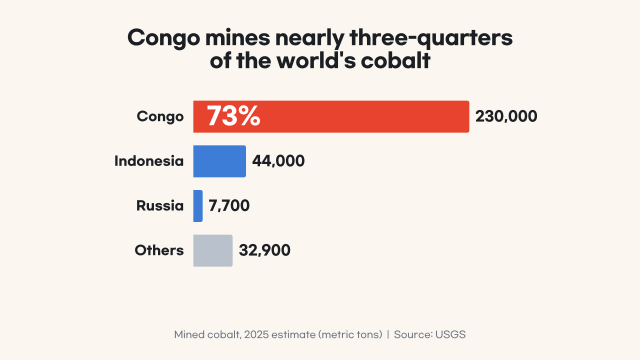
The latest reminder came this week. The Democratic Republic of Congo, which accounts for about 75 percent of global cobalt output and 55 percent of reserves, will suspend cobalt exports starting next Monday, its strategic minerals regulator ARECOMS said on Monday.
The regulator said the move was meant to "address the oversupply in the international market and to promote a sustainable rebalancing." It is Congo's second suspension in less than two years.
Chinese cobalt futures jumped to their highest in more than three months on Tuesday. Prices for cobalt hydroxide, Congo's main cobalt export, had nearly halved from their April peak, according to Fastmarkets.
Congo's cobalt reaches Korea largely by way of China, which refined 79 percent of the world's supply last year, according to the Cobalt Institute.
Much of that material arrives at Korean battery makers as precursor, the nickel-cobalt-manganese (NCM) compound used to make nickel-rich cathodes. Those nickel-rich cells remain the core business of LG Energy Solution, Samsung SDI and SK On.
South Korea took 95 percent of China's NCM precursor exports in December 2025, according to Shanghai Metals Market.
The last ban showed how quickly that pipeline can tighten. Battery-grade cobalt sulfate prices jumped nearly 80 percent in the three weeks around Congo's first suspension in February 2025, according to price data from the Korea Mine Rehabilitation and Mineral Resources Corp.
The energy storage cells Korean makers are racing to supply to AI data centers increasingly use lithium iron phosphate (LFP), a chemistry that contains no cobalt.
But LFP is home turf for Chinese suppliers, and Chinese technology is already finding its way into the U.S. market.
On Nov. 18, Ford began shipping the first LFP cells from its BlueOval Battery Park in Marshall, Michigan, which uses technology licensed from CATL, the world's largest battery maker. Ford owns and staffs the plant, which has a planned annual capacity of 20 gigawatt-hours.
Ford describes the arrangement as "a limited technology-licensing and services agreement." In practice, it lets CATL's designs reach the U.S. market even as Chinese-made cells remain largely shut out by tariffs and tax-credit rules.
Ford is extending the model. In December 2025, it agreed to dissolve its BlueOval SK joint venture with SK On and kept the venture's Kentucky plant, which is now being converted to build energy storage systems using the same CATL-licensed technology. First deliveries are slated for late 2027.
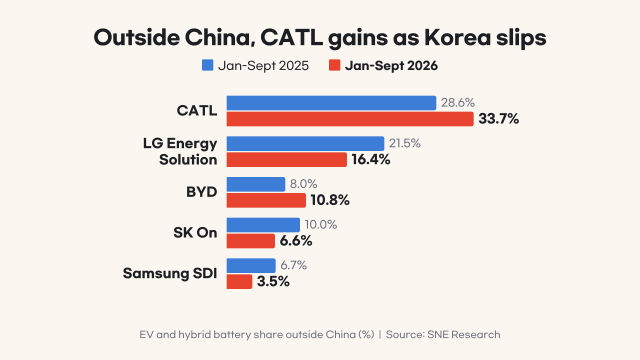
The EV retreat has left deep scars on Korean balance sheets.
LG Energy Solution's standalone accumulated deficit swelled by 2.76 trillion won in the two years to September, reaching 4.31 trillion won. That was the largest increase among 347 major Korean companies surveyed by CEO Score.
On the same basis, the company booked net losses in 2024 and 2025 and lost another 1.82 trillion won in the first nine months of this year. SK On's accumulated deficit of 2.18 trillion won was the second-largest in the survey.
SK On was also the only one of the three to post an operating loss in the third quarter, at 80.5 billion won. LG Energy Solution's consolidated operating profit of 756 billion won would have shrunk to 339.1 billion won without U.S. production tax credits.
Washington, meanwhile, is sending mixed signals on Chinese participation.
President Donald Trump has said he is open to Chinese manufacturers that hire Americans. "If China wanted to come in and open a plant to build their cars here, I'd be OK with that," he told Fox News in September. "The big thing is they hire our people."
Just days earlier, Transportation Secretary Sean Duffy had pressed Ford to cut its technology ties with CATL.
The U.S. Trade Representative is also preparing tariffs on 16 economies, including China and South Korea, following a probe into industrial overcapacity. An announcement could come as soon as this week.
Korean goods are expected to stay within the 15 percent cap set under Seoul's trade deal with Washington, and autos, already taxed on national security grounds, are likely to be excluded, according to Bloomberg and The Wall Street Journal. China is expected to face the steepest rates.
Beijing has a deadline of its own. Its October 2025 export controls on NCM precursors, synthetic graphite anodes and high-end battery cells are suspended only until Jan. 10, the same day the U.S.-China tariff truce is due to expire. Korean battery makers rely on Chinese supplies of the materials covered by those controls.
Some analysts, however, say the cobalt ban and the Ford deal pose less of a threat than the headlines suggest.
"Prices have already fallen so much that we don't think it will have a big impact," said Han Byung-hwa, an analyst at Eugene Investment & Securities.
"It's not as if they are restricting exports when supply is extremely tight," Han said. "They're doing it because demand is weaker than expected and prices are so weak."
Fastmarkets' benchmark for standard-grade cobalt in Rotterdam was assessed at $17.40-21.20 a pound on Nov. 13, well below its June 29 peak of $25.65-27.10.
"In the past, there was no LFP to be had in the United States, so they brought in CATL's technology to give it a try," he said.
"Now the situation has completely changed. And Ford isn't a battery company, so it isn't competitive, even if it does it."
Korean makers, for their part, have since moved into LFP production on American soil. LG Energy Solution began mass-producing LFP storage cells at its plant in Holland, Michigan, in 2025, ahead of schedule, and is pitching bundled power systems to AI data centers.
Samsung SDI recently started LFP output at its Indiana joint venture with Stellantis. On Nov. 16, it signed a 16-gigawatt-hour LFP supply deal with BlackRock-owned Jupiter Power, with two more production lines due from the first half of next year. SK On is converting lines in Georgia and will begin shipping storage cells to NeoVolta next year.
Korean cells are increasingly marketed in America as the safe, non-Chinese choice. But for their mainstay nickel-rich batteries, much of the cobalt still takes a detour through Chinese refineries first.
Kim Dong-young
Kim Dong-young is a bilingual journalist at AJU Press (AJP), covering Korean tech, energy, and bio/pharma.
He reports from the field at events like CES and APEC, runs AJP's YouTube channels,
and is pursuing a master's at Sogang's MOT program.
Copyright ⓒ Aju Press All rights reserved.
Related News
-
 Korea's chip wealth brims, battery deficit deepens
SEOUL, November 25 (AJP) -Samsung Electronics and SK hynix accounted for more than a third of retained earnings at South Korea’s largest companies as the AI buildout swelled chipmakers’ accumulated profits while the EV chasm deepened deficits for battery makers, a study of third-quarter results showed Wednesday. The chip duo’s combined balance reached 686.1 trillion won at end-September, or 36.9 percent of the 1,861.9 trillion won tallied by CEO Score. The survey covered 347 companies among the country’s 500 largest by revenue, using standalone financial statements. The two accounted for nearly 70 percent of the increase in retained earnings over two years, with their combined consolidated net profit reaching 368.0 trillion won in January–September — Samsung’s 194.0 trillion won and SK hynix’s 174.0 trillion won — according to third-quarter financial statements filed with the Financial Supervisory Service. Retained earnings represent accumulated profits kept in the business and are distinct from cash reserves. Battery makers suffered the biggest accumulated deficits as they faced supply contract cancellations amid poor market conditions. LG Energy Solution had the survey’s largest accumulated deficit at 4.31 trillion won, followed by SK On at 2.18 trillion won. LG Energy Solution reported a standalone net loss of 1.82 trillion won for the first nine months. Tags: Samsung Electronics, SK hynix, retained earnings, AI chip boom, semiconductor profits, LG Energy Solution, SK On, EV slowdown, battery industry, CEO Score, South Korean companies, corporate earnings
-
NVIDIA Market Cap Surges to 1,300 Trillion Won Following Jensen Huang's Return
NVIDIA's market capitalization surged to 1,300 trillion won (KRW) following the surprise return of CEO Jensen Huang, with the stock price soaring by 31.48%—the largest single-day increase since May 2003, resulting in an approximate 1,281 trillion won (KRW) rise in market value.The domestic stock market also rebounded sharply, buoyed by expectations of reduced uncertainty in AI investments. On the 24th, the KOSPI closed up 6.32% at 5,006.03, while the KOSDAQ rose 4.79% to finish at 665.88.Both Samsung Electronics (up 6.70%) and SK Hynix (up 6.73%) experienced significant gains, with their combined market capitalization increasing by about 92 trillion won (KRW) in just one day. The total market capitalization of the KOSPI and KOSDAQ also expanded by approximately 262 trillion won (KRW).However, concerns have been raised regarding the deepening coupling between NVIDIA and the domestic stock market. During the 18 trading days from September 29, NVIDIA's stock fell by 41.2%, while SK Hynix and Samsung Electronics dropped by 28.9% and 23.49%, respectively.Analysts noted that while Huang's return has improved sentiment around AI investments, lingering issues such as the U.S. Securities and Exchange Commission (SEC) investigation, semiconductor export controls, and uncertainties in big tech capital expenditures could lead to increased volatility in the domestic market.Major ReportsIBK Investment & Securities forecasts the KOSPI will range between 5,000 and 8,000 next year, predicting a rebound in the first half followed by a decline in the second half due to concerns over economic slowdown and corporate earnings.The KOSPI has dropped about 40% over the past five months, similar to declines seen during the dot-com bubble burst in 2000 and the 2008 financial crisis, which were followed by rebounds after approximately six months.Expectations of easing inflation in the first half and reduced regulatory uncertainty for U.S. data centers may lead to a buying spree in undervalued and growth stocks.In the second half, concerns over declining leading indicators for both South Korea and the U.S., along with worries about major semiconductor companies' earnings, may persist, with foreign selling likely to continue into next year.Historically, it takes an average of 48 months to recover to previous peak levels after entering a bear market, making it unlikely for the KOSPI to surpass its previous peak of approximately 8,500 (based on monthly closing prices) next year.For next year, sectors such as semiconductor materials, parts, and equipment (known as 'so-bo-jang') are expected to be more promising than large semiconductor firms, with attention also on biotechnology (BIO), entertainment (BTS), and secondary batteries (BATTERY) as 'BBB' sectors.Major Announcements After Market Close (24th)Daol Investment Securities: Acquired 2,804,346 shares of its affiliate Daol Savings Bank for 22.17 billion won (KRW).HJ Heavy Industries: Selected as the winning bidder for the construction project of the Seohae-Yongdeok section of National Highway No. 30, ordered by the Korea Expressway Corporation.Sonokong: Ceased operations in its toy division due to declining sales and ongoing operating losses.Weldex: Acquired tangible assets worth 44.09 billion won (KRW) to expand production capacity.Fund Trends (as of the 23rd, excluding ETFs)Domestic Equity: 21.2 billion won (KRW).Overseas Equity: Not specified.Key Schedule for Today (25th)South Korea: Business Survey, Economic Sentiment Index (November).Germany: Final GDP for Q3.United States: Personal Income, Personal Spending, PCE Price Index (October), Revised Q3 GDP, Durable Goods Orders (October), New Home Sales (October).* This article has been translated by AI.
-
Samsung Executive Reshuffle Highlights Three Key Themes: Meritocracy, Tech Talent, and Women Leaders
Samsung Electronics and its major affiliates announced the promotion of 173 executives on November 24. While the semiconductor division maintained its promotion numbers, the smartphone and home appliance sectors significantly reduced theirs, clearly emphasizing the principle of meritocracy based on performance. The proactive selection of future tech talent and women leaders across affiliates also drew attention.Samsung Electronics conducted its regular executive reshuffle, promoting 131 individuals, a decrease of 30 (18.6%) from last year's 161. The Device Solutions (DS) division, responsible for semiconductors, increased its promotions from 69 to 70, while the Device Experience (DX) division, which oversees smartphones and home appliances, saw a drastic reduction from 92 to 61. The decrease in promotions was concentrated in the underperforming DX division.Promotion numbers varied across affiliates. Samsung Electro-Mechanics increased its promotions from 8 last year to 15 this year, and Samsung SDI rose from 8 to 11. In contrast, Samsung Display's promotions fell from 23 to 16. The total number of promotions across the four Samsung companies decreased from 200 last year to 173 this year, a 13.5% decline.The selection of tech talent focused on next-generation businesses such as artificial intelligence (AI) semiconductors and robotics. The DS division of Samsung Electronics recognized individuals who contributed to the development and productivity improvement of high-bandwidth memory (HBM). Notable examples include Vice President Ha Kyung-soo, who led HBM4 circuit design and mass production, and Vice President Park Tae-hoon, who contributed to improving DRAM yield. The DX division also promoted key talents in robotics and AI, notably Lee Jae-hoon, a 38-year-old executive from Samsung Research.Samsung Electro-Mechanics and Samsung Display also focused on securing technological competitiveness. Samsung Electro-Mechanics promoted talents in multilayer ceramic capacitors (MLCC), semiconductor package substrates, and camera modules. Samsung Display promoted Vice Presidents Ahn Gi-wan, who contributed to the mass production of 8.6-generation OLEDs for IT, and Song Ha-jung, who improved QD-OLED productivity.Samsung SDI emphasized enhancing battery quality competitiveness and operational capabilities at overseas production bases, promoting 11 individuals, including 4 vice presidents. Vice President Kang Yong-hae was recognized for securing battery electrode quality and applying new methods, while Vice President Jeong Hoon was acknowledged for improving productivity at the Hungarian production subsidiary and stabilizing new product mass production.The rise of women leaders was also notable. The number of women promoted at Samsung Electronics increased from 9 last year to 11 this year, marking the highest number on record. While the overall number of promotions decreased by 18.6%, the number of women promoted actually increased. Vice President Lee Yoon-kyung, who led the establishment of the AI data platform, was among those promoted.Oh Il-seon, head of the Korea CXO Research Institute, stated, "While the door to promotion has narrowed, women and young talents have made significant strides, and there are disparities across business divisions. This can be summarized with the acronym 'WRAP,' which encapsulates Women, Reduction, Advancement of Young Executives, and Polarization across divisions."* This article has been translated by AI.