
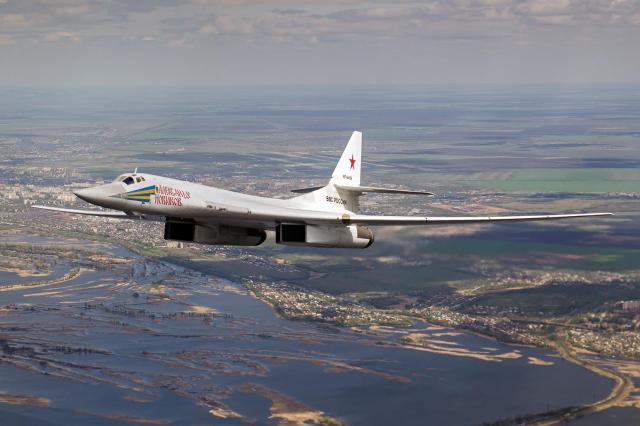
The Russian Defense Ministry said its Tu-160 strategic bombers flew for about 10 hours, escorted by Su-35S and Su-30SM fighter jets, according to state-run TASS news agency.
The ministry said foreign fighter jets had monitored the bombers during parts of the flight, insisting that the Russian aircraft had complied with international aviation rules.
The statement came after four Russian military aircraft, including two Tu-160 bombers and two fighter jets, entered the Korea Air Defense Identification Zone (KADIZ) without prior notice Tuesday morning.
The aircraft reportedly flew south toward Ulleung Island, approaching within about one kilometer of the boundary of South Korean territorial airspace before turning away.
South Korea's military responded to the approaching aircraft, although no violation of the country's sovereign airspace was reported.
Unlike territorial airspace, an air defense identification zone extends beyond a country's borders and is used to identify and monitor approaching aircraft. Entering such a zone does not itself constitute a violation of international law.
The involvement of Tu-160 bombers drew particular attention because of their nuclear strike capabilities.
The Tu-160 is a supersonic, long-range strategic bomber capable of carrying nuclear missiles and flying more than 12,000 kilometers. The aircraft, nicknamed the "White Swan" for its distinctive white exterior, is among Russia's most powerful strategic bombers.
The Russian military's footage of the flight also raised questions about whether its fifth-generation Su-57 stealth fighter had participated in the mission.
Foreign media outlets and military observers suggested that an aircraft resembling the Su-57 could be seen in the footage, although Russia's Defense Ministry did not specifically mention the fighter in its statement.
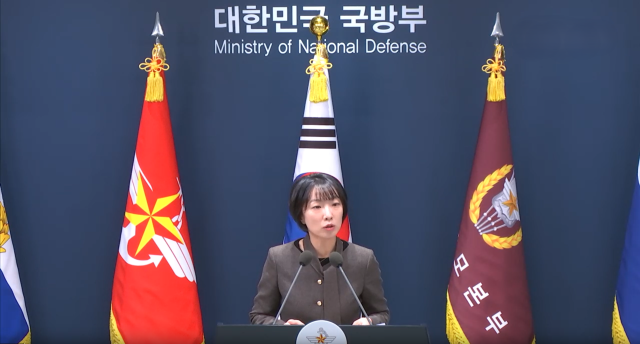
South Korea's Defense Ministry summoned Russian defense attaché Col. Nikolai Marchenko on Tuesday, expressing strong objections to the unauthorized KADIZ entry and the aircraft's close approach to Ulleung Island.
Kim Hak-jo, the ministry's director general for international policy, urged Moscow to prevent similar incidents, warning that repeated entries into KADIZ and flights near South Korean airspace could unnecessarily heighten tensions on the Korean Peninsula and across the region.
Russia maintained that its aircraft had not violated international law, an argument reportedly reiterated by its defense attaché during the meeting with South Korean officials.
Meanwhile, Russia's Foreign Ministry said Wednesday that South Korean Ambassador to Moscow Lee Seok-bae had requested a meeting with Russian Deputy Foreign Minister Andrey Rudenko to discuss current issues.
The ministry did not provide further details about the discussions.

Kim Hee-su
Kim Hee-su is a bilingual reporter at AJU Press, covering defense and foreign affairs. Before joining AJP in 2025, she worked at The Korea Times, where she wrote interview stories, including a profile of North Korean defector Kim Gum-hyok, and produced digital content. She also previously worked as a researcher for KBS News 9’s International News Department, supporting correspondents in 10 countries around the world. She graduated from the University of Toronto in Canada with a double major in Book and Media Studies and East Asian Studies.
Copyright ⓒ Aju Press All rights reserved.
Related News
-
 Exclusive: Government Coordinates Sanctions Against Russia While Research Institute Engages with Moscow
The head of the Sejong Institute, a private think tank under the Ministry of Foreign Affairs, has confirmed a visit to Moscow, where he held meetings with key local policy institutions. This comes as the administration of Lee Jae-myung emphasizes its commitment to participating in international sanctions against Russia and continuing support for Ukraine. Amid escalating military ties between North Korea and Russia, discussions reportedly included the role Russia could play in normalizing Korea-Russia relations and resuming inter-Korean dialogue.According to comprehensive coverage by Aju Economy on the 26th, Director Kim visited Moscow from October 28 to 29, accompanied by Jeong Jae-hyung, head of the Diplomatic Strategy Center, and Choi Eun-joo, head of the Korea Peninsula Strategy Center. The delegation held closed-door meetings with the Institute of Modern China and Asia Studies (ICCA RAS) and the Russian International Affairs Council (RIAC), signing Memorandums of Understanding (MOUs) with both institutions.On the 28th, the delegation met with ICCA RAS Director Kirill Babayev and Deputy Director Lyudmila Zakharova to discuss Korea-Russia cooperation projects, the potential for expanding economic and trade cooperation, the situation on the Korean Peninsula and in Northeast Asia, as well as Korea's relations with the United States and China. ICCA RAS is a federal scientific institution that provides policy analysis and advice to the Russian government regarding China and the Korean Peninsula. The discussions covered a wide range of topics, from economic and trade cooperation to issues on the Korean Peninsula, with an institution closely linked to Russia's Asia policy.The following day, the delegation held a closed meeting at RIAC with Chairman Dmitry Trenin, Deputy Secretary Dmitry Kikou, and Alexander Vorontsov, head of the Korean and Mongolian Studies Department at the Russian Academy of Sciences. The agenda included the security situation on the Korean Peninsula, prospects for resuming inter-Korean dialogue, Russia's role in this process, and the current state of Korea-Russia relations, including opportunities and limitations in the normalization process.RIAC is a policy institution established by presidential decree, with participation from the Russian Ministry of Foreign Affairs, the Ministry of Science and Higher Education, and the Russian Academy of Sciences. The Sejong Institute's visits to these two institutions, which maintain close ties with the Russian government, and the signing of MOUs are seen as moves to establish regular channels of exchange rather than one-off visits.This visit was initiated by the Sejong Institute itself. However, it has been confirmed that the government was aware of the delegation's plans to visit Russia in advance. According to documents obtained by Aju Economy, the South Korean embassy in Russia was aware of the Sejong Institute delegation's travel plans. The embassy held a luncheon meeting with the delegation during their visit to exchange views on the dynamics of Korea-Russia relations, key issues, and the situation on the Korean Peninsula. Given that the embassy was aware of the schedule and discussed policy issues with the delegation before the visit, some argue that this exchange cannot be viewed as entirely separate from government involvement.In this regard, a Sejong Institute official stated, "The schedule was conducted as part of mutual exchange and academic collaboration with local think tanks," adding, "It was meant to facilitate communication at a time when government-to-government communication is almost at a standstill." The Sejong Institute initially posted details of Director Kim's itinerary and meeting photos on its website on the 30th of last month, but removed the post a few hours later.This is not the first instance of a government-related research institution conducting a private visit to Russia. In June, Kim Seong-bae, head of the National Security Strategy Institute, which is affiliated with the National Intelligence Service, also visited Moscow to hold a closed roundtable meeting titled 'Russia-Korea Strategic Dialogue' with RIAC. At that time, both sides reportedly discussed security on the Korean Peninsula and the potential for developing Korea-Russia relations.As contacts between heads of research institutions in the fields of intelligence and diplomacy with Russia continue, there are speculations that the government may be operating a so-called '1.5 track' to gauge Russia's intentions and explore the possibility of restoring relations, separate from official diplomatic channels. This approach is interpreted as a way to reduce the diplomatic burden associated with direct government contact while indirectly conveying the intent to manage relations with Russia.A diplomatic source noted, "The government is doing what it can, while private contacts are being established under the 1.5 track concept," adding, "This is seen as an initial step to restore communication channels and understand each other's positions."The government has consistently emphasized its commitment to implementing sanctions and export controls against Russia in coordination with the international community since Russia's invasion of Ukraine, and has reiterated its intention to continue supporting Ukraine. Given the government's emphasis on sanctions coordination, the private contacts by affiliated research institutions with Russia are likely to spark discussions about the consistency and transparency of its Russia policy.Particularly, with the United States and Europe closely monitoring South Korea's approach to Russia, concerns have been raised that if the purpose and scope of these contacts are not adequately shared with allied nations, it could strain diplomatic trust.Another diplomatic expert stated, "Strategic activities regarding Russia should be conducted within a framework that has been agreed upon with allies in advance," emphasizing that even if unofficial dialogue channels are utilized to prevent a rupture in relations with Russia, the purpose of the contacts and coordination with allies must be clearly explained."* This article has been translated by AI.
-
US, China, and Russia Discuss Global Order in Historic Summit
The world's leading economic and military power, the United States, the second-largest economy, China, and nuclear power Russia discussed the future of the international order. This was the first time the three countries held a separate trilateral summit. Although specific agreements were minimal, the meeting was significant in that it addressed the issue of jointly managing the global order. On November 19, in Shenzhen, Guangdong Province, US President Donald Trump, Chinese President Xi Jinping, and Russian President Vladimir Putin attended the US-China-Russia summit. The meeting lasted about 1 hour and 30 minutes. President Trump stated that a significant portion of the discussions focused on the issue of the Ukraine war. After the summit, all three leaders expressed that they had achieved substantial outcomes. President Trump rated the summit as '12 out of 10,' while President Xi described it as 'active, constructive, and fruitful.' The success of this summit was not a simple matter. The US and China are engaged in strategic competition over trade, advanced technology, and Taiwan issues. The US and Russia have been sharply divided over the Ukraine war. While China and Russia maintain a strategic cooperative relationship, the US has different conflict factors with each country. Nevertheless, the summit took place because all three countries recognized the need for dialogue with each other. For President Trump, ending the Ukraine war and resolving international disputes could be diplomatic achievements. Particularly, after suffering a setback in the midterm elections, his political standing has weakened, making international diplomatic success even more crucial. For President Putin, it was an opportunity to demonstrate that Russia is a key player in the international order by engaging directly with the US president. For President Xi, it was a stage to enhance China's international status by engaging with both the US and Russia simultaneously. This summit is particularly noteworthy from the perspective of Chinese diplomacy. China has long challenged the US-centered international order and advocated for a multipolar world. However, this time, it invited the leaders of the US and Russia to discuss global peace and security issues. This symbolically shows that China is positioning itself as a major power that not only challenges the existing international order but also participates in shaping and managing it. Wang Yi, a member of the Political Bureau of the Communist Party of China and Foreign Minister, described the meeting as a 'symbolic event that will be recorded in history' during a press conference after the summit. He emphasized that the three leaders deeply discussed important issues concerning global peace and security, and that it was a peace summit promoting strategic stability in great power relations. This highlights the diplomatic significance that China attributes to this meeting. Of course, it is premature to evaluate this summit as having brought about fundamental changes in the global order. There is still a lack of evidence that specific agreements were reached on key issues such as conditions for ending the Ukraine war, nuclear disarmament, and US-China strategic competition. It remains uncertain whether the three countries can adjust their interests and move toward practical cooperation. Nevertheless, this summit confirmed an important reality. The US, China, and Russia are in competition and confrontation with each other, but no single country can be excluded from solving global security issues. The three leaders directly acknowledged the necessity of cooperation among their countries in the major decision-making processes of the global order. We are in an era where the US-centered unipolar system is shaking, and multipolarization is progressing. It is still unclear whether this summit will serve as a starting point for a new international order. However, it is clear that China has emerged as a key player in discussing the future of the global order alongside the US and Russia.* This article has been translated by AI.
-
Nuclear Talks Among US, China, and Russia: Who Designs Peace on the Korean Peninsula?
Nuclear weapons are the most powerful weapons created by humanity. At the same time, they are the most tragic invention that proves humans can destroy their own civilization. They represent a victory of science but a defeat of human reason. Countries that possess nuclear weapons can become great powers, but a world that cannot eliminate nuclear weapons can never be a safe civilized society.On November 19, 2026, a historic scene unfolded in Shenzhen, China. U.S. President Donald Trump, Chinese President Xi Jinping, and Russian President Vladimir Putin sat together. The leaders of three nuclear-armed nations that influence the strategic balance of the world held an unprecedented trilateral summit and announced a joint declaration for peace.The essence of the declaration was simple. There are no winners in a nuclear war, and nuclear war must never occur. The three countries agreed to engage in dialogue to reduce nuclear risks and prevent the proliferation of nuclear weapons.This is a statement that seems obvious when considering the fate of humanity. However, the fact that the leaders of the world's three great powers jointly confirmed this principle is significant. It acknowledges a shared responsibility not to neglect the dangers of nuclear war. "Developing Nuclear Weapons Late Violates International Order"... The Contradiction of the Non-Proliferation TreatyThe issue arises after the declaration. There is a deep chasm between the promise not to engage in nuclear war and the practical steps to reduce nuclear weapons. There is an even more daunting mountain range between the agreement to prevent proliferation and the task of dismantling the nuclear arsenals of countries that have already developed them.At the center of that mountain range lies the Korean Peninsula.The atomic bombs dropped on Hiroshima and Nagasaki in August 1945 were the first demonstration of what nuclear weapons are. Cities were destroyed, and countless lives were lost. For the survivors, radiation damage and deep scars remained. World War II ended, but the fear of nuclear weapons did not.During the Cold War, the United States and the Soviet Union competitively stockpiled nuclear weapons. The theory of nuclear deterrence, which posits that the ability to destroy the opponent actually deters war, became the central logic of international security. This is the so-called balance of terror.However, the balance of terror is not the same as peace. It is an order built on the uneasy expectation that the opponent will not pull the trigger first. A miscalculation, a technical error, or a wrong judgment by a political leader could lead to an irreversible disaster.To reduce these risks, the international community adopted the Treaty on the Non-Proliferation of Nuclear Weapons (NPT) in 1968 and brought it into force in 1970. This treaty recognizes the United States, Russia, China, the United Kingdom, and France as nuclear-armed states while preventing the proliferation of nuclear weapons to other countries and imposing an obligation on nuclear-armed states to engage in sincere negotiations for nuclear disarmament.Herein lies the fundamental contradiction of the nuclear order. Countries that possess nuclear weapons are recognized as nuclear-armed states, while countries that seek to develop nuclear weapons late are deemed violators of the international order. This structure is understandable considering historical circumstances, but it cannot be justified indefinitely.The ultimate goal of the NPT is not to perpetuate the privileges of existing nuclear-armed states but to move toward a world without nuclear weapons. If nuclear-armed states neglect their disarmament obligations while demanding denuclearization from other countries, it will be difficult to gain the trust of the international community.The true value of the recent U.S.-China-Russia summit hinges on how much this contradiction can be resolved.The three countries promised to engage in dialogue to prevent nuclear war and proliferation. However, the joint declaration did not include targets for reducing warheads, verification procedures, or specific negotiation timelines. While principles were confirmed, a blueprint for implementation was not presented. North Korean Nuclear Issue and Korean Peninsula Denuclearization Not Specified in Joint DeclarationThe North Korean nuclear issue is particularly noteworthy.According to the Chinese announcement, the three leaders discussed international issues, including the Korean Peninsula. However, the joint declaration did not specify North Korean nuclear weapons or the denuclearization of the Korean Peninsula. The agreement to engage in dialogue to prevent proliferation is entirely different from agreeing on North Korean denuclearization.While this declaration could serve as a diplomatic opportunity for denuclearization on the Korean Peninsula, it does not itself promise the dismantling of North Korean nuclear weapons. This is the challenge that South Korean diplomacy must address.How should this silence be interpreted?It cannot be concluded that the three leaders ignored the North Korean nuclear issue. There is a possibility that the joint declaration contained only broad principles. However, it is also possible that they could not reach a specific agreement on denuclearization of the Korean Peninsula or did not align their positions enough to include it in the joint document.The clear fact is that the North Korean nuclear issue remains unresolved.North Korea declared its withdrawal from the NPT in 2003 and conducted its first nuclear test in 2006. Since then, it has continued to develop nuclear weapons and ballistic missiles through several tests. In 2022, it legalized its nuclear policy, defining nuclear power as a core means of national defense.The International Atomic Energy Agency (IAEA) reported on the 18th that activities continue at North Korea's uranium enrichment facilities in Yongbyon and Kangson. Notably, additional expansion work at the existing enrichment facility in Yongbyon has been observed since mid-September, with completion noted by the end of October. The IAEA also reported signs of operation at the Yongbyon 5-megawatt reactor and the status of the operation of the light-water reactor. While there are limitations to on-site inspections, the international community's concerns about the expansion of North Korea's nuclear program are evident.The North Korean nuclear issue can no longer be resolved by mere declarations. North Korea's fear that abandoning nuclear weapons would threaten its regime's security clashes directly with the concerns of South Korea and the international community that possessing nuclear weapons threatens regional safety.If this dilemma is not resolved, denuclearization of the Korean Peninsula will remain merely a slogan.The United States is an ally that provides extended deterrence to South Korea. China has significant economic and diplomatic influence over North Korea. Russia has also been strengthening its strategic relationship with North Korea. Therefore, it is difficult to expect a fundamental resolution to the North Korean nuclear issue without cooperation among the three countries.However, the fate of the Korean Peninsula cannot be left solely to negotiations among the three great powers.If a nuclear war were to occur on the Korean Peninsula, the first to be destroyed would be the lives of the Korean people. This includes the citizens of Seoul and Pyongyang, industrial facilities, cultural heritage, and the history of the nation built over many years. This is why the lives and safety of the residents of the Korean Peninsula must take precedence over the strategic interests of great powers. Deterrence is a Means to Prevent War, Not the Ultimate Goal of PeaceSouth Korea must leverage this declaration as a new diplomatic opportunity.First, it must maintain effective deterrence and crisis management capabilities based on its alliance with the United States. It should not ignore real security threats in the name of pursuing peace. However, military deterrence alone cannot resolve the nuclear issue. Deterrence is a means to prevent war, not the ultimate goal of peace.At the same time, it must demand responsible roles from China and Russia. If the two countries jointly commit to preventing proliferation, they must also apply that principle to the North Korean nuclear issue. Their friendly relations with North Korea should not serve as a justification for tolerating nuclear proliferation.Dialogue with North Korea must also not be abandoned. While maintaining the ultimate goal of denuclearization, it is necessary to negotiate a phased approach to halt nuclear tests and missile provocations, limit the production of nuclear materials, ensure international verification, and reduce military tensions. A phased approach does not mean legally recognizing North Korea's possession of nuclear weapons. It is a diplomatic method to reduce real risks while moving toward ultimate denuclearization.Above all, nuclear disarmament and non-proliferation cannot be separated.If the United States, China, and Russia continue to enhance their nuclear capabilities while demanding that North Korea abandon its nuclear weapons, their arguments will have limits. Conversely, North Korea's justification of its nuclear development based on the nuclear possession of great powers is also unacceptable. The danger of nuclear weapons does not disappear depending on which country possesses them.Here, humanity faces a fundamental question.Does science exist for humanity, or do humans become subordinate to the power of science?Nuclear physics has unveiled the secrets of nature. Nuclear power has contributed to electricity production and advancements in medicine and industry. However, the same science can become a weapon that can destroy countless lives in an instant. Science itself is neither good nor evil. The morality and political judgment of those who wield that power determine the direction of civilization.Albert Einstein deeply worried about the dangers of the nuclear age. He reminded us that the advancement of science and technology alone cannot guarantee humanity's safety. Today, as artificial intelligence and advanced military technology converge, that warning becomes even more urgent.Eastern wisdom is no different. The "Tao Te Ching" emphasizes restraint and humility over the display of force. The "Analects" finds the foundation of politics in the trust of the people. The measure of a civilized nation is not how many nuclear weapons it possesses, but how much it can restrain that power.The leaders of the United States, China, and Russia hold immense power to influence the global nuclear order. However, that power cannot exist above the lives of humanity. While nuclear weapons may symbolize national strength, the true leadership lies in the restraint of using nuclear weapons and the ultimate responsibility to reduce them. The Promises of the US, China, and Russia Must Lead to a Resolution of the North Korean Nuclear IssueThis declaration from Shenzhen could serve as a historic starting point. At the same time, it could also remain a diplomatic rhetoric that ends without any action. The difference depends on what actions the three countries take moving forward.South Korea also has a clear task. It must become a country that actively designs the denuclearization of the Korean Peninsula and the peace order in Northeast Asia, rather than passively being incorporated into the nuclear order of great powers.There are no winners in a nuclear war.Therefore, there should be no bystanders in preventing nuclear war.The promises of the US, China, and Russia must lead to a resolution of the North Korean nuclear issue. Denuclearization of the Korean Peninsula is an important test of the sincerity of that promise.A nuclear-free Korean Peninsula. A war-free Northeast Asia. A world where humanity, culture, and nature coexist.That is the future of peace that the declarations of the three great powers should aim for.* This article has been translated by AI.