

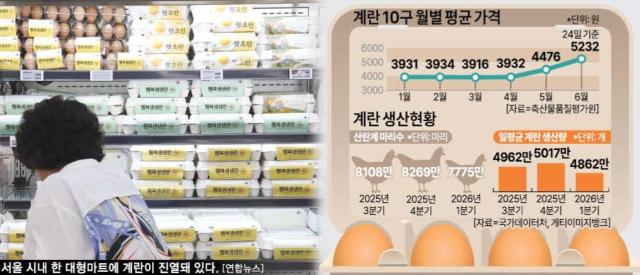
Egg prices are soaring, putting increased cost pressure on the food industry. Although the government has announced measures to expand the supply of imported eggs and provide discounts, the recovery in supply has been slow, compounded by rising prices of key raw materials, creating a tense atmosphere across the industry.
According to the Korea Institute of Animal Products Quality Evaluation, the average consumer price for a dozen special eggs from June 1 to June 23 reached 5,232 won. This marks the first time the average monthly price has exceeded 5,000 won since records began. This figure represents a 38.2% increase compared to the same period last year (3,786 won) and a 16.9% rise from the previous month (4,476 won).
The surge in egg prices is largely due to the ongoing effects of last winter's highly pathogenic avian influenza (AI). The culling of laying hens has reduced supply, and concerns over productivity declines due to heat waves and policies aimed at improving farming conditions have further exacerbated supply instability. While the government is supplying 21 million fresh eggs from the U.S. and Thailand and conducting discount promotions, the tangible impact on the market remains minimal.
The issue is that eggs are a key ingredient widely used across the food industry. They are essential in products such as cakes, bread, and cookies, as well as in sandwiches, sauces, and various processed foods, meaning price fluctuations can significantly affect the entire sector.
Particularly, the bakery industry is also grappling with rising costs for key raw materials like cocoa, butter, and flour due to high exchange rates. With egg prices climbing, profit margins are under even greater pressure.
Industry representatives state that they currently have no plans to adjust product prices, but they express concerns about accumulating cost pressures. In an environment of persistent inflation, consumer resistance to price increases has grown, making it difficult to immediately pass on rising costs to product prices.
An official from a processed food company noted, "Eggs are a fundamental ingredient in most baked goods, so price fluctuations directly impact us. Right now, we are absorbing costs internally, but if the burden of raw material prices continues for an extended period, we may need to consider our options."
Another industry representative added, "Not only eggs but also the prices of key raw materials like butter, cocoa, and flour remain high overall, significantly increasing the burden of cost management for companies."
There are concerns that if the trend of rising egg prices continues, it could lead to increased prices for processed foods, including baked goods. According to data released by the National Statistical Office, the consumer price index rose 3.1% year-on-year in May, marking a return to the 3% range for the first time in 26 months. Eggs led this increase with a 10.2% rise, driving up food prices.
An industry representative cautioned, "There are limits to how much we can absorb the accumulated cost increases internally. If 'eggflation' does not stabilize, we could see widespread price increases starting with bakeries and restaurant franchises."
* This article has been translated by AI.
Copyright ⓒ Aju Press All rights reserved.