

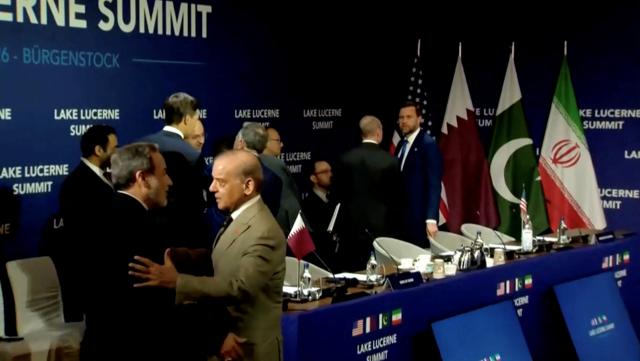
Pakistan is asserting its presence on the international stage by leading recent peace negotiations between the United States and Iran in Switzerland. However, opinions are divided on whether this diplomatic role will translate into economic benefits for the country.
Reuters reported on June 23 that while Pakistan's involvement in the negotiations could serve as a diplomatic asset, it is unlikely to yield significant economic gains. Experts suggest that economic development stems more from internal reforms than from available funds.
Alongside Qatar, Pakistan coordinated the negotiations between the US and Iran, drawing attention for its efforts. Iran, which achieved significant outcomes in the talks, including the release of frozen funds, extended a warm welcome to Pakistan. According to Al Jazeera, on June 23, Iranian President Masoud Pezeshkian traveled directly to Islamabad. During a press conference, he emphasized the need to elevate the relationship between Iran and Pakistan to a level befitting their status in the Islamic world, stating, "We can create a successful cooperation model based on solidarity and brotherhood," as reported by the Pakistani daily Dawn. Pakistani officials, including President Asif Ali Zardari, Prime Minister Shehbaz Sharif, and Foreign Minister Ishaq Dar, gathered to welcome President Pezeshkian at Nur Khan Air Base near Islamabad.
As a mediator, Pakistan received a warm reception in the US as well. US Vice President JD Vance reportedly embraced General Asim Munir, the powerful chief of the Pakistani military, during the post-war negotiations at the Bürgenstock resort in Switzerland, asking, "How have you been?" On June 24, Al Jazeera reported that Vance humorously remarked during his speech at the Swiss negotiation venue, "I have two very important people in my life—one is my Indian wife (Usha Vance) and the other is my Pakistani friend, Munir."
Despite this diplomatic stature, Pakistan's economic situation remains precarious. With a population of 250 million, the country faces significant challenges, including economic inequality, a narrow tax base, and repeated International Monetary Fund (IMF) bailouts, as noted by Reuters. The formalization of the underground economy is also a major issue. Last year, only 1.3% of Pakistanis filed income tax returns, and just 7.7% of adults owned debit or credit cards.
Moreover, the United Arab Emirates (UAE), a Middle Eastern Islamic nation that had previously maintained friendly relations with Pakistan, has recently expelled many Pakistani workers, causing economic repercussions. The New York Times reported that in one region of northwestern Pakistan, 900 individuals were expelled and returned home within weeks. The newspaper attributed the UAE's displeasure to Pakistan's failure to strongly condemn Iran's missile and drone attacks, which have caused significant damage to the UAE. In April, the UAE recalled a $3.5 billion loan to Pakistan, equivalent to one-fifth of the country's foreign reserves. Fortunately, Saudi Arabia deposited an additional $3 billion into Pakistan's central bank, preventing a deeper crisis. Over 2 million Pakistanis reside in the UAE, and they sent home $8 billion last year.
Bloomberg noted that Pakistan's role as a mediator in the ongoing conflict could help it escape the shadow of wealthier regional competitor India and potentially attract foreign capital. Al Jazeera also suggested that the recent easing of US sanctions might revive discussions on Pakistan's long-desired pipeline project with Iran.
Domestically, there are calls for economic reforms rather than merely relying on the "crumbs" from mediation efforts. Dawn columnist Khurram Hussain pointed out, "Whether Iran remembers us favorably or whether the US offers generous rewards is beyond our control. However, domestic economic issues cannot be resolved by a grateful neighbor or a benevolent benefactor."
* This article has been translated by AI.
Copyright ⓒ Aju Press All rights reserved.