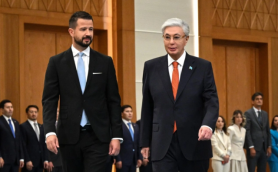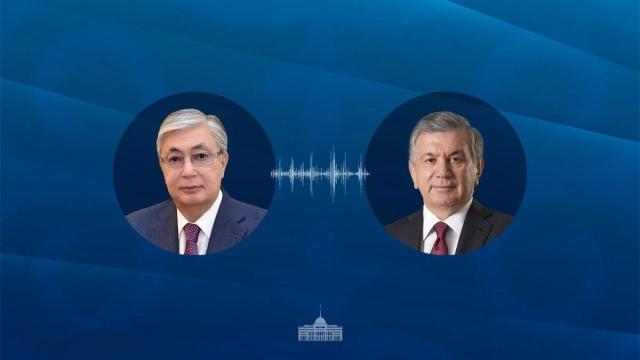
SEOUL, June 25 (AJP) - To strengthen their decades-old close friendship and bilateral relations, the leaders of the two largest countries in Central Asia have engaged in a meeting via a phone call on Wednesday (local time) that extends from their April Bukhara meeting, where strategic cooperation in trade, logistics, and energy sectors was discussed.
Kazakhstan's Presidential Office said that the Kazakh President Kassym-Jomart Tokayev and the Uzbek President Shavkat Mirziyoyev spoke on the phone to discuss issues regarding the enhancement of the bilateral cooperation and expressed satisfaction with the development momentum that the Kazakh-Uzbek relations have gained.
Built on a shared history and deep mutual trust, the two largest countries in Central Asia are accelerating their partnership to become much closer and stronger. Kazakhstan and Uzbekistan established their modern diplomatic relations in November 1992, and their friendship was fortified by a series of events, including the historic Treaty of State Border Delimitation in 2022.
Since 2023, both informal and formal meetings between the leaders have been held frequently, providing opportunities for the Kazakhstan President Kassym-Jomart Topkayev and the Uzbekistan President Shavkat Mirziyoyev to discuss various issues, while working-level engagements also took place on the sidelines of the high-level meetings.
Kazakhstan and Uzbekistan, the countries that rely heavily on exports of natural resources such as gas, oil, and mined minerals to make money, are also working fast to transform into modern, technology-driven economies. Astana named 2026 the "Year of Digitalization and Artificial Intelligence," while its neighbor is pushing the "Uzbekistan 2030" plan to bring together online services, digital banking, and tech jobs.
In March, Kazakhstan's foreign minister Yermek Kosherbatev met with his Uzbek counterpart Bakhtiyor Saidov in Tashkent and agreed to increase bilateral trade to $ 10 billion by 2030 from last year's $ 5 billion. The two countries also chose cooperation over competition. They have teamed up on big practical projects such as road infrastructure establishment, sharing of water supplies during hot summers, and providing support for businesses that operate across both borders.
Copyright ⓒ Aju Press All rights reserved.