

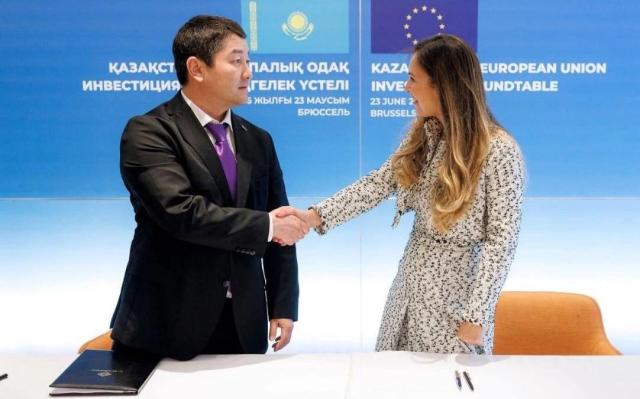
SEOUL, June 25 (AJP) - Kazakhstan and Dutch shipbuilder Damen Shipyards Group signed a framework agreement in Brussels on Tuesday (local time) to develop a €100 million ($113.6 million) shipyard in the Mangystau region, the province home to Kazakhstan's two main Caspian ports, targeting what analysts have consistently identified as the weakest link in the Trans-Caspian International Transport Route.
Cargo volumes crossing the Caspian surged more than 63 percent in 2024, reaching 4.1 million tons, an eightfold increase from the 500,000 tons recorded before Russia's invasion of Ukraine, according to the Carnegie Endowment for International Peace. Container traffic climbed a further 36 percent in 2025 to approximately 77,000 twenty-foot containers. The European Union pledged €12 billion to Central Asia's infrastructure development at the 2025 EU-Central Asia Summit in Samarkand and designated the corridor a flagship project under its Global Gateway strategy, the bloc's global infrastructure investment program.
Kazakhstan has no meaningful domestic capacity to build the vessels that move cargo across its own sea. The shipyard deal is a direct response to that gap.
The Trans-Caspian International Transport Route, known as the Middle Corridor, runs roughly 4,000 kilometers, connecting China's eastern coast to Eastern Europe by rail and sea. Cargo moves by rail across Kazakhstan to the port of Aktau on the Caspian Sea, crosses by ship to Baku in Azerbaijan, then continues by rail through Georgia and Turkey to European markets.
At approximately 3,000 kilometers shorter than the route through Russia, transit times run around 15 days, compared with 45 to 55 days for traditional sea shipping. Costs are higher, moving a 40-foot container on the Middle Corridor runs $3,500 to $4,500 against $2,800 to $3,200 via the northern route, but European companies seeking to reduce exposure to Russian transit have broadly accepted that premium.
The Caspian crossing is where constraints are sharpest. The sea is landlocked, meaning no vessel can be sailed in from elsewhere in the world. Every ship operating on the Caspian was either built at one of the region's aging facilities or assembled in pieces transported overland. Kazakhstan relies heavily on Azerbaijan's Baku Shipyard for vessel construction and maintenance, adding cost and time to an already complex chain. When cargo demand spikes, as it has repeatedly since 2022, Astana has limited means to respond.
The Caspian Sea is also shrinking. Water levels have been dropping by an average of up to 30 centimeters annually since 2020, driven by reduced inflows from Russia's dammed Volga River and accelerating evaporation. Rail tank car ferry transport on the Baku-Kuryk route, one of the main trans-Caspian passages, fell 22 percent as shallowing began to restrict vessel movement. Ports built for a deeper sea now require continuous dredging to stay open. Damen already has a stake in that problem: the company signed a contract with Azerbaijan's Baku Shipyard last year to build a dedicated dredging vessel for Baku's main port. That prior work gives Damen direct knowledge of the Caspian's physical conditions that a new entrant to the region would not have.
Founded in 1927 in Gorinchem in the Netherlands, Damen Shipyards Group is one of the world's largest commercial shipbuilders, with a portfolio spanning ferries, tankers, tugs, dredgers, and offshore support vessels. The company has long supplied Caspian operators. Caspian Offshore Construction, a regional client, operates a fleet in which half the vessels are Damen-built. Operating in the Caspian requires vessels with a shallow draft, meaning they sit close to the water's surface and extend only minimally below it, unlike standard ocean ships, engineering choices Damen has already had to make.
A local shipyard in Mangystau would let Kazakhstan build, maintain, and expand its Caspian fleet without depending on yards in Baku or further afield. The vessels most immediately needed are ferries, tankers, and support craft, the categories that determine how fast and how much cargo crosses the sea in any given week.
The deal was one of more than 30 commercial agreements totaling over €10 billion signed during President Kassym-Jomart Tokayev's official visit to Brussels on June 22 and 23. Tokayev met European Council President Antonio Costa and European Commission President Ursula von der Leyen, and the joint statement issued by all three leaders explicitly highlighted the Trans-Caspian route. The European Investment Bank separately agreed to finance road rehabilitation along the Middle Corridor. The European Bank for Reconstruction and Development signed a transport digitalization agreement with Kazakhstan.
"Kazakhstan is a global gateway, and so is Central Asia," von der Leyen said at the summit. "We are ready to turn that gateway into a pathway for jobs, business opportunities, and common prosperity."
The agreement carries significant caveats. It is a framework, not a signed contract. The €100 million figure is an estimate, not committed financing. Site selection, permitting, detailed engineering, and financial close all remain ahead. Past Caspian shipyard announcements in Kazakhstan, including a joint project by Italian energy company Eni and Kazakhstan's national oil company KazMunaiGas at Kuryk, which entered planning more than a decade ago, took years to advance and ran into repeated delays.
The Middle Corridor faces pressures beyond the Caspian. Georgia's Anaklia deep-water port, widely seen as the most important missing piece of western infrastructure on the route, remained stalled in 2026, with its Chinese developer's commitment in question and state funding sharply reduced. The Baku-Tbilisi-Kars railway, the main land link from Azerbaijan to Turkey, has effectively reached physical capacity. The corridor currently carries roughly 4.1 million tons annually, around six percent of the 100 million tons that once moved along the northern route through Russia.

Copyright ⓒ Aju Press All rights reserved.
