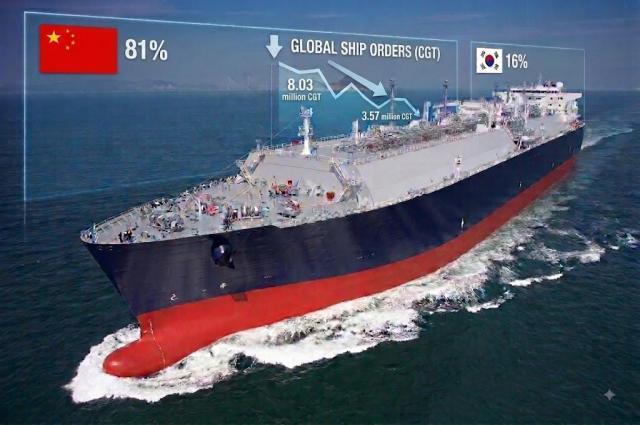
SEOUL, August 12 (AJP) - With global ship orders falling by more than half in July from the previous month, China accounted for more than 80 percent of the orders, while South Korea accounted for just 16 percent.
According to data released by London-based Clarkson Research Services on Wednesday, global ship orders last month totaled 3.57 million compensated gross tons (CGT) or 137 vessels, down 56 percent from 8.03 million CGT a month earlier and 22 percent from 4.55 million CGT a year earlier.
By country, China secured 2.90 million CGT across 111 vessels, accounting for 81 percent of the total, while South Korea secured 570,000 CGT across 21 vessels or 16 percent of the total.
China continued to maintain its dominance. Of the 50.93 million CGT or 1,778 vessels in cumulative global ship orders during the first seven months of this year, China secured 38.02 million CGT or 1,394 vessels, accounting for 75 percent of the total, up 107 percent from the same period last year. South Korea secured 8.70 million CGT across 218 vessels, taking a mere 17 percent.
Meanwhile, Clarkson's index measuring the cost of building new ships stood at 185.49 in July, up 0.34 percentage points from the previous month and up 29 percent from July 2021, when the index stood at 143.95.
By vessel type, an LNG carrier would cost $248.5 million to build, compared with $130.5 million for a very large crude carrier (VLCC) and $259.5 million for an ultra-large container ship in the 22,000 to 24,000 twenty-foot equivalent unit (TEU) class.
Industry officials said China's market presence has increased sharply amid a rise in orders for bulk carriers and tankers from domestic shipping companies, while South Korea has maintained a selective strategy focused on higher-value vessels such as liquefied natural gas (LNG) carriers, prioritizing profitability over the number of monthly orders.
AJP Takeaways:
0 Global ship orders fell 56 percent in July 2026 from the previous month to 3.57 million compensated gross tons (CGT), or 137 vessels, according to Clarkson Research Services.
- China accounted for 81 percent of global ship orders in July 2026, securing 2.90 million CGT across 111 vessels, while South Korea took 16 percent with 570,000 CGT across 21 vessels.
- China led cumulative global ship orders from January through July 2026, securing 38.02 million CGT across 1,394 vessels, or 75 percent of the 50.93 million CGT total, up 107 percent from the same period in 2025.
- South Korea secured 8.70 million CGT across 218 vessels from January through July 2026, taking a 17 percent share as South Korean shipbuilders focused on higher-value vessels such as liquefied natural gas (LNG) carriers.
- Clarkson Research Services' newbuilding price index rose to 185.49 in July 2026, up 29 percent from 143.95 in July 2021; newbuild prices reached $248.5 million for LNG carriers, $130.5 million for very large crude carriers and $259.5 million for 22,000 to 24,000 TEU ultra-large container ships.
According to data released by London-based Clarkson Research Services on Wednesday, global ship orders last month totaled 3.57 million compensated gross tons (CGT) or 137 vessels, down 56 percent from 8.03 million CGT a month earlier and 22 percent from 4.55 million CGT a year earlier.
By country, China secured 2.90 million CGT across 111 vessels, accounting for 81 percent of the total, while South Korea secured 570,000 CGT across 21 vessels or 16 percent of the total.
China continued to maintain its dominance. Of the 50.93 million CGT or 1,778 vessels in cumulative global ship orders during the first seven months of this year, China secured 38.02 million CGT or 1,394 vessels, accounting for 75 percent of the total, up 107 percent from the same period last year. South Korea secured 8.70 million CGT across 218 vessels, taking a mere 17 percent.
Meanwhile, Clarkson's index measuring the cost of building new ships stood at 185.49 in July, up 0.34 percentage points from the previous month and up 29 percent from July 2021, when the index stood at 143.95.
By vessel type, an LNG carrier would cost $248.5 million to build, compared with $130.5 million for a very large crude carrier (VLCC) and $259.5 million for an ultra-large container ship in the 22,000 to 24,000 twenty-foot equivalent unit (TEU) class.
Industry officials said China's market presence has increased sharply amid a rise in orders for bulk carriers and tankers from domestic shipping companies, while South Korea has maintained a selective strategy focused on higher-value vessels such as liquefied natural gas (LNG) carriers, prioritizing profitability over the number of monthly orders.
AJP Takeaways:
0 Global ship orders fell 56 percent in July 2026 from the previous month to 3.57 million compensated gross tons (CGT), or 137 vessels, according to Clarkson Research Services.
- China accounted for 81 percent of global ship orders in July 2026, securing 2.90 million CGT across 111 vessels, while South Korea took 16 percent with 570,000 CGT across 21 vessels.
- China led cumulative global ship orders from January through July 2026, securing 38.02 million CGT across 1,394 vessels, or 75 percent of the 50.93 million CGT total, up 107 percent from the same period in 2025.
- South Korea secured 8.70 million CGT across 218 vessels from January through July 2026, taking a 17 percent share as South Korean shipbuilders focused on higher-value vessels such as liquefied natural gas (LNG) carriers.
- Clarkson Research Services' newbuilding price index rose to 185.49 in July 2026, up 29 percent from 143.95 in July 2021; newbuild prices reached $248.5 million for LNG carriers, $130.5 million for very large crude carriers and $259.5 million for 22,000 to 24,000 TEU ultra-large container ships.
Copyright ⓒ Aju Press All rights reserved.