

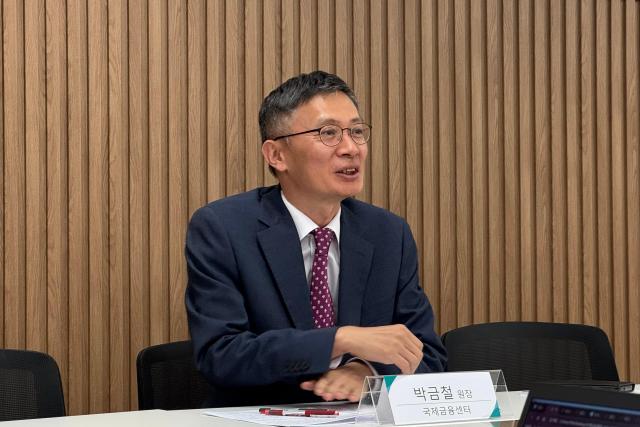
Park Geum-cheol, head of the National Financial Center, speaks at the '2026 Global Economic and International Financial Market Outlook' briefing on June 25. [Photo by Jang Seon-a]
The National Financial Center forecasts a gradual recovery in the global economy during the second half of 2026, driven by the effects of artificial intelligence (AI) investment, despite supply shocks from the Middle East and high inflation. Key factors influencing financial markets in the latter half of the year include AI investment, potential oil crises, instability in the bond market, and monetary policies of major countries.
AI Rally Continues, but Oil Prices and Bond Yields Pose Risks
Park Geum-cheol, head of the National Financial Center, stated at the briefing held on June 25 in Seoul that "the second half of this year will test the resilience of AI amid high inflation and supply shocks."
The center anticipates that the effects of AI investment will lead to a gradual recovery in the global economy, with growth rates expected to rebound from a low of 2.4% in the second quarter to between 2.8% and 3.0% in the third and fourth quarters.
Park identified the key variables that will influence the global economy and financial markets in the second half as: AI investment, the possibility of an oil crisis, instability in the bond market, and the monetary policies of major economies.
He noted that global stock markets are likely to see further gains, particularly in AI-related sectors. However, risks such as delays in monetization, increased external funding, and delays in power grid expansion were highlighted. Additionally, a slowdown in corporate profit growth, the potential for further tightening by the Federal Reserve, and high valuation pressures could limit the extent of any gains.
In the oil market, the center predicts that declining global crude oil inventories will continue to exert upward pressure on prices. The normalization of navigation through the Strait of Hormuz and the recovery of production in Gulf oil-producing countries are seen as critical variables.
Furthermore, rising inflation expectations, increased fiscal spending, growing national debt, and decreased foreign demand for U.S. Treasury bonds could contribute to upward pressure on long-term interest rates. The potential for further interest rate hikes by the European Central Bank (ECB) and the Bank of Japan (BOJ), as well as the Federal Reserve's tightening measures, are also considered significant factors.
The center anticipates that the effects of AI investment will lead to a gradual recovery in the global economy, with growth rates expected to rebound from a low of 2.4% in the second quarter to between 2.8% and 3.0% in the third and fourth quarters.
Park identified the key variables that will influence the global economy and financial markets in the second half as: AI investment, the possibility of an oil crisis, instability in the bond market, and the monetary policies of major economies.
He noted that global stock markets are likely to see further gains, particularly in AI-related sectors. However, risks such as delays in monetization, increased external funding, and delays in power grid expansion were highlighted. Additionally, a slowdown in corporate profit growth, the potential for further tightening by the Federal Reserve, and high valuation pressures could limit the extent of any gains.
In the oil market, the center predicts that declining global crude oil inventories will continue to exert upward pressure on prices. The normalization of navigation through the Strait of Hormuz and the recovery of production in Gulf oil-producing countries are seen as critical variables.
Furthermore, rising inflation expectations, increased fiscal spending, growing national debt, and decreased foreign demand for U.S. Treasury bonds could contribute to upward pressure on long-term interest rates. The potential for further interest rate hikes by the European Central Bank (ECB) and the Bank of Japan (BOJ), as well as the Federal Reserve's tightening measures, are also considered significant factors.
"Exchange Rates Expected to Gradually Decline Towards Year-End; Foreign Capital is a Variable
The National Financial Center expects the U.S. dollar to maintain a gradual strength due to relatively high growth rates and interest levels in the U.S., as well as a preference for U.S. assets. For advanced economies, the narrowing interest rate differential with the U.S. is a key variable, while for emerging markets, the volatility of foreign capital inflows and outflows is significant.
The recent fluctuations of the won-dollar exchange rate in the mid-1500s range are expected to show a gradual decline towards the end of the year, considering domestic fundamentals. However, outflows of foreign equity capital could exert upward pressure on the exchange rate.
Lee Sang-won, head of the Foreign Exchange Analysis Division at the National Financial Center, remarked, "Given the current account surplus in our country, it is unusual for the exchange rate not to trend downward. However, the recent sharp rise in the KOSPI has led to foreign investors adjusting their asset and currency exposures, resulting in capital outflows that are putting upward pressure on the exchange rate."
He added, "Since the outflow of foreign equity capital exceeds the current account surplus, we expect a gradual decline accompanied by volatility for the time being. If the outflow of foreign capital slows down and seasonal characteristics of expanding current account surpluses emerge towards the end of the year, downward pressure on the exchange rate will increase."
Regarding U.S. monetary policy and the direction of the dollar, it is anticipated that the Federal Reserve will seek a balance between inflation stability and political pressures. It is also noted that the strong dollar cannot be interpreted as a result of deliberate government actions.
Yoon In-goo, head of the International Financial Market Analysis Division at the National Financial Center, commented, "The Federal Reserve is likely to seek a balance between President Trump's pressure for interest rate cuts and inflationary pressures, considering one or no additional rate hikes this year. It is difficult to interpret the strong dollar as a result of intentional government policy."
The recent fluctuations of the won-dollar exchange rate in the mid-1500s range are expected to show a gradual decline towards the end of the year, considering domestic fundamentals. However, outflows of foreign equity capital could exert upward pressure on the exchange rate.
Lee Sang-won, head of the Foreign Exchange Analysis Division at the National Financial Center, remarked, "Given the current account surplus in our country, it is unusual for the exchange rate not to trend downward. However, the recent sharp rise in the KOSPI has led to foreign investors adjusting their asset and currency exposures, resulting in capital outflows that are putting upward pressure on the exchange rate."
He added, "Since the outflow of foreign equity capital exceeds the current account surplus, we expect a gradual decline accompanied by volatility for the time being. If the outflow of foreign capital slows down and seasonal characteristics of expanding current account surpluses emerge towards the end of the year, downward pressure on the exchange rate will increase."
Regarding U.S. monetary policy and the direction of the dollar, it is anticipated that the Federal Reserve will seek a balance between inflation stability and political pressures. It is also noted that the strong dollar cannot be interpreted as a result of deliberate government actions.
Yoon In-goo, head of the International Financial Market Analysis Division at the National Financial Center, commented, "The Federal Reserve is likely to seek a balance between President Trump's pressure for interest rate cuts and inflationary pressures, considering one or no additional rate hikes this year. It is difficult to interpret the strong dollar as a result of intentional government policy."
* This article has been translated by AI.
Copyright ⓒ Aju Press All rights reserved.