

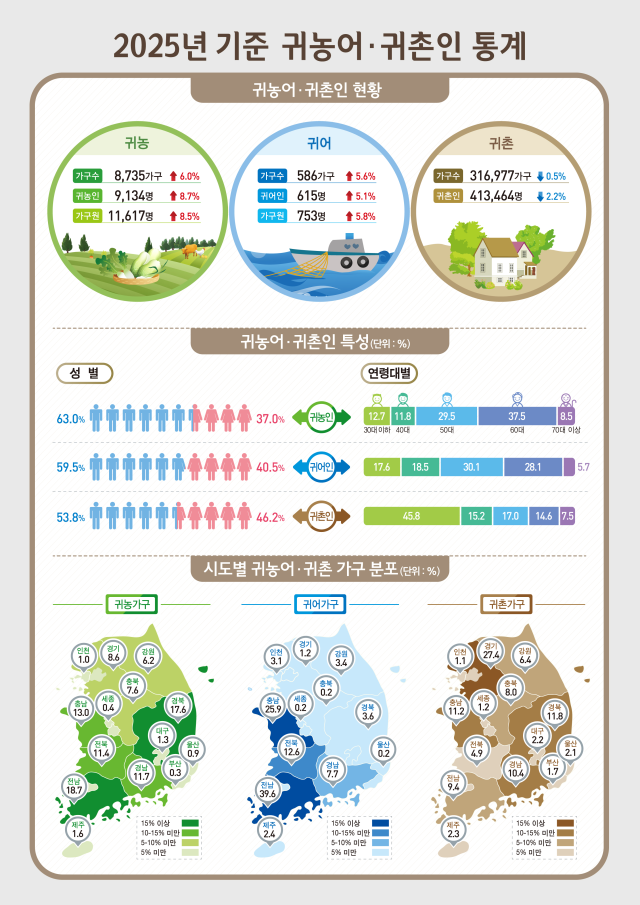
Image of rural resettlement households [Source: National Data Agency]
Last year, the number of households moving to rural areas and engaging in fishing increased compared to the previous year, largely due to the retirement of the baby boomer generation.
According to the National Data Agency's report on '2025 Rural and Fishing Household Statistics' released on June 25, the number of rural households reached 8,735 in the previous year, marking a 6% increase (492 households) from 8,243 in the prior year. The average household size for these rural families was 1.33 members, slightly up from 1.30 the previous year.
The average age of heads of rural households was 55.8 years, with men making up 64.8% of this demographic. Notably, 77.8% of rural households were single-person households, while 15.4% were two-person households.
Similarly, fishing households also saw growth, with 586 households reported last year, a 5.6% increase (31 households) from 555 the previous year. The average household size for fishing families remained stable at 1.28 members. The average age of heads of fishing households was 52.8 years, with men constituting 60.2%. Among these households, 79.9% were single-person households, and 13.7% were two-person households.
In contrast, the number of households moving to urban areas decreased. The number of urban households fell by 0.5% (1,681 households) to 316,977 from 318,658 the previous year. The average household size for urban households decreased to 1.3 members from 1.33.
The average age of heads of urban households was 45.8 years, with men making up 60.0%. Among these households, 78.0% were single-person households, and 15.6% were two-person households.
In the past five years, 15,631 individuals who moved to rural areas have started farming. The majority, 4,866 (31.1%), began farming in their first year after relocating, followed by 3,869 (24.8%) in their second year, and 2,825 (18.1%) in their third year.
Additionally, 1,248 individuals who moved to fishing areas began fishing in the last five years. Of these, 505 (40.5%) started in their first year, 263 (21.1%) in their second year, and 186 (14.9%) in their third year.
The phenomenon of 'reverse migration,' where individuals move back to urban areas after relocating to rural areas, was most prevalent among those who had moved within the past year. Among rural migrants, 1,969 individuals relocated back to urban areas within five years, with 542 (27.5%) doing so in their first year, 434 (22.0%) in their second year, and 386 (19.6%) in their third year.
Among fishing migrants, 174 individuals moved back to urban areas within five years, with the highest number, 41 (23.6%), relocating in their third year, followed by 36 (20.7%) in their first and second years, and 35 (20.1%) in their fourth year.
A representative from the Statistics Agency noted, "This survey indicates that individuals in their 60s are a significant portion of the rural population, suggesting that many baby boomers are choosing to move to rural areas after retirement."
According to the National Data Agency's report on '2025 Rural and Fishing Household Statistics' released on June 25, the number of rural households reached 8,735 in the previous year, marking a 6% increase (492 households) from 8,243 in the prior year. The average household size for these rural families was 1.33 members, slightly up from 1.30 the previous year.
The average age of heads of rural households was 55.8 years, with men making up 64.8% of this demographic. Notably, 77.8% of rural households were single-person households, while 15.4% were two-person households.
Similarly, fishing households also saw growth, with 586 households reported last year, a 5.6% increase (31 households) from 555 the previous year. The average household size for fishing families remained stable at 1.28 members. The average age of heads of fishing households was 52.8 years, with men constituting 60.2%. Among these households, 79.9% were single-person households, and 13.7% were two-person households.
In contrast, the number of households moving to urban areas decreased. The number of urban households fell by 0.5% (1,681 households) to 316,977 from 318,658 the previous year. The average household size for urban households decreased to 1.3 members from 1.33.
The average age of heads of urban households was 45.8 years, with men making up 60.0%. Among these households, 78.0% were single-person households, and 15.6% were two-person households.
In the past five years, 15,631 individuals who moved to rural areas have started farming. The majority, 4,866 (31.1%), began farming in their first year after relocating, followed by 3,869 (24.8%) in their second year, and 2,825 (18.1%) in their third year.
Additionally, 1,248 individuals who moved to fishing areas began fishing in the last five years. Of these, 505 (40.5%) started in their first year, 263 (21.1%) in their second year, and 186 (14.9%) in their third year.
The phenomenon of 'reverse migration,' where individuals move back to urban areas after relocating to rural areas, was most prevalent among those who had moved within the past year. Among rural migrants, 1,969 individuals relocated back to urban areas within five years, with 542 (27.5%) doing so in their first year, 434 (22.0%) in their second year, and 386 (19.6%) in their third year.
Among fishing migrants, 174 individuals moved back to urban areas within five years, with the highest number, 41 (23.6%), relocating in their third year, followed by 36 (20.7%) in their first and second years, and 35 (20.1%) in their fourth year.
A representative from the Statistics Agency noted, "This survey indicates that individuals in their 60s are a significant portion of the rural population, suggesting that many baby boomers are choosing to move to rural areas after retirement."
* This article has been translated by AI.
Copyright ⓒ Aju Press All rights reserved.