

![Minister Jeong Eun-kyeong of the Ministry of Health and Welfare explains the 'Health Insurance Payment Structure Innovation Plan' during a briefing at the Government Seoul Building on June 25. [Photo=Ministry of Health and Welfare]](https://image.ajunews.com/content/image/2026/06/25/20260625144010464501.jpg)
The South Korean government will inject 3.6 trillion won annually into health insurance to revitalize the struggling regional and essential medical infrastructure. At the same time, it will eliminate fees that local clinics have traditionally collected for outsourcing blood tests and significantly reduce the costs of high-profit tests like CT and MRI scans, aiming to save 2.6 trillion won. This reform intends to shift focus from lucrative tests to rewarding life-saving complex surgeries and regional hospitals.
Why the Change? Blood Tests Yielding 190% Profit vs. Brain Surgery Costs
The core concept of this policy, known as 'payment structure,' refers to the compensation the government provides to medical institutions from health insurance funds for medical services. This overhaul of the health insurance payment structure is the largest in 25 years since the current system was introduced in 2001.
The medical community has long identified 'distorted payment imbalances' as a key reason for the collapse of essential medical services. According to a study by the Ministry of Health and Welfare's Medical Cost Analysis Committee, the profit margin for blood tests and other specimen tests is 190%, while special imaging tests like CT and MRI reach 194.1%. This means hospitals earn 190 won for every 100 won spent on tests.
In contrast, direct patient consultations (70.7%), inpatient care (57.3%), and anesthesia (75.1%) are in severe deficit. Consequently, hospitals have resorted to 'three-minute consultations' and unnecessary 'excessive tests' to generate revenue, while essential complex surgeries, which involve significant risks and responsibilities, have become less appealing to physicians.
To address these structural contradictions, the government plans to overhaul the payment system and significantly shorten the revision cycle from 5-7 years to within 2 years to quickly rectify unreasonable aspects.
The medical community has long identified 'distorted payment imbalances' as a key reason for the collapse of essential medical services. According to a study by the Ministry of Health and Welfare's Medical Cost Analysis Committee, the profit margin for blood tests and other specimen tests is 190%, while special imaging tests like CT and MRI reach 194.1%. This means hospitals earn 190 won for every 100 won spent on tests.
In contrast, direct patient consultations (70.7%), inpatient care (57.3%), and anesthesia (75.1%) are in severe deficit. Consequently, hospitals have resorted to 'three-minute consultations' and unnecessary 'excessive tests' to generate revenue, while essential complex surgeries, which involve significant risks and responsibilities, have become less appealing to physicians.
To address these structural contradictions, the government plans to overhaul the payment system and significantly shorten the revision cycle from 5-7 years to within 2 years to quickly rectify unreasonable aspects.
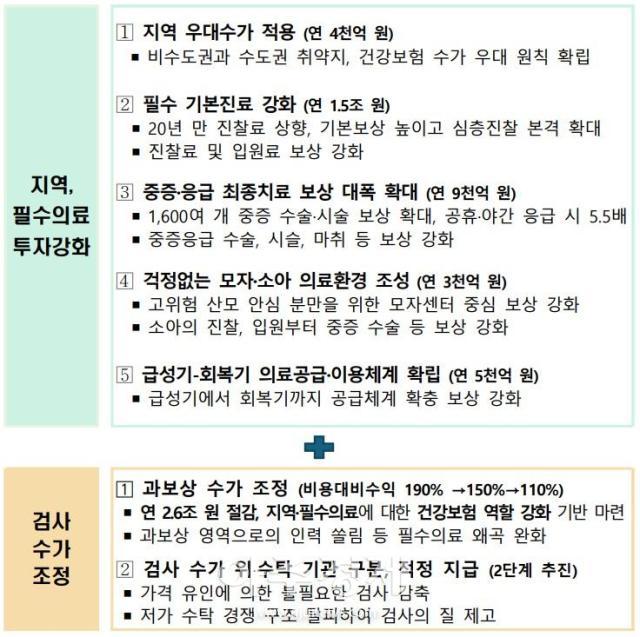
New 'Regional Preferential Payment' Adds 10% to Surgical Fees in Local Hospitals
A significant feature of this reform is the introduction of a 'Regional Preferential Payment' that will allocate 400 billion won annually. Until now, the South Korean healthcare system has provided the same payment amount regardless of whether the facility is in the heart of Seoul or in a remote area.
Going forward, approximately 2,700 surgical procedures and treatments performed at general hospitals in six designated medical underserved areas (including Uijeongbu, Namyangju, Icheon, Pocheon, and Incheon) will receive a 10% increase in health insurance payments. An additional 10% will be added for emergency surgeries performed at night or on holidays, aiming to alleviate the financial strain on local hospitals.
The impact of this change is evident in the numbers. For instance, if a general hospital in Jeonbuk performs an emergency aneurysm surgery at night, the payment will rise from 10.5 million won to 17.02 million won with the regional and night/emergency bonuses applied.
Additionally, hospitals, clinics, and local clinics located in 84 designated areas facing population decline will see a 5% increase in basic consultation and hospitalization fees to support their role as essential healthcare providers for local residents.
Going forward, approximately 2,700 surgical procedures and treatments performed at general hospitals in six designated medical underserved areas (including Uijeongbu, Namyangju, Icheon, Pocheon, and Incheon) will receive a 10% increase in health insurance payments. An additional 10% will be added for emergency surgeries performed at night or on holidays, aiming to alleviate the financial strain on local hospitals.
The impact of this change is evident in the numbers. For instance, if a general hospital in Jeonbuk performs an emergency aneurysm surgery at night, the payment will rise from 10.5 million won to 17.02 million won with the regional and night/emergency bonuses applied.
Additionally, hospitals, clinics, and local clinics located in 84 designated areas facing population decline will see a 5% increase in basic consultation and hospitalization fees to support their role as essential healthcare providers for local residents.
Ending 'Three-Minute Consultations': Consultation Fees Increased for the First Time in 20 Years
The government will inject 1.5 trillion won annually into basic consultation and hospitalization fees.
For the first time in 20 years, the relative value score for consultation fees (a metric for assessing the value of medical services) will be increased. The initial consultation fee for local clinics will rise by 6% (from 18,840 won to 19,980 won), while follow-up consultations will increase by 4% (from 13,370 won to 13,900 won). Medical institutions will see a 2% increase for both initial and follow-up consultations.
To improve the quality of inpatient care, the basic hospitalization fee, which has been frozen for over a decade, will also rise by 7% for general wards and 10% for intensive care units.
Moreover, the government aims to promote a culture of 'in-depth consultations' by allowing physicians to spend more time with patients. The current pilot program will be expanded to reward specialists in advanced general hospitals or local pediatricians who conduct consultations lasting over 15 minutes with compensation of 2-3 times the initial consultation fee (approximately 85,720 won for advanced general hospitals).
In primary care settings like internal medicine, family medicine, and obstetrics, consultations lasting over 10 minutes will receive double the initial consultation fee for up to 4-6 times a year.
In response to concerns that doctors might intentionally prolong consultations to increase revenue, the Ministry of Health and Welfare stated during a briefing that, "Current pilot program results show no evidence of medical staff extending time for profit, and both patients and doctors report high satisfaction with thorough explanations, leading to calls for program expansion." They also assured that they would monitor whether the increase in consultation fees leads to unnecessary patient visits.
For the first time in 20 years, the relative value score for consultation fees (a metric for assessing the value of medical services) will be increased. The initial consultation fee for local clinics will rise by 6% (from 18,840 won to 19,980 won), while follow-up consultations will increase by 4% (from 13,370 won to 13,900 won). Medical institutions will see a 2% increase for both initial and follow-up consultations.
To improve the quality of inpatient care, the basic hospitalization fee, which has been frozen for over a decade, will also rise by 7% for general wards and 10% for intensive care units.
Moreover, the government aims to promote a culture of 'in-depth consultations' by allowing physicians to spend more time with patients. The current pilot program will be expanded to reward specialists in advanced general hospitals or local pediatricians who conduct consultations lasting over 15 minutes with compensation of 2-3 times the initial consultation fee (approximately 85,720 won for advanced general hospitals).
In primary care settings like internal medicine, family medicine, and obstetrics, consultations lasting over 10 minutes will receive double the initial consultation fee for up to 4-6 times a year.
In response to concerns that doctors might intentionally prolong consultations to increase revenue, the Ministry of Health and Welfare stated during a briefing that, "Current pilot program results show no evidence of medical staff extending time for profit, and both patients and doctors report high satisfaction with thorough explanations, leading to calls for program expansion." They also assured that they would monitor whether the increase in consultation fees leads to unnecessary patient visits.
Emergency and Complex Surgeries to See Up to 5.5 Times Increase in Fees
The government will allocate 1.2 trillion won annually to the so-called 'final treatment' areas, including emergency rooms, operating rooms, and delivery rooms (900 billion won for complex and emergency surgeries, and 300 billion won for maternal and pediatric care).
Initially, the fees for over 1,600 complex surgeries performed at general hospitals for conditions like cancer and cardiovascular diseases will be uniformly increased by 20%. Notably, if these surgeries are performed urgently at regional emergency medical centers during holidays or at night, the compensation can increase by up to 5.5 times (450% increase).
The fees for general anesthesia and high-complexity special anesthesia will also see a 50% increase to ensure the essential conditions for saving lives.
Compensation for the maternal and pediatric fields, which are struggling with workforce shortages, will also be significantly enhanced. Previously, caring for high-risk mothers or premature infants was a daunting task for hospitals due to high costs and inadequate compensation. Moving forward, hospitals will receive an additional 4.4 million won for delivering infants born before 28 weeks at complex maternal centers, and up to 5.06 million won for centers outside the metropolitan area.
The hospitalization fees for neonatal intensive care units will also be raised by up to 2.5 times in non-metropolitan areas. The age limit for additional compensation for pediatric consultations and hospitalizations will be expanded from 'under 6 years' to 'under 8 years.' Furthermore, 500 billion won will be allocated annually to establish a medical system that allows critically ill patients to transition from acute care to rehabilitation without returning to the emergency room.
Initially, the fees for over 1,600 complex surgeries performed at general hospitals for conditions like cancer and cardiovascular diseases will be uniformly increased by 20%. Notably, if these surgeries are performed urgently at regional emergency medical centers during holidays or at night, the compensation can increase by up to 5.5 times (450% increase).
The fees for general anesthesia and high-complexity special anesthesia will also see a 50% increase to ensure the essential conditions for saving lives.
Compensation for the maternal and pediatric fields, which are struggling with workforce shortages, will also be significantly enhanced. Previously, caring for high-risk mothers or premature infants was a daunting task for hospitals due to high costs and inadequate compensation. Moving forward, hospitals will receive an additional 4.4 million won for delivering infants born before 28 weeks at complex maternal centers, and up to 5.06 million won for centers outside the metropolitan area.
The hospitalization fees for neonatal intensive care units will also be raised by up to 2.5 times in non-metropolitan areas. The age limit for additional compensation for pediatric consultations and hospitalizations will be expanded from 'under 6 years' to 'under 8 years.' Furthermore, 500 billion won will be allocated annually to establish a medical system that allows critically ill patients to transition from acute care to rehabilitation without returning to the emergency room.
Reducing Excessive Fees for Blood Tests and Imaging to Fund Reforms
To fund the 3.6 trillion won investment, the government plans to eliminate excessive profits in the testing sector. The fees for specimen tests and special imaging (CT and MRI) that previously yielded nearly double their costs will be significantly reduced, aiming to save 2.6 trillion won (1.9 trillion won from specimen tests and 700 billion won from imaging).
The Ministry of Health and Welfare has outlined a roadmap to reduce these fees to 150% of their costs by the second half of 2026 and to 110% by 2028, establishing a 'balanced payment' system that does not generate surplus profits.
For example, the cost of a standard abdominal CT scan at a general hospital will decrease by about 22%, from 132,920 won to 103,340 won, reducing the patient's out-of-pocket expense from 66,400 won to 51,600 won. Similarly, the cost of a head and neck MRI will drop by approximately 33%, from 267,160 won to 179,560 won, easing the financial burden on patients.
Notably, the government will also overhaul the 'specimen testing outsourcing system,' which has been in place since 1999. Many local clinics have lacked their own blood testing facilities and have sent patients' blood to external laboratories, collecting 10% of the total testing fee as 'outsourcing management fees.'
The Ministry has determined that this opaque fee distribution structure has led to price dumping among laboratories and unnecessary excessive testing by local clinics, prompting the decision to abolish the 10% management fee, which alone is expected to save approximately 240 billion won.
However, some critics express concern that increasing regional and essential medical fees by 3.6 trillion won could lead to a collapse of health insurance finances or skyrocketing patient costs. In response, the Ministry firmly stated, "There will be no explosive increase in hospital costs or sudden financial burdens for patients." The newly established regional preferential payments will be fully funded by health insurance, ensuring that patients in vulnerable areas will not face any out-of-pocket expenses.
Additionally, the increase in essential medical fees will be offset by the reductions in patient costs from the aforementioned cuts to specimen and special imaging fees, according to the government. In fact, the net additional burden on health insurance finances due to this payment structure reform is estimated to be around 1 trillion won annually. The Ministry added, "By achieving 300 billion won in savings each year through expenditure efficiency, we expect a total savings effect of 15 trillion won over the next decade, along with increased health insurance revenue from performance bonuses in high-growth sectors like semiconductor companies." They also plan to announce additional strategies to expand revenue bases in the second half of the year to manage these changes without a sharp increase in insurance premiums.
The Ministry of Health and Welfare has outlined a roadmap to reduce these fees to 150% of their costs by the second half of 2026 and to 110% by 2028, establishing a 'balanced payment' system that does not generate surplus profits.
For example, the cost of a standard abdominal CT scan at a general hospital will decrease by about 22%, from 132,920 won to 103,340 won, reducing the patient's out-of-pocket expense from 66,400 won to 51,600 won. Similarly, the cost of a head and neck MRI will drop by approximately 33%, from 267,160 won to 179,560 won, easing the financial burden on patients.
Notably, the government will also overhaul the 'specimen testing outsourcing system,' which has been in place since 1999. Many local clinics have lacked their own blood testing facilities and have sent patients' blood to external laboratories, collecting 10% of the total testing fee as 'outsourcing management fees.'
The Ministry has determined that this opaque fee distribution structure has led to price dumping among laboratories and unnecessary excessive testing by local clinics, prompting the decision to abolish the 10% management fee, which alone is expected to save approximately 240 billion won.
However, some critics express concern that increasing regional and essential medical fees by 3.6 trillion won could lead to a collapse of health insurance finances or skyrocketing patient costs. In response, the Ministry firmly stated, "There will be no explosive increase in hospital costs or sudden financial burdens for patients." The newly established regional preferential payments will be fully funded by health insurance, ensuring that patients in vulnerable areas will not face any out-of-pocket expenses.
Additionally, the increase in essential medical fees will be offset by the reductions in patient costs from the aforementioned cuts to specimen and special imaging fees, according to the government. In fact, the net additional burden on health insurance finances due to this payment structure reform is estimated to be around 1 trillion won annually. The Ministry added, "By achieving 300 billion won in savings each year through expenditure efficiency, we expect a total savings effect of 15 trillion won over the next decade, along with increased health insurance revenue from performance bonuses in high-growth sectors like semiconductor companies." They also plan to announce additional strategies to expand revenue bases in the second half of the year to manage these changes without a sharp increase in insurance premiums.
Minister Jeong Eun-kyeong stated, "This reform plan is the first step in significantly enhancing investment in regional and essential medical services to save lives. Starting with the unprecedented investment of 3.6 trillion won, we will expand the regional healthcare workforce and alleviate the burden of medical malpractice for physicians, ensuring that everyone can receive prompt emergency treatment and have children without worrying about hospital costs in their local areas."
* This article has been translated by AI.
Copyright ⓒ Aju Press All rights reserved.