

The Drone Operations Command, established under the Yoon Suk Yeol administration, will be restructured into the Defense Drone Headquarters, which will focus on policy development for drone and anti-drone operations, rather than operational command.
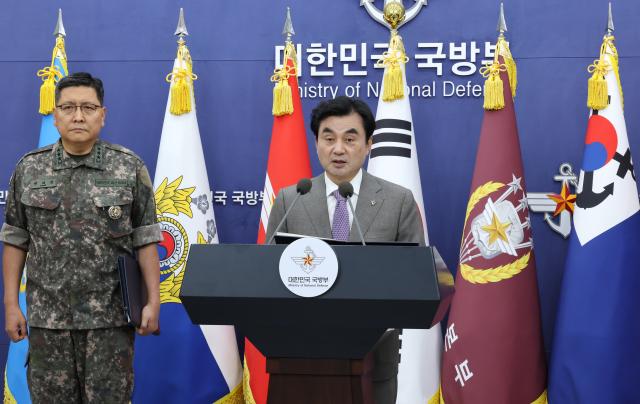
On June 26, Defense Minister An Gyu-baek held a briefing at the Ministry of National Defense in Seoul to announce the drone and anti-drone development policy.
The ministry stated that it will expedite the deployment of K-LUCAS to counter strategic threats and neutralize enemy air defense systems, with plans to deploy the drones before the previously scheduled mid-2030s timeline.
Additionally, the government aims to acquire over 20,000 low-cost, expendable drones, including short-range reconnaissance drones and small kamikaze drones, by 2030. It will also work on securing next-generation drones, such as swarm drones utilizing artificial intelligence (AI), to prepare for future battlefields.
Long-term plans include deploying anti-drone systems in frontline areas and small unmanned aerial vehicle (UAV) response systems, with a commitment to immediately field proven commercial equipment next year.
Specifically, the ministry plans to establish a differentiated rapid acquisition system for drones, allowing for the swift introduction of civilian technology into military applications and linking certification systems for commercial drones to military use.
The Drone Operations Command was created in December 2022 as a response to North Korea's incursion of unmanned aerial vehicles into South Korean airspace.
The ministry plans to transfer operational functions from the Drone Operations Command to the respective military branches, while the Defense Drone Headquarters will specialize in concept development, requirement identification, acquisition support in collaboration with the military, and partnerships with industry and various organizations.
As the Drone Operations Command is disbanded, personnel from its subordinate units will return to their respective military branches, and the unmanned aerial systems previously held by the command will be redistributed based on mission requirements.
The newly established Defense Drone Headquarters will be organized as a direct unit under the Ministry of National Defense, led by a general officer.
Furthermore, the ministry reaffirmed its commitment to train 500,000 drone operators, enabling all service members to utilize drones as a "second personal weapon." The military plans to procure around 60,000 domestically produced training drones.
The ministry stated, "We will improve the current system where some drone capabilities are operated by specific units, allowing each military branch to conduct integrated surveillance, reconnaissance, and strike operations. We will also develop drone operation concepts and tactics tailored to the unique characteristics and missions of the Army, Navy, Air Force, and Marine Corps."
* This article has been translated by AI.
Copyright ⓒ Aju Press All rights reserved.