

Traditionally, the Chinese stock market has been dominated by bank stocks, with state-owned banks holding a significant share of the market capitalization. However, the ongoing boom in artificial intelligence (AI) and semiconductors is changing this landscape. Ten years ago, traditional sectors such as finance, telecommunications, and energy were at the forefront, but now companies in AI and semiconductor industries, including Foxconn Industrial Internet and Zhongji Innolight, are rapidly filling the void left by these legacy firms. In the second half of this year, major players like Changxin Memory Technologies (CXMT), China's largest DRAM manufacturer, and Yangtze Memory Technologies (YMTC), a leader in NAND flash memory, are set to go public, further enhancing the presence of AI and semiconductors in the Chinese stock market.
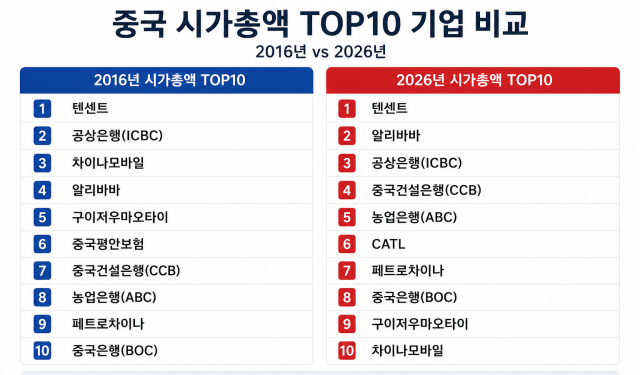
As of June 26, according to CompaniesMarketCap, the top 10 companies by market capitalization in China include big tech firms, state-owned banks, and advanced manufacturing companies. Tencent leads with a market cap of $484.9 billion, followed by China Construction Bank at $378.2 billion, Agricultural Bank of China at $321.4 billion, Industrial and Commercial Bank of China (ICBC) at $301.4 billion, and Bank of China at $274.9 billion. CATL, a major player in electric vehicle batteries, ranks sixth with a market cap of $274 billion.
The remaining spots in the top 10 are occupied by Alibaba at $230.9 billion, Foxconn Industrial Internet at $225.1 billion, Kweichow Moutai at $223.3 billion, and Zhongji Innolight at $217.5 billion. Notably, Zhongji Innolight, which produces high-speed optical transceivers for AI data centers, is considered a beneficiary of the NVIDIA AI ecosystem.
A decade ago, the Chinese stock market was primarily centered around large traditional firms in finance, telecommunications, and energy. Excluding Tencent and Alibaba, the market structure was dominated by state-owned financial, energy, and telecommunications giants. According to Wind, a Chinese financial information company, Tencent was the top-listed company by market capitalization in January 2016, valued at $245.5 billion, followed by ICBC at $236.6 billion, China Mobile at $229.8 billion, Alibaba at $229.2 billion, and PetroChina at $213.2 billion.
The 6th to 10th positions included China Construction Bank (approximately $192.4 billion), Agricultural Bank of China (approximately $143.9 billion), Bank of China (approximately $141.5 billion), Sinopec (approximately $92.5 billion), and Ping An Insurance (approximately $92.5 billion). This dominance of state-owned financial and energy companies reflected China's debt-driven growth and domestic-focused economic structure.
In the past decade, the Chinese government has emphasized the upgrading of manufacturing and technological self-sufficiency, leading to a shift in the stock market's focus. Kim Kyung-hwan, a researcher at Hana Financial Investment, noted, "Since the U.S.-China trade dispute in 2018, the push for nurturing strategic industries such as semiconductors, batteries, AI, and advanced manufacturing has intensified, resulting in rapid growth in the market capitalization of related companies. The government's emphasis on industrial technological self-sufficiency has influenced the leading stocks and market capitalization changes in the stock market."
Looking ahead, the anticipated IPOs of AI and semiconductor-related companies are generating excitement in the Chinese stock market. CXMT is preparing to list on the Shanghai Star Market, often referred to as China's version of NASDAQ, aiming to raise approximately 29.5 billion yuan, or about $4.5 billion. This would mark one of the largest fundraising efforts on the Star Market since the foundry company SMIC in 2020.
YMTC, a leading NAND flash manufacturer, is also preparing for its IPO, expected to take place as early as the fourth quarter of this year. The simultaneous entry of CXMT and YMTC into the stock market could significantly highlight the memory semiconductor value chain encompassing DRAM and NAND in the Chinese stock market.
Chinese authorities are also actively promoting a restructuring of the stock market centered around technology stocks, including AI and semiconductors. Recently, at the Lujiazui Financial Forum, the China Securities Regulatory Commission announced plans to expand the scope of IPOs for loss-making companies on the Star Market to include future industries such as AI large language models (LLMs), quantum computing, biotechnology, and humanoid robots.
Ultimately, the Chinese stock market is positioning itself at the center of the global AI and semiconductor paradigm. Kim emphasized, "Companies related to AI and semiconductors, such as YMTC and CXMT, are expected to further increase their market capitalization share through IPOs and inclusion in major indices over the next four to five years. The significance of ICT and hard-tech companies centered around semiconductors will likely remain substantial in the Chinese stock market going forward."
* This article has been translated by AI.
Copyright ⓒ Aju Press All rights reserved.