

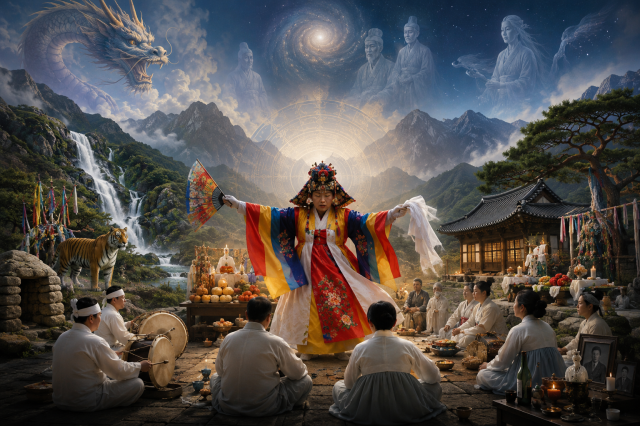
Korean shamanism serves as an ancient spiritual path that connects heaven and earth, mountains and rivers, ancestors and descendants, and the living and the dead. It is not merely superstition; rather, it embodies the Korean people's reverence for the sky, respect for nature, remembrance of ancestors, healing of troubled hearts, and prayers for community well-being.
The spirituality of Koreans has always been deeply intertwined with the heavens. In the myth of Dangun, Hwanin is the god of heaven, Hwanung descends from the sky, and Dangun is born at the intersection of heaven and earth, where the divine meets humanity. This is not just a founding myth; it reflects a belief that humans are not disconnected from the heavens but are meant to realize heavenly intentions on earth. Thus, Korea's ancient faith begins with a worldview that sees heaven, earth, and humanity as part of a unified order.
The essence of shamanism lies in this connection. Shamans serve as intermediaries who speak for the divine and articulate the pains of the people. Rituals, or gut, are not mere ceremonies; they are acts of unblocking, reconnecting, soothing grievances, and rebuilding fractured communities. For the sick, they offer healing words; for the deceased, they provide comfort; and for the living, they restore the strength to continue life.
Korean shamanism features a variety of deities, including mountain spirits, the Seven Stars, the Dragon King, and ancestral spirits. These are not separate religions but rather a web of beliefs woven into the lives of Koreans. Mountains symbolize the source of life, water represents abundance, stars signify destiny and longevity, and ancestors are the roots of family and community. Koreans perceive divinity within all these elements. Therefore, Korean shamanism embodies nature worship, ancestor veneration, community faith, healing religion, and a pathway to the divine.
Shamanism should not be dismissed lightly. Historically, it has sometimes been labeled as superstition and rejected during modernization as an outdated custom. However, beneath this surface lies a deep sense of life that has persisted through generations. When a child is born, prayers are offered to the Three Gods; when difficulties arise, ancestors are invoked; and when disasters strike a village, the community gathers to pray at the shrines. This has been a religion of life that predates academic doctrines.
One of the most significant characteristics of Korean shamanism is its affirmation of life. It does not shy away from pain, conceal tears, or bury death in silence. Rituals are filled with cries, songs, dances, food, prayers, and resolutions. Thus, Korean shamanism does not allow tragedy to end in tragedy alone. It soothes aggrieved souls, eases the hearts of the living, and enables them to eat, work, and dream again. This is the vitality of Korean shamanism.
Among the various spiritualities in Asia, Korean shamanism occupies a unique position. While Hinduism speaks of the vast order of the universe, Buddhism addresses the causes of suffering and the path to liberation, Taoism offers wisdom in nature and non-action, and Shinto discusses the kami within nature, Korean shamanism focuses on unblocking the paths between heaven, earth, and humanity. It is closer to the realities of life than abstract philosophy, nearer to tears than doctrine, and more aligned with human emotions and prayers than institutional practices.
Korean shamanism represents the oldest form of spirituality among the Korean people. It encompasses a reverence for heaven, a love and fear of nature, a commitment to remembering ancestors, and a shared sense of community pain. Therefore, understanding Korean shamanism is essential to grasping the religious sentiments, arts, folk songs, dances, rituals, village communities, and even today's cultural sensitivities of the Korean people.
The narrative of Korean shamanism will now unfold in three parts. The first will explore the beginnings of spirituality connecting heaven and humanity. The second will delve into everyday faith through rituals, mountain spirits, the Seven Stars, and ancestral deities. The third will address why shamanism continues to thrive in contemporary Korean society.
Korean shamanism is not a relic of the past. It is an ancient practice that has enabled Koreans to persevere through hardships. The spirituality that involves praying to the heavens, living grounded on earth, invoking the names of ancestors, and collectively addressing community pain is one of the deepest roots of Korean culture. This is why we must discuss Korean shamanism following the narrative of Shinto in Japan.
* This article has been translated by AI.
Copyright ⓒ Aju Press All rights reserved.