
SEOUL, June 26 (AJP) - From cradle to grave. That's the extent of the stock craze sweeping South Korea. Active trading accounts have increased by more than 10 million this year, with even toddlers joining the market as parents increasingly open brokerage accounts in their children's names as part of long-term financial planning.
Economists say the trend reflects a broader shift in how Korean households save and invest for the next generation, although some warn it could also deepen wealth inequality and expose families to greater market risk.
The number of active stock trading accounts across domestic brokerages reached 108.77 million as of Wednesday, up 10.49 million from the end of last year, according to the Korea Financial Investment Association on Friday. The increase has nearly matched the 11.72 million accounts added during all of last year.
An active stock trading account refers to a brokerage or securities savings account with at least 100,000 won ($73) in deposits and at least one transaction over the past six months.
With South Korea's population standing at roughly 50 million, the figures translate into more than two active stock accounts per person, underscoring how deeply this year's record-setting KOSPI rally has penetrated Korean households.
One of the clearest signs of the shift has been the surge in brokerage accounts for minors. Rather than relying solely on bank deposits, parents are increasingly using stocks as long-term savings vehicles for their children's education, housing and future inheritance.
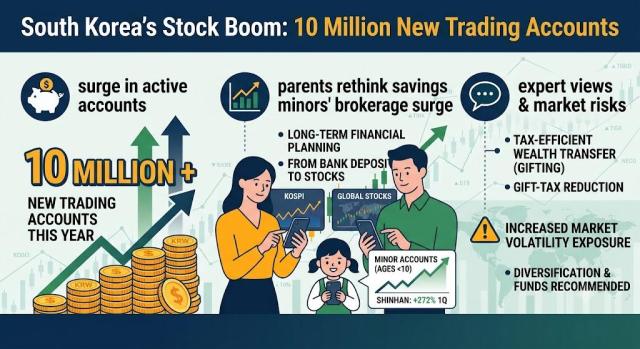
According to Daishin Securities, new accounts opened for children under age 10 jumped 119.2 percent between January and April. Shinhan Securities said brokerage accounts opened for minors in the first quarter rose 272 percent from a year earlier.
Woo Seok-jin, an economics professor at Myongji University, said the increase in children's brokerage accounts reflects not only growing interest in investing but also a tax-efficient way for families to transfer wealth. Assets that appreciate after being gifted can reduce future gift-tax burdens, making brokerage accounts an increasingly attractive estate-planning tool.
"Passing family wealth to the next generation this way isn't necessarily desirable from a social perspective," Woo said.
He added, however, that if wealth is going to be passed down anyway, channeling it into capital markets would be preferable to concentrating it in real estate or private businesses.
Woo said the trend could also help diversify South Korea's household wealth, which remains unusually concentrated in property. Real estate accounts for roughly 80 percent of Korean household assets, compared with around 50 percent in many advanced economies.
He cautioned, however, that Korean investors' heavy preference for direct stock investing also leaves households more vulnerable to market swings.
"Professional fund managers can rebalance portfolios when markets become volatile, but individual investors often cannot," he said. Broader participation through diversified funds, rather than individual stock picking, would be healthier for long-term investments made on behalf of children.

For a growing number of Korean parents, investing is becoming the new saving.
P.K.Y., a civil servant in his late 30s, has invested about 20 million won in a brokerage account opened in his son's name. "I wasn't trying to predict which market would perform best. My goal was simply to invest for my child's future over the long term," he said.
"My child won't need this money for another 10 or 20 years, and cash sitting in a bank account loses value over time because of inflation. My parents' generation could build wealth through bank deposits, but I don't think that's enough anymore."
Not every parent, however, views a child's brokerage account solely as a vehicle for higher returns. For some, it is also a way to teach children how money grows over time.
Lee S.H., a 41-year-old professor at a university in Seoul, said she sees opening a brokerage account for her child as both a savings strategy and an opportunity to teach financial responsibility.
"I hope my child grows up understanding that money can work for you over time," she said. "I want the money to work for my child, not just sit in a bank account."
Yang Jun-sok, an economics professor at the Catholic University of Korea, offered a more positive assessment, saying opening brokerage accounts for children is not fundamentally different from opening savings accounts if the money is genuinely intended to benefit the child rather than avoid taxes.
"In many ways, it's another tool for helping children prepare for the future," Yang said. "If the money is eventually used for college tuition or buying a first home, the higher long-term return potential can make it more beneficial than a traditional savings account."
Yang added that safeguards should nevertheless be considered to prevent parents from freely withdrawing money intended for their children while still allowing flexibility when families face legitimate financial needs before a child reaches adulthood.
Market conditions have also contributed to the surge in brokerage accounts.
Account openings typically accelerate during periods of strong initial public offering activity because investors in South Korea must open an account with the brokerage managing a share sale in order to subscribe for newly issued stock.
During the pandemic-era stock boom in 2021, blockbuster listings including SK IE Technology, SK Bioscience and SK Biopharmaceuticals helped lift the number of stock trading accounts by more than 22 million in a single year.
Although the IPO market has been relatively subdued this year, several newly listed companies have attracted strong retail demand after their shares tripled from their offering prices on debut.
Brokerage firms' aggressive account-opening promotions, together with campaigns encouraging investors to shift money back into domestic equities from overseas markets, have further fueled the rapid increase.
The surge in brokerage accounts suggests South Korea's stock boom is evolving into something larger than a market cycle. As households increasingly treat equities as savings accounts, inheritance vehicles and financial education tools, the country's long-standing preference for bank deposits and real estate may gradually be giving way to a more market-oriented model of household wealth.

Copyright ⓒ Aju Press All rights reserved.