
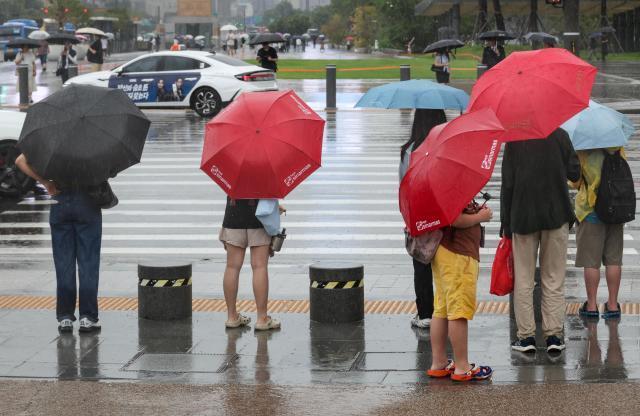
The Korea Meteorological Administration said the heaviest accumulation as of 3 p.m. was recorded at Geumnam in Hadong at 114.5 mm, followed by 99.5 mm on Mount Jiri in Sancheong and 92.5 mm in Hadong, with most key sites logging about 40 to 100 mm.
A heavy rain warning was in effect for Namhae, Sacheon, Goseong, Geoje and Tongyeong, with a lesser advisory covering the rest of the province. Farms and reservoirs strained by falling water levels and stunted crops were expected to gain substantial relief from the rain.
With more than 250 mm forecast for parts of Mount Jiri, the Korea Forest Service raised its landslide alert for the province, and disaster response headquarters shifted to emergency operations, tightening patrols of steep slopes and mountain valleys and clearing out campers.
The Gyeongsangnam-do Provincial Fire Headquarters said 13 incidents were reported across the province. A pile of rocks collapsed behind a temple in Hadong at 8:44 a.m., a utility pole toppled in Uiryeong at 9:05 a.m., and a basement flooded at a supermarket in Gimhae around 12:22 p.m., prompting drainage crews to respond.
The weather agency forecast a further 150 to 250 mm or more through Sunday, concentrated along the southern coast and near Mount Jiri. No casualties were reported.
AJP Takeaways
• South Gyeongsang province recorded as much as 114.5 mm of rain on Saturday, easing weeks of heat and drought that had strained farms and reservoirs.
• The Korea Forest Service raised its landslide alert to "caution" as more than 250 mm was forecast for parts of Mount Jiri.
• The provincial fire service reported 13 weather-related incidents, including a rockslide and a toppled utility pole, but no casualties.

Kim Dong-young
Kim Dong-young is a bilingual journalist at AJU Press (AJP), covering Korean tech, energy, and bio/pharma.
He reports from the field at events like CES and APEC, runs AJP's YouTube channels,
and is pursuing a master's at Sogang's MOT program.
Copyright ⓒ Aju Press All rights reserved.
Related News
-
 Rain Falls in Sinan After Drought Prayer at Seungbong Mountain
Residents of Amtae-myeon in Sinan County, weary from severe drought, received welcome rain just two days after holding a prayer for rain at the summit of Seungbong Mountain. Although the amount of rain is insufficient to fully alleviate the drought, it has provided a small sense of fulfillment for the residents as it moistens the parched land.According to Sinan County, as of noon on the 16th, the region recorded a maximum rainfall of 33mm in Aphaedo, with an average of 12.9mm across Sinan.On the 14th, residents held a rain prayer at the summit of Seungbong Mountain, the highest peak in the area at 355 meters above sea level, to seek relief from the drought.The event was attended by over 30 participants, including members of the Amtae-myeon Village Leaders Association, led by Yang Heung-gil, and representatives from 13 local social organizations. Faced with ongoing heat and a lack of rainfall, residents came together to address the challenges of securing drinking and agricultural water, as well as concerns over crop damage.The traditional ceremony featured offerings of purified water, rice, grains, and fruits. A symbolic performance called the 'Amtae Life Water Gathering' was conducted to express the community's unity and determination to overcome the drought by combining water that represents both domestic and agricultural needs.The prayer included heartfelt wishes for rain to replenish water sources and reservoirs, ensuring stable access to drinking and agricultural water for residents. Farmers also prayed for their carefully tended rice and crops to withstand the drought and yield a bountiful harvest.Yang Heung-gil, chairman of the Amtae-myeon Village Leaders Association, remarked, "I remember times in the past when we prayed for rain at the summit of Seungbong Mountain during droughts. I hope our wishes reach the heavens and bring us rain."Moon Seon-woong, chairman of the Sinan County Council's Operations Committee, stated, "The heavens must understand the frustrations of the residents," and promised to establish drought response measures at the county council level.Son Tae-won, head of Amtae-myeon, expressed, "The residents' earnestness in performing the ceremony at the rugged summit of Seungbong Mountain from dawn is significant. We will focus our administrative efforts on establishing permanent drought measures to ensure stable access to drinking and agricultural water."Just two days after the residents' heartfelt prayers, the long-awaited rain fell in the Sinan region on the 16th.By noon that day, Aphaedo received 33mm of rain, while the average rainfall in Sinan was recorded at 12.9mm. Although this amount is insufficient to resolve the prolonged drought, it has been a much-needed relief for the drying crops and parched land, bringing joy to residents and farmers alike.As of August, Amtae-myeon has accumulated 539.5mm of rainfall, which is only 48.6% of the average for this time of year. Consequently, the area is conducting campaigns to encourage residents to conserve domestic water and manage agricultural water as part of their drought response efforts.With the residents' urgent calls for rain echoing from the summit of Seungbong Mountain just two days prior, there is growing hope that this rain marks the beginning of sufficient additional rainfall to alleviate the drought.* This article has been translated by AI.
-
AI Requires Water as Well as Power, Says K-water CEO Yoon Suk-dae
AI is not just an industry that consumes electricity; it also requires water. Data centers, which operate numerous GPUs, need significant power and water for cooling, and the production of AI semiconductors also requires substantial water resources. Yoon Suk-dae, CEO of Korea Water Resources Corporation (K-water), is integrating AI into this process. The goal is to ensure a stable supply of water necessary for the AI industry while using AI to predict floods and droughts and to enhance the intelligence of water treatment plants and pipeline networks. We are entering an era of 'water for AI, and AI for water.' As we discuss the AI era, semiconductors and power are often the first topics that arise. AI data centers, which utilize high-performance GPUs, require a lot of electricity. However, electricity alone cannot sustain these data centers. High-performance semiconductors generate heat during continuous operations, necessitating cooling systems that consume significant amounts of water. Water is also crucial in semiconductor production. Ultra-pure water, which has had impurities removed, is used in the manufacturing process. To run AI models, GPUs are needed, and to produce GPUs, semiconductor factories are required. Both data centers and semiconductor factories depend on a reliable supply of electricity and water. This is where water policy intersects with advanced industrial policy. In this context, K-water's role is evolving. It is not just a public enterprise that supplies clean water and manages dams and rivers; it is increasingly recognized as a key infrastructure agency supporting the AI and semiconductor industries. As competition among AI data centers intensifies, the criteria for their locations are changing. Decisions about where to build data centers must consider not only power and communication networks but also cooling methods and water supply conditions. Similarly, semiconductor production facilities require a stable supply of industrial water. This is why K-water is gaining attention in the AI era. As the AI industry grows, the importance of securing and supplying industrial water reliably, as well as the need for reuse and efficiency, is becoming more pronounced. Water must now be viewed as a strategic resource that determines the competitiveness of a nation's advanced industries, beyond just a resource for daily life. Moreover, K-water is not stopping at merely supplying water; it is transforming water management itself through AI. Central to Yoon's vision are digital twin technology, AI water treatment plants, and smart pipeline management. By combining years of accumulated water management experience and data with AI, K-water aims to enhance predictive and decision-making capabilities. Results are already emerging. The AI water treatment plant was recognized as a global lighthouse in the water sector at the World Economic Forum in 2024, and in January of this year, approximately 9,000 visitors attended K-water's booth at CES 2026 in Las Vegas, leading to export and investment consultations worth about 132 billion won. The smart pipeline management technology also received an award at the Global Mobile Awards during Mobile World Congress (MWC) 2026. Yoon stated, “2026 will be the year we transition our AI-first strategy into action,” adding, “We will start with water management that protects public safety and support industry and the economy.” On one hand, K-water supplies water necessary for AI data centers and advanced industries, while on the other, it uses AI to manage South Korea's water more precisely. This is the intersection of water for AI and AI for water. The climate crisis is also changing water management practices. With repeated heavy rainfall and extreme droughts, it has become difficult to manage dams and rivers based solely on past experiences. K-water's digital twin-based water management creates virtual representations of actual dams and rivers, combining meteorological and hydrological data to simulate various scenarios in advance. When heavy rain is anticipated, the system analyzes various conditions, such as inflow and outflow rates at dams, to support operators' decision-making. The true value of AI lies not only in responding quickly after a disaster occurs but also in predicting risks in advance to minimize damage. AI is also being integrated into water treatment plants that produce the water we drink daily. K-water has been applying AI technologies such as autonomous operation, energy management, predictive maintenance, and intelligent imaging to major metropolitan water treatment plants. The goal is to develop an intelligent operating system that comprehensively analyzes water quality, flow rates, energy consumption, and equipment status to find optimal operating conditions. The same applies to pipelines. Smart pipeline management analyzes data on water pressure and flow rates in the water supply network to detect anomalies. As AI advances, this can evolve from responding to leaks after they occur to a preventive management approach that identifies unusual patterns in advance. The entire water management process, from dams to treatment plants to faucets, is becoming interconnected through data and AI. One of K-water's significant assets is the extensive water data it has accumulated over many years. Data on rainfall, river levels, dam inflow and outflow rates, water quality, water treatment plant operations, and pipeline networks is continuously generated. If this data is standardized and utilized for AI training, it can lead to the development of specialized water AI capable of predicting floods and droughts, optimizing water treatment plant operations, and detecting leaks. In the future, multiple AI agents may analyze weather, dam, water treatment plant, and pipeline data individually and collaborate to propose response strategies, evolving into an agentic AI water management system. The growth of the AI industry presents new challenges. While the demand for water from data centers and semiconductor factories is likely to increase, climate change is also increasing the volatility of floods and droughts. It is essential to maintain a balance between providing stable water for advanced industries and existing water for daily life and agriculture. Therefore, water policy in the AI era should not merely focus on increasing supply. It must also consider expanding the use of recycled water, improving water use efficiency, and regional water resource conditions. Data centers should not only base their location decisions on power availability but also take into account water supply and local environmental factors. The management of water resources will become a key factor in South Korea's AI competitiveness. The national transition to an AI-driven economy is not solely a software issue. To implement AI in reality, physical infrastructure such as semiconductors, data centers, power, and water is necessary. K-water's tasks are twofold: one is to ensure a stable supply of water necessary for AI industries like data centers and semiconductors, and the other is to manage South Korea's water more safely and efficiently through AI. Digital twin technology, AI water treatment plants, and smart pipeline management are making this second task a reality. In the industrial era, roads, ports, and power networks determined national competitiveness. In the AI era, data centers, semiconductors, and water are emerging as new national infrastructure. The two lifelines of AI civilization are electricity and water. For South Korea to become a powerhouse in AI, it is not enough to secure GPUs and data centers alone. It must also prepare the electricity and water needed to operate them reliably. This is why K-water is being recognized as a key infrastructure agency supporting South Korea's AI industry, beyond just being a water management public enterprise. Yoon Suk-dae, CEO of K-water, is leading the transition of K-water to AI through digital twin technology, AI water treatment plants, and smart pipeline management. He is focusing on providing stable water supply for advanced industries such as semiconductors and data centers while managing floods and droughts in response to the climate crisis. He is establishing an 'AI-first' water management system that supplies water to the AI industry while utilizing AI for water management.* This article has been translated by AI.
-
Sensl's 'Mute Cream Perfume': A Convenient Daily Fragrance
Mornings can be hectic, making it easy to overlook makeup and fragrance while preparing for work. As a result, many find themselves reaching for their cosmetic pouches at the office.Currently, I carry Sensl's 'Mute Cream Perfume' in my pouch. True to its name, this cream-based fragrance is small and lightweight, making it easy to carry. Packaged in an aluminum tube similar to hand cream, it is less likely to break if squeezed or dropped. It can be attached to a keyring for quick access when needed.What I appreciated most was its application method and formulation. Instead of spraying, you simply apply it to your desired area. This allows for discreet use without overwhelming those around you, making it easy to add a touch of fragrance whenever you like. The formulation is also impressive. The transparent cream applies smoothly, defying expectations of heaviness or stickiness. According to the product description, it features a 'silk balm texture' that holds the fragrance well.When applied, it melts into the skin with body heat, leaving no sticky or greasy residue. After applying, my wrists feel comfortable, allowing for easy reapplication throughout the day.Above all, it stays true to the essence of a fragrance. The 'scent' is well-executed. My go-to variant, 'First Minute,' releases a sweet and fresh aroma of orange and peach upon application. The description of 'a fresh floral for the first moments of the day' is spot on.As time passes, the scent evolves into a fresh grass and subtle floral aroma reminiscent of walking through a rain-soaked garden. Overall, the fragrance is light and refreshing, making it suitable for those new to using perfumes.For anyone looking to add a small change to their daily routine or enjoy a light fragrance, Sensl's Mute Cream Perfume is an excellent choice.* This article has been translated by AI.