

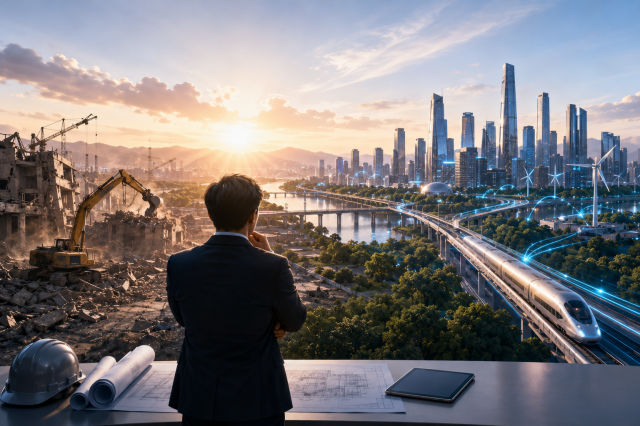
South Korea is not living in ordinary times. Political battles continue between parties, and ideological disputes are unending. However, the world is moving at a much faster pace. The generative AI revolution and the AI semiconductor revolution, described as the largest civilizational shift since the Industrial Revolution, have begun, rapidly changing the criteria that determine a nation's rise and fall.
In such an era, can we still discuss the future using the political grammar of the past?
Recently, author Yoo Si-min's advice to President Lee Jae-myung sparked considerable debate. His metaphor of 'expansion versus reconstruction' has led to various interpretations within and outside political circles. The president can be criticized, and it is a fundamental principle of democracy that those in power should be held to stricter scrutiny. However, when considering the historical challenges South Korea faces, this debate should extend beyond internal party lines or political rhetoric to address how to design the nation's future.
I believe that South Korea requires national innovation closer to 'reconstruction' than 'expansion.' This reconstruction does not mean overturning the constitutional order or denying democracy. It suggests redesigning a new national system that aligns with the AI civilization era, based on the achievements South Korea has built through industrialization and democratization.
The world is already creating a new order centered around AI. Semiconductors have become national security assets, and data is now a strategic resource more valuable than oil. Robotics, autonomous driving, biotechnology, quantum computing, space industries, and energy technology have emerged as key areas that determine national competitiveness. Competition among companies has expanded to competition among nations, and the integration of economy, security, diplomacy, and industry into a single strategy has become the norm.
Geopolitical instability has compounded these challenges. Since the return of President Donald Trump, countries have strengthened strategies prioritizing their own industries and security. Protectionism and supply chain restructuring have become commonplace, while regions continue to experience religious and ethnic conflicts and territorial disputes. The Korean Peninsula also faces the serious reality of North Korea's advancing nuclear and missile capabilities.
In this context, South Korea must not repeat past successes. Instead, it needs a national overhaul suitable for the new era.
First, political redesign is necessary. Politics should evolve beyond a battleground for ideological victories to become a platform for enhancing national competitiveness. Political parties are public institutions for the people, and the ruling party must design policies for the entire nation, not just specific support bases. Conversely, the opposition must also transform into a responsible party that contemplates national strategy beyond mere opposition.
Second, governance and administrative innovation are required. In the AI era, government should not merely be an organization that issues permits and regulations; it must become a digital government that designs policies based on data and provides faster and more accurate services to citizens. Administration should enhance efficiency and transparency, while the public sector should leverage AI to improve citizens' quality of life.
Third, a paradigm shift in the economy is essential. The government must lead strategic investments and institutional reforms for future industries, while companies should boldly challenge future growth engines such as AI, semiconductors, biotechnology, robotics, and the space industry, moving beyond mere manufacturing competitiveness. Households must also equip themselves with lifelong learning and digital skills to adapt to the changing labor market.
Fourth, the operation of society must change. Labor groups should consider both productivity and innovation, while businesses must practice sustainable management that fulfills social responsibilities. Civil society organizations should grow into partners that propose policy alternatives rather than merely monitoring. Universities and research institutions should become the brains behind national future strategies, and the media should play a role in guiding national discussions rather than amplifying conflicts.
Ultimately, when the government, businesses, households, and political, labor, and civil society change together, South Korea can achieve a new leap forward. This is not just the task of a single administration but a historical challenge for the entire nation.
Yoo Si-min's advice is worth listening to. However, now is not the time to dwell on the metaphor of 'expansion versus reconstruction.' The more fundamental question is whether South Korea is preparing a new blueprint for the transition to an AI civilization. If the existing structure is inadequate to accommodate the future, bold innovation is not an option but a necessity.
South Korea has repeatedly turned crises into opportunities. It transformed the ruins of war into an industrial nation, connected industrialization with democratization, and became a global leader in the information and communication revolution. Now, we face another monumental civilizational shift.
Reconstructing the nation does not mean denying the past. It is about designing the future based on past achievements. What is needed now is not the victory of a particular faction but the victory of the nation. What is required is not politics that seeks to undermine opponents but politics that aims to rebuild South Korea.
Beyond the debate of expansion versus reconstruction, we must now collaboratively draw the blueprint for the future of South Korea. The AI era presents both a crisis and an opportunity. If we can seize this opportunity, South Korea can once again achieve a significant leap at a pivotal moment in world history.
* This article has been translated by AI.
Copyright ⓒ Aju Press All rights reserved.