
Following large-scale personal data breaches at Coupang and Tving, users are changing how they respond to security threats. Instead of relying solely on corporate measures, more individuals are proactively checking for data leaks and changing their passwords to manage their personal information directly.
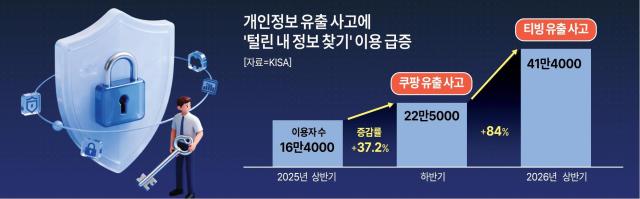
According to the Korea Internet & Security Agency (KISA), the number of users utilizing the 'Find My Stolen Information' service reached 414,000 in the first half of this year. This marks an approximately 84% increase from the second half of last year (225,000 users) and a 2.5-fold rise compared to the first half of last year (164,000 users).
This figure is the second highest since the service began, following the first half of 2023, which saw 448,000 users. The spike at that time was largely due to the service being promoted through major YouTube channels and television programs. In contrast, the increase in the first half of this year reflects heightened anxiety and awareness among users following consecutive major data breaches at Coupang and Tving.
Indeed, the rise in users in the second half of last year also followed the Coupang data breach, and the significant increase in the first half of this year coincided with Tving's large-scale data leak. As such breaches continue to occur, there is a growing sentiment that users must take responsibility for checking their accounts and enhancing their security, rather than viewing data protection as solely a corporate responsibility.
The 'Find My Stolen Information' service allows users to check whether their usernames and passwords have been illegally circulated on the dark web. While it does not confirm if data has been leaked from specific companies, the surge in users during major breaches indicates a rising social awareness of data security issues.
Experts in the security industry point out that the impact of recent data breaches goes beyond just the exposure of names and contact information. If leaked account information is used across multiple sites, the risk of cascading hacks increases significantly.
Many users employ the same username and password across various platforms, raising the likelihood of financial losses due to account theft and spam.
In response, KISA recommends that users check for potential data leaks using the 'Find My Stolen Information' service and immediately change passwords for all sites where their accounts are used if a breach is suspected. They also advise enabling two-factor authentication (2FA), logging out from all devices, and activating login alerts as additional security measures.
Park Chun-sik, a former professor of cybersecurity at Ajou University, stated, "It is a fundamental duty of companies to manage personal data securely, and they should be held accountable in the event of a breach." However, he added, "It is difficult to fully protect personal data through corporate security efforts alone."
He emphasized that users must recognize personal information as a valuable asset and develop habits to protect it, advising against using the same password across different sites and making two-factor authentication a regular practice.
* This article has been translated by AI.
Copyright ⓒ Aju Press All rights reserved.