

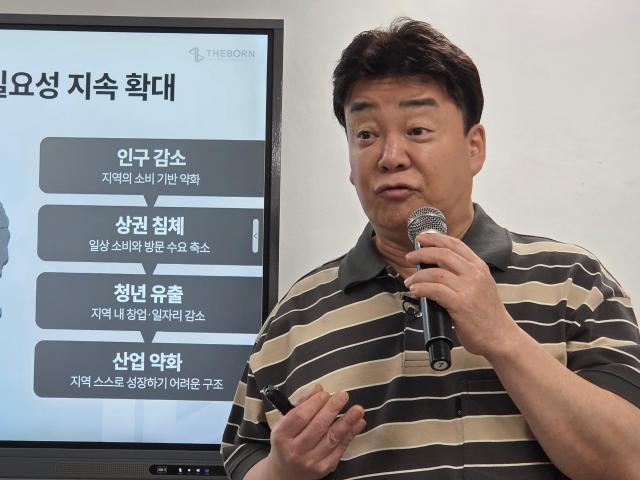
Baek Jong-won speaks at a press conference at the Dabong Food Industry Development Center in Yeosan, Chungnam. [Photo by Jo Jae-hyung]
"It is important to create reasons for people to intentionally visit the area," Baek Jong-won, CEO of Dabong Korea, emphasized during a media briefing at the Dabong Food Industry Development Center in Yeosan, Chungnam, on June 26. He stated that revitalizing a region is not about erecting costly structures to create 'photo spots.'
After a year of avoiding public appearances due to various controversies, Baek presented a blueprint for a regional development ESG (Environmental, Social, and Governance) initiative centered around Yeosan Market. His strategy focuses on utilizing local specialties and unique stories. Just as Andong is known for its salted mackerel and Hoengseong for its beef, he believes that distinctive content exclusive to a location can serve as the foundation for tourism, even without flashy attractions.
Baek defined this regional development not merely as corporate social responsibility but as a core long-term growth driver for the company. He explained, "Food companies invest heavily in menu research and development (R&D), and we can revitalize regions while accumulating data on local specialties and testing them on-site. The data we gather for menu development becomes a tremendous asset for the company."
Yeosan Market is the first stage for Baek's regional development plan. Once attracting only 10 to 20 visitors a day, the market has seen over 10 million visitors since its reopening in 2023 after renovations that included menu development and infrastructure improvements. Inside the market, a mix of aging buildings and newly renovated food spaces can be seen.
At 'Shin-gwang Butcher Shop,' which has revived a sign from a closed butcher shop, a young owner, Kim Guk-heon, was hard at work. A former contestant on an idol audition program, Kim entered the food industry through a cooking competition and settled in Yeosan Market. He stated, "Thanks to the three months of training I received from Dabong Korea on everything from ingredient preparation to management and hygiene, I was able to stand on my own, and they continue to support me in all aspects of operation." Recently, he has also seen a steady influx of Chinese tourists coming to taste specialty cuts after watching online videos.
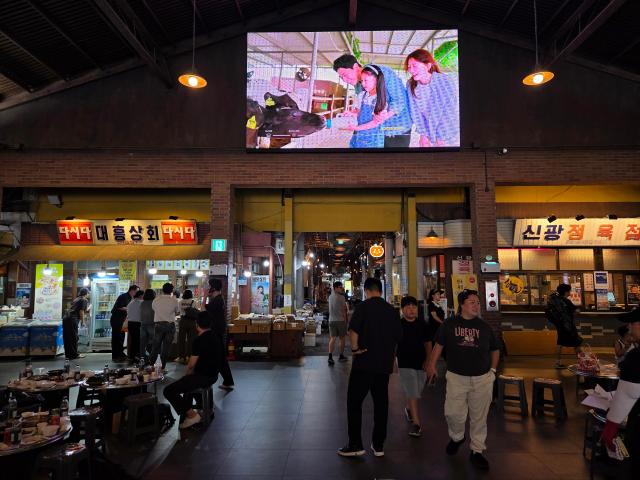
Interior view of Yeosan Market. [Photo by Jo Jae-hyung]
At one corner of the market, a 'Alley Brewery' was producing makgeolli (Korean rice wine) using 100% Yeosan rice. Park Yu-deok, who started his business in Daejeon, settled in the Yeosan Market project and is now exporting premium makgeolli to the United States. Park stated, "To overcome the short shelf life of fresh makgeolli and the limitations of cold distribution, I developed a sterilized takju (unfiltered rice wine) that can be distributed at room temperature. This place is not just a sales point but a continuous R&D space for testing products."
Future regional development plans aim to evolve from large-scale direct investments like those in Yeosan Market to a 'public-private partnership consulting model.' A Dabong Korea representative noted, "We will not simply replicate the Yeosan Market experience but will create customized models based on each region's unique flavors, stories, industries, and spaces." Under this structure, local governments will establish infrastructure while Dabong Korea will handle menu development, merchant training, and hygiene consulting tailored to the market.
Dabong Korea is currently working on transforming the 30,000-pyeong site of the long-abandoned Chungnam Textile in Yeosan into a complex content hub, creating a specialized street for gopchang (grilled intestines) at Sapgyo Market, and establishing a traditional liquor experience complex. They are also planning to introduce the successful Yeosan Market model to the site of the old Gyeonggi Silk Factory in Yeoju. Baek concluded, "The ultimate goal of regional development is to make money. I want to grow together with the region while earning praise and profits."
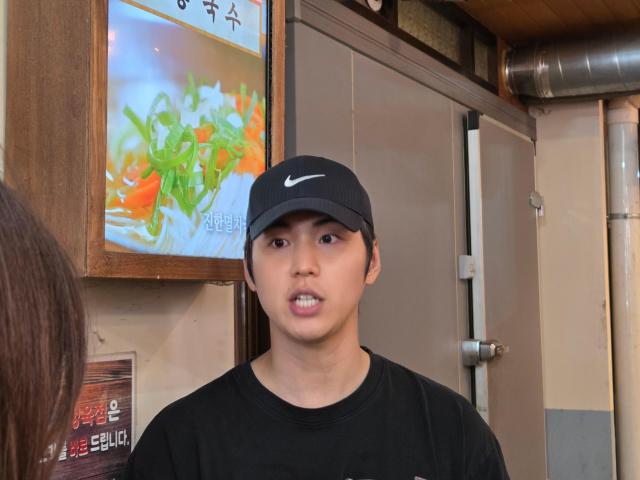
Kim Guk-heon, owner of Shin-gwang Butcher Shop, speaks with reporters. [Photo by Jo Jae-hyung]
* This article has been translated by AI.
Copyright ⓒ Aju Press All rights reserved.