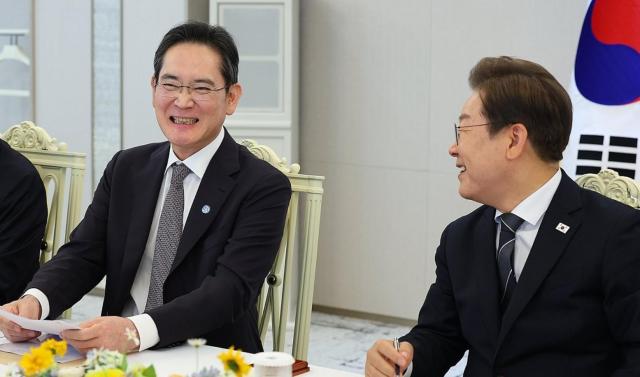
The map redrawing will be announced at 2 p.m. at the presidential office of Cheong Wa Dae, where President Lee Jae Myung will be joined by Samsung Chairman Lee Jae-yong, SK Group Chairman Chey Tae-won and ministers overseeing industry, science, energy, climate and land to unveil a coordinated public-private push combining corporate investment with government commitments on power, water, transport infrastructure and regulatory support for the mega-scale industrial overhaul.
The event, dubbed the "National Report on Korea's Three Mega Projects," will feature policy presentations by the ministries before Samsung and SK unveil their investment plans, followed by a discussion on implementing the strategy.
The centerpiece is expected to be the creation of a second semiconductor manufacturing belt in the southwestern Honam region, complementing the Yongin chip cluster under development south of Seoul. The government has stressed the new cluster is intended to expand, not replace, the Yongin project while easing mounting land, water and power constraints around the capital region.
Samsung and SK are expected to unveil separate 10-year investment roadmaps spanning semiconductors, gigawatt-scale AI datacenters and physical AI. Local media estimate the combined investment could top 1,000 trillion won, although officials have stopped short of confirming the figure.
Ahead of the announcement, Lee held separate meetings with Samsung Chairman Lee and SK Chairman Chey to discuss cooperation on semiconductors, artificial intelligence, renewable energy, employment and regional investment.
The government is expected to pair the corporate spending with fast-tracked permitting, licensing reforms and expanded industrial infrastructure, seeking to channel the AI-driven semiconductor boom into a broader redrawing of South Korea's industrial map and reinforce its position at the center of the global AI supply chain.
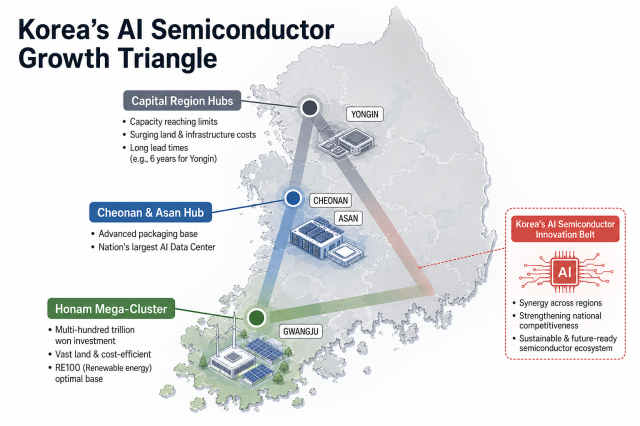
Presidential Chief of Staff for Policy Kim Yong-beom last week has described the initiative as a joint government-business strategy centered on semiconductors, gigawatt-class AI datacenters and physical AI. While declining to confirm reports of investment commitments exceeding 1,000 trillion won, Kim hinted that "the numbers involved will be unprecedented."
The initiative represents a strategic shift beyond expanding chip production, seeking to use the AI boom to reshape South Korea's industrial map, disperse advanced manufacturing beyond the Seoul metropolitan area and reinforce the country's position at the center of the global AI semiconductor ecosystem.
Copyright ⓒ Aju Press All rights reserved.