

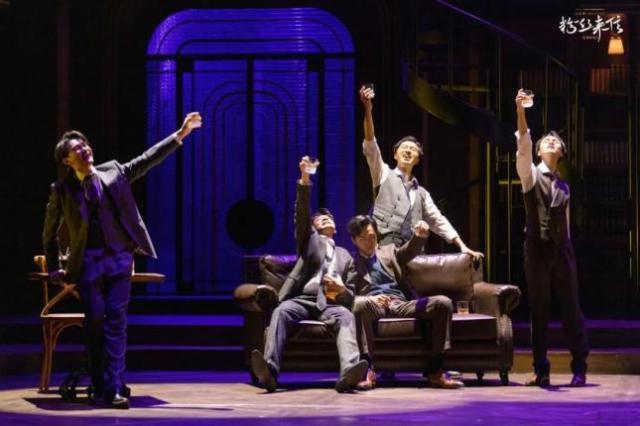
Nearly half of the musicals performed in China are licensed from Korea, highlighting the growing popularity of K-Musicals in the local market. Once dominated by Western licensed productions, the Chinese musical scene is rapidly embracing Korean original works as a new wave of Hallyu content.
On June 29, the South China Morning Post reported that "despite cultural restrictions, K-Musicals resonate more easily with Chinese audiences due to cultural similarities compared to Western musicals."
A prime example is the musical 'Fan Letter,' set during the Japanese colonial period. The production, which premiered in Korea in 2016, was recognized for its artistic merit and was reimagined for Chinese audiences in 2022.
The Chinese version of 'Fan Letter' shifts the setting from Seoul to Shanghai, yet retains the original storyline about the struggles of protagonists living under Japanese colonial rule in the 1930s, garnering positive responses from local audiences. Since its debut in China in 2022, 'Fan Letter' has been performed in over ten cities annually, expanding its fan base.
Other K-Musicals, such as 'Mia Familia' and 'Mio Fratello,' have also enjoyed consistent success since their respective premieres in China in August 2020 and April 2021.
A research paper published in the April issue of the Chinese journal 'Exploration of Humanities and Social Sciences' identified cultural commonalities as a key factor in the success of K-Musicals in China. The study noted, "China and Korea share cultural traditions, social values, and aesthetic sensibilities as part of the East Asian cultural sphere, which has facilitated the localization of musicals that originated in the West."
As a result, the localization process often involves adapting historical and cultural contexts to fit Chinese circumstances. For instance, 'Fan Letter' was relocated from Seoul to Shanghai, while the musical 'Goddess is Watching' underwent a complete reconfiguration of its historical and spatial background when adapted for a Chinese audience.
The K-Musical industry's ability to thrive in China can also be attributed to its relative immunity from the cultural restrictions imposed by the Chinese government. Although the government has not officially announced a ban on Korean content following the deployment of the THAAD missile defense system, Korean films, dramas, and K-pop artists have faced significant limitations in their activities in China. In contrast, musicals have experienced less direct regulation and have steadily expanded their presence in the Chinese market over recent years.
The Chinese musical market itself is also growing rapidly. According to the China Association of Performing Arts, the number of musical performances across the country reached 19,700 last year, an increase of over 15% from the previous year, with audience numbers surpassing 8.18 million. Approximately 80% of attendees are under the age of 35.
Industry experts anticipate that cooperation in the musical sector will become more active, following an agreement during this year's China-Korea summit to gradually expand cultural exchanges between the two countries.
Recently, the presence of Chinese original musicals in the Korean market has also been increasing. In Seoul's Daehakro district, licensed Chinese works such as '#0528' and 'Butterfly Transformation' have received positive responses, and this year, the Daegu International Musical Festival invited the original musical 'Boook,' based on the classic Chinese novel 'Dream of the Red Chamber.'
* This article has been translated by AI.
Copyright ⓒ Aju Press All rights reserved.