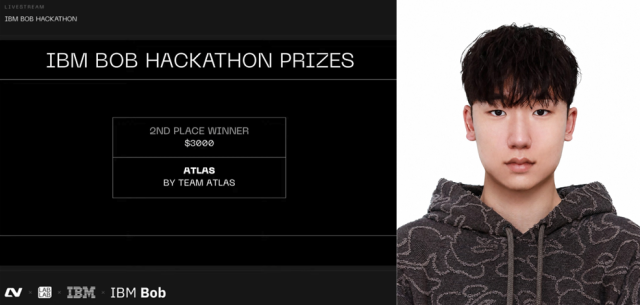
SEOUL, June 29 (AJP) - A student from Kookmin University in Seoul was placed second at the IBM Bob Hackathon on June 11 in a global artificial intelligence competition that drew more than 5,600 participants from around the world and challenged them to build working software in 48 hours, the university announced Monday.
Kookmin University (KMU)'s AI Department student Kim Chan-joong competed alone in the hackerthon. The competition, jointly organized by IBM and NativelyAI, the company that runs the AI hackathon platform lablab.ai, received 503 project submissions from 1,672 teams in total.
IBM Bob, the tool at the center of the competition, is an AI development agent that works directly inside a software developer's coding environment. Unlike conventional code assistants that respond to isolated queries, Bob reads an entire repository's context, understands developer intent across a codebase, and helps users move from an initial concept to a working application.
Kim's submission, a web application named Atlas, targeted a common frustration in software development, which is making sense of an unfamiliar codebase. Large software projects routinely contain hundreds of folders and files, making it difficult for a new developer to grasp the overall structure at a glance. Atlas solves this by rendering a GitHub repository as a city map. GitHub is a widely used platform where developers share and store code publicly. In Atlas, top-level folders appear as color-coded districts. Individual files become buildings, their size determined by the volume of code they contain. Key files are highlighted like landmarks.
The tool requires no installation. A user pastes the web address of a public repository into Atlas and the map is generated automatically, with layout calculations processed on the server. The result appears directly in a web browser. The finished map supports zooming, panning, hover tooltips displaying individual file details, and a full-image download.
"I wanted to move away from the kinds of topics AI projects tend to gravitate toward and try something fresh," Kim said. "I had always found it took too long to get a sense of how an unfamiliar codebase was organized, and I wanted to solve that discomfort in a way that felt as intuitive as reading a city map."
Kim said narrowing the project's scope early was a key factor in the result. "I cut back on ambition and focused on getting the core right. I want to use this experience as a foundation and keep pushing into new territory."
Copyright ⓒ Aju Press All rights reserved.