
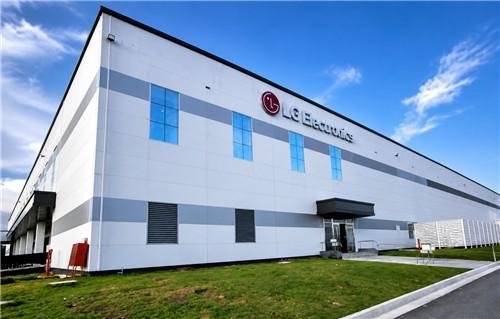
The factory in Parana state started operations on Thursday, the company said Sunday, becoming its second production base in Brazil after the Manaus plant established in the Amazonas state in 1996. The site can turn out about 600,000 refrigerators a year.
The plant runs on a smart-factory system built around artificial intelligence and industrial robots, using vision-AI inspection and digital-twin technology to detect faults on the line before they arise, while multi-joint robots cut manufacturing costs and improve worker safety.
The refrigerators are tailored to Brazilian homes, carrying a dual-voltage function suited to a grid that runs at 127 volts in some regions and 220 volts in others, along with sterilization and rapid-cooling features aimed at the country's hot, humid climate and home-party culture.
LG plans to use Parana as an export hub reaching Argentina, Uruguay and other South American markets.
"Building on the expanded capacity from the new Parana plant, we will secure stable supply and offer locally tailored appliances to raise our standing in Brazil and across Latin America," said Baek Seung-tae, head of LG's HS division.
AJP Takeaways
• LG Electronics has brought its second Brazilian plant online, shifting refrigerators for the region from imports to local assembly and shortening its supply lines into Latin America.
• The Parana site anchors a "Global South" strategy — premium goods for developed markets, volume-zone products for emerging ones — after revenue across India, Brazil and Saudi Arabia rose more than 20 percent last year.
• For Korea's flagship appliance maker, the plant is as much a hedge against saturated Western demand as a beachhead for exports to Argentina, Uruguay and beyond.

Kim Dong-young
Kim Dong-young is a bilingual journalist at AJU Press (AJP), covering Korean tech, energy, and bio/pharma.
He reports from the field at events like CES and APEC, runs AJP's YouTube channels,
and is pursuing a master's at Sogang's MOT program.
Copyright ⓒ Aju Press All rights reserved.
Related News
-
 LG Electronics Hosts Home Lifestyle Fair Featuring 1.1 Million Home Enthusiasts
At the 'Lifezip' exhibition held at COEX in Samseong-dong, Seoul, visitors were greeted by rooms decorated with distinct themes. From vibrant artworks and lush plants to cozy rooms filled with charming decor, and workspaces equipped with instruments, speakers, and lighting, the exhibition featured five themes: 'Rest, Creation, Relationships, Collection, and Exploration.' The spaces felt like a personal home, inviting guests to explore.Attendees moved seamlessly from room to room, admiring how furniture and decor complemented each other, often pausing to take photos in their favorite spaces. The 'Exploration House' was designed like a personal workspace, complete with a wooden desk, keyboard, plants, and walls adorned with photos and posters, reflecting an individual's unique taste. Touring the exhibition felt akin to visiting someone's home to admire their interior design and personal style.The event, titled '2026 House Archive: Home Digging Fair,' is LG Electronics' first standalone home lifestyle fair under the Lifezip community. Running from August 13 for four days, the fair attracted approximately 3,000 visitors on its opening day, with LG Electronics anticipating around 13,000 attendees throughout the event.The 670-pyeong exhibition space was divided into five 'houses' representing the themes: 'Rest House' for creating personal routines, 'Creation House' where work and play blend, 'Relationship House' for social gatherings, 'Collection House' for favorite items, and 'Exploration House' connecting with nature. This reinterprets the concept of a home beyond just a place to sleep, encompassing spaces for relaxation, creativity, socializing, and discovering new hobbies.As visitors moved through the exhibition, the eclectic tastes of home enthusiasts captured attention. Tables filled with ceramics, art prints, stationery, plants, and crafts showcased the diversity of items. About 70 brands participated, with over 30 Lifezip members selling items they created or collected at table markets. LG Electronics aimed to create an event where users, who have been active in the online community, could also participate as content creators offline.In addition to visual displays, interactive experiences were available throughout the venue. The 'Rest House' offered experiences with scents, tea, and sleep, along with a meditation space. Many attendees were seen sitting on cushions, participating in meditation programs. There was also a space to try out massage devices for body posture and shape management.Notably, LG Electronics' products were subtly integrated into the exhibition rather than prominently displayed. Unlike typical appliance shows where products are lined up for demonstration, LG's offerings were naturally placed throughout the venue.A prime example is the 'LG Tiun Mini,' a plant-based home appliance positioned among yellow flowers and green plants, emphasizing the lifestyle of nurturing plants at home. Other products, such as the portable lifestyle screen 'LG StanbyME2 Max,' wireless speaker 'LG Xboom 360,' and table-type air purifier 'LG PuriCare AeroFurniture,' were showcased in environments resembling real living spaces. This approach allowed visitors to discover products organically while exploring tastefully decorated homes.This strategy aligns with how LG Electronics engages customers through Lifezip. Instead of showcasing appliances first and encouraging purchases, the focus is on understanding what people want to do at home, their preferred spaces, and how they relax and enjoy life.At the heart of this initiative is the Lifezip community. Launched in 2022 with 450 members, Lifezip has grown to 1.1 million members and approximately 300,000 monthly active users, sharing various home activities like cooking, interior design, gardening, and pet care.Home enthusiasts who initially connected online are now transitioning to offline interactions. LG Electronics opened its first pop-up store, 'Lifezip Housewarming,' in Seongsu-dong, Seoul, in 2024, followed by participation in the Seoul Living Design Fair last year. This year, the fair has expanded to more than double the size of the previous pop-up store, creating a community where users who shared their tastes online can now participate as sellers, while other members explore and purchase their creations in a physical space.Jae-woong Jeong, head of LG Electronics' Customer Value Innovation Division, stated, "Lifezip is expanding customer touchpoints through various offline activities, from online communities to pop-up stores and this fair. We will continue to create a differentiated customer experience while building a new home lifestyle culture with our customers."* This article has been translated by AI.
-
President Lee Confirms Plans for Constitutional Amendment to Introduce Four-Year Term Limits
President Lee reaffirms plans for constitutional amendment to decentralize power President Lee Jae-myung has reiterated his proposal for a constitutional amendment aimed at decentralizing presidential powers and introducing a four-year term limit or re-election system. He stated that discussions on the amendment should be led by the National Assembly based on bipartisan agreement, and he is open to shortening his term if necessary to facilitate the amendment's passage. On August 14, President Lee posted on X (formerly Twitter), "The majority of the public agrees that our constitution, which has been in place for 40 years, is outdated and needs to be amended. If an amendment is to be made, it is preferable for the specific content to be determined through bipartisan agreement in the National Assembly." He outlined specific directions for the amendment, including enshrining the spirit of the May 18 Democratic Uprising and the Busan-Masan Democratic Movement in the preamble, adjusting the powers of the president and the National Assembly, introducing a four-year term limit or re-election system for the president, and strengthening local autonomy and citizens' basic rights. Research Institute calls for reflection on An Sang-ho's pro-Japanese actions The National Issues Research Institute has addressed the controversy surrounding actor Ha Young's great-grandfather, An Sang-ho, stating that his pro-Japanese actions are clear and calling for historical reflection and remorse. The institute clarified that An Sang-ho's exclusion from the "Pro-Japanese Personnel Dictionary" does not negate or absolve his pro-Japanese activities. On August 14, the institute issued a statement saying, "The fact that he is not listed in the Pro-Japanese Personnel Dictionary does not mean he had no pro-Japanese actions." The National Issues Research Institute is a civic organization that published the dictionary in 2009. The institute explained that it released the statement in response to requests from citizens and members to clarify the facts amid growing media and online discussions about An Sang-ho's pro-Japanese actions and the behavior of his descendants. Binance launches perpetual futures for Korean stocks, blocks local accounts Global cryptocurrency exchange Binance announced on August 14 the launch of perpetual futures that allow investments in companies such as Naver, LG Electronics, Samsung Electro-Mechanics, and Hanmi Semiconductor with leverage of up to 20 times. However, accounts verified under Korean names are currently blocked from accessing these products. According to the cryptocurrency industry, Binance began trading perpetual futures linked to domestic stocks, including Naver, LG Electronics, Samsung Electro-Mechanics, Hanmi Semiconductor, and the KODEX 200 ETF, on this date. These products can be traded 24/7 with up to 20 times leverage. While these products were previously available to Korean accounts, access has now been restricted. Industry sources believe this decision was made independently by Binance, not at the request of Korean financial authorities. The newly listed products track the prices of four stocks listed on the Korean stock market and the KODEX 200 ETF, allowing traders to bet on price fluctuations without holding the actual stocks, with settlements made in the stablecoin Tether (USDT). Democratic Republic of Congo reports Ebola death in new area, raising concerns In the Democratic Republic of Congo, a new area that had not previously reported Ebola cases has now seen a death, raising concerns about the spread of the virus. On August 14, Jean Kaseya, Secretary-General of the Africa Centers for Disease Control and Prevention, held a virtual press conference on August 13 (local time) and announced that a man who died in the northeastern province of Ituri tested positive for Ebola. Ahn Song-yi achieves milestone of 300 tournament cuts in KLPGA Ahn Song-yi has made history by becoming the first player in the Korea Ladies Professional Golf Association (KLPGA) Tour to pass the cut in 300 tournaments. She also expressed her ambition to challenge for the record of the oldest winner in the KLPGA Tour. On August 14, Ahn completed the second round of the KLPGA Tour Mediheal-Korea Daily Championship at the Myungseong Mountain Course (par 72) in Pocheon with a score of 3-under 141, placing her in a tie for 19th. She improved her score by two strokes from the previous day to make the cut. Broadcasting Commission reverses sanctions against fact-checking organization, issues apology The Broadcasting and Communications Commission has partially reversed sanctions against the fact-checking organization Party after a re-examination and issued an apology. This decision came after it was determined that there was no evidence of misuse of funds outside of labor costs. On August 14, the commission visited the social cooperative Party to express its apologies for the difficulties faced during the audit and administrative sanction process. Previously, the commission had announced in 2024 that an audit found evidence of misuse of funds by Party, which was an indirect beneficiary of the fact-checking project. As a result, it had canceled the 2025 grant decision and imposed a fine. OpenAI's annual revenue projected to exceed $40 billion, doubling in a year OpenAI's annual revenue has reportedly surpassed $40 billion. On August 14, it was reported that OpenAI's annual revenue has exceeded $40 billion, doubling from approximately $20 billion at the end of last year. The company's revenue has grown rapidly in recent months, partly due to the success of its coding models, as well as growth in subscription sales and its nascent advertising business. The consumer segment, which is its core business, is also said to be continuing to grow.* This article has been translated by AI.
-
Government and Telecom Companies Strengthen Measures Against Illegal Spam Ahead of Chuseok
The government has reviewed the implementation of measures to prevent illegal spam in collaboration with the three major telecom companies and bulk messaging service providers, discussing enhanced spam blocking strategies in preparation for the Chuseok holiday.On August 14, the Ministry of Science and ICT and the Korea Communications Commission held the sixth plenary meeting of the Public-Private Council on Illegal Spam in Seoul, where they assessed the progress of specific tasks and gathered feedback on efforts to combat illegal spam from private sector participants.The meeting was co-hosted by the Korea Communications Commission and the Ministry of Science and ICT, with participation from relevant agencies such as the Personal Information Protection Commission, the National Police Agency, and representatives from SK Telecom, KT, LG Uplus, and Samsung Electronics.During the meeting, the commission reviewed five key strategies and twelve specific action items outlined in the Comprehensive Plan for Preventing Illegal Spam.The commission encouraged active participation from service providers in areas such as the implementation of the Enforcement Decree of the Act on Promotion of Information and Communications Network Utilization and Information Protection, the disclosure of spam reporting statistics, and the sharing of illegal spam sender numbers. They also emphasized the need for enhanced AI filtering and related measures.The Ministry of Science and ICT urged the application of a blocking system for illegal spam sent from invalid numbers, improvements in blocking overseas spam through cooperation with foreign messaging service providers, and thorough management and supervision of bulk messaging clients by domestic and international message relay services.In particular, service providers committed to strengthening their efforts to prevent user harm by raising awareness and blocking potential illegal spam ahead of the Chuseok holiday in September.Shin Young-kyu, Director of the Broadcasting and Communications User Policy Bureau at the Korea Communications Commission, stated, “We aim to swiftly finalize improvements to related systems so that citizens can enjoy digital media services without worrying about illegal spam.” He also urged the three major mobile carriers and device manufacturers to enhance their efforts in detecting and blocking illegal spam using AI technology.Nam Seok, Director of Communication Policy at the Ministry of Science and ICT, remarked, “We will work harder to eradicate illegal spam through the discussed blocking system for invalid numbers and improvements in blocking overseas spam.”According to the government, the total number of spam reports and detections in the second half of last year was 23.67 million, a 39.0% decrease compared to the first half (38.83 million). Among these, text message spam accounted for 12.88 million, a 59.7% reduction, while voice spam increased to 8.73 million, a 49.0% rise.* This article has been translated by AI.