SEOUL, June 30 (AJP) - Kazakhstan and Georgia signed a strategic partnership in Astana on Monday (local time), tying together a trade route and an oil pipeline that have taken on new weight as Russia's war in Ukraine closes off traditional routes and the war in Iran chokes the Strait of Hormuz.
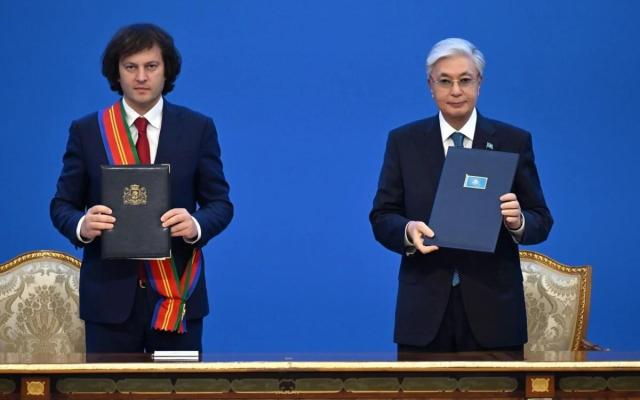
Kazakh President Kassym-Jomart Tokayev and Georgian Prime Minister Irakli Kobakhidze signed a Joint Statement along with memoranda on culture, tourism, and digital development, according to Kazakhstan's presidential press service, Akorda. The two leaders discussed trade, investment, and energy cooperation, including Kazakh oil exports through a pipeline that crosses Georgia on its way to the Turkish coast, and agreed to deepen cooperation on the Trans-Caspian International Transport Route, also known as the "Middle Corridor," linking East Asia to Europe without crossing Russian territory. Transit volume along the route has grown three and a half times over the past five years, the Kazakh presidency said.
The Middle Corridor stretches 4,000 kilometers from western China to Eastern Europe through Central Asia, the Caspian Sea, the South Caucasus, and Turkiye. The corridor only became commercially significant after Russia's full-scale invasion of Ukraine in February 2022, when shippers began looking for routes free of sanctions risk and active conflict. Cargo volumes grew 62 percent in 2024 alone, reaching 4.5 million tons, and container traffic rose 37 percent in the first ten months of 2025, hitting 63,300 twenty-foot containers, according to Azerbaijan Railways and the Eurasian Transport Route Association. In April 2026, Azerbaijan, Georgia, Kazakhstan, and Turkiye signed a joint roadmap aiming for 11 million tons of annual freight by 2030.
Georgia sits at the western end of the corridor, where its Black Sea ports serve as the last stop before cargo crosses into Turkiye, while Kazakhstan anchors the eastern end, where its Caspian ports of Aktau and Kuryk handle the switch from rail to ferry on the way to Baku. The two countries are effectively the bookends of the route. Kazakhstan said that it wants to expand its presence at Georgian ports beyond Batumi to include Poti and Anaklia. Anaklia has long been planned as a deep-water port on Georgia's Black Sea coast, built to handle far larger cargo volumes than the country currently manages. The European Bank for Reconstruction and Development estimates that fixing the corridor's bottlenecks will require around 18.5 billion euros ($210.8 billion) in investment.
The energy discussions centered on the Baku-Tbilisi-Ceyhan pipeline, which runs 1,768 kilometers from Baku in Azerbaijan through Tbilisi in Georgia to the port of Ceyhan on Turkiye's Mediterranean coast. BP operates the Azerbaijani and Georgian sections of the pipeline, which has carried oil since 2006 and has carried Kazakh crude since October 2013. Kazakhstan shipped about 1.4 million tons of oil through the pipeline in 2024 and 1.3 million tons in 2025, according to the Kazakh Ministry of Energy, with plans to reach 1.6 million tons in 2026.
That pipeline has gained new importance because of developments in the Strait of Hormuz, the narrow passage between Iran and Oman through which roughly a fifth of the world's oil trade normally flows. Iran declared the strait closed in early March 2026, after the United States and Israel struck Iran on February 28, and Iranian forces began attacking ships attempting to pass through it. The International Energy Agency called the resulting disruption the largest the global oil market has ever seen. A memorandum signed by the United States and Iran on June 17 set off a tentative reopening. Still, traffic through the strait remained far below normal when Tokayev and Kobakhidze met in Astana. War-risk insurance for tankers, which cost roughly 0.05 percent of a vessel's value before the war, climbed past 5 percent at the worst of the crisis, pricing most commercial shippers out of the route entirely.
The Baku-Tbilisi-Ceyhan pipeline moves oil overland from landlocked Caspian fields to a Mediterranean port, bypassing the Persian Gulf altogether, which is precisely why it has drawn fresh attention since February. Kazakhstan's long-term goal is to ship 20 million tons of oil a year through the route, though reaching that figure would require substantial new investment in both the pipeline and the Caspian crossing points that feed it.
The third agreement signed Monday covers artificial intelligence and digital development, linking Kazakhstan's Ministry of Artificial Intelligence and Digital Development with Georgia's Ministry of Economy and Sustainable Development. Both countries are trying to move beyond the economic models that built them, Kazakhstan beyond oil and Georgia beyond tourism and agriculture, and both have settled on technology as the tool to do it.
Kazakhstan established its Ministry of Artificial Intelligence and Digital Development in 2025, lifting AI policy to the level of a Deputy Prime Minister and signaling how seriously the government takes the shift. That same year the country switched on its first national supercomputer, a machine with two exaflops of processing power and 512 NVIDIA H200 chips, now running the country's national AI platform and its own language models. One of those models, KazLLM, launched in December 2024 after training on 148 billion tokens and was built to operate in both Kazakh and Russian.
A new law setting risk-based rules for AI took effect in January 2026. More than 92 percent of Kazakh government services are now handled online, and the country ranks 24th in the world and 10th for online services specifically, in the latest United Nations E-Government survey.
Georgia's technology sector has grown faster than its readiness to use AI. Information technology made up just 0.4 percent of Georgia's economy in 2019 but had grown to 5.2 percent by 2023, worth 4.2 billion lari, according to the Policy and Management Consulting Group. Yet only 2.2 percent of Georgian firms had adopted AI as of 2024, according to a UNESCO study, a gap the new memorandum is meant to begin closing.
Tokayev closed the visit by awarding Kobakhidze the Order of Dostyk, First Class, an honor Akorda said recognized his role in strengthening ties between the two countries.
Copyright ⓒ Aju Press All rights reserved.