

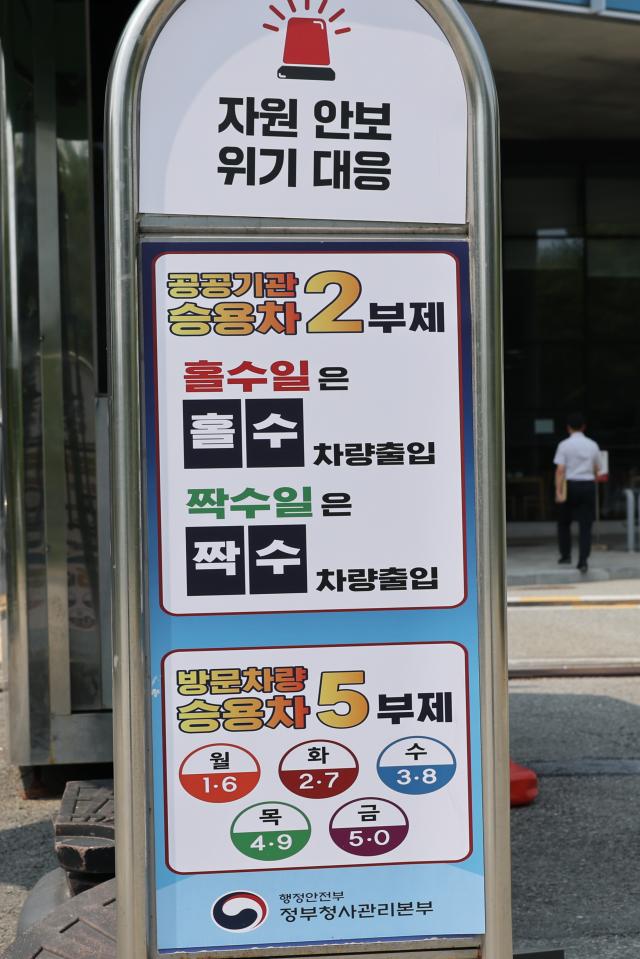
The government has lifted the public vehicle restriction measures as it downgraded the resource security crisis alert level. However, support for public transportation during peak commuting hours and congestion relief measures will remain in place to some extent.
The Ministry of Land, Infrastructure and Transport's Metropolitan Transport Committee announced on July 1 that, following the downgrade of the resource security crisis alert to a 'caution' level, it will adjust and implement the 'Comprehensive Measures for Peak Commuting Public Transport Congestion Relief.'
As of midnight on July 1, the public vehicle restriction measures for government agencies and the five-day parking restriction at public parking lots have been lifted. From now on, the use of personal vehicles will be governed by the usual voluntary system based on the agency's discretion.
Previously, the Metropolitan Transport Committee had announced a comprehensive plan on April 28, which included 32 detailed tasks across four sectors, in response to increased congestion in public transport due to the impact of the Middle East conflict. The plan aimed to reduce personal vehicle use, expand public transport supply, distribute commuting demand, and launch a public campaign.
After international oil prices stabilized, the government decided on June 30 during a Cabinet meeting to lower the resource security crisis alert level. Consequently, some emergency measures linked to the alert level were lifted, while efforts to promote public transport and alleviate congestion will continue.
The extension of subway services on congested routes, such as the Shinbundang Line and Seoul Subway Lines 2 and 7, as well as temporary increases in city and metropolitan bus services, will be reviewed based on passenger convenience and congestion trends.
The 'Everyone's Card' benefits aimed at easing public transport costs will remain in effect until September. The fixed-rate refund threshold will be reduced by more than 50%, and the basic refund rate for users during peak commuting hours will be increased by 30 percentage points, regardless of the alert level.
Peak commuting hours are defined as the hour before and after regular commuting times: from 5:30 AM to 6:30 AM, 9 AM to 10 AM, 4 PM to 5 PM, and 7 PM to 8 PM.
Recommendations for flexible working hours in the public sector and support for the spread of flexible working hours in the private sector will continue, although the recommendation for a minimum 30% staggered commuting in the public sector has been lifted.
However, with the lifting of vehicle restrictions, there is a possibility that personal vehicle use may increase again, making it crucial to maintain incentives for public transport use to manage commuting congestion effectively.
Kim Yong-seok, chair of the Metropolitan Transport Committee, expressed gratitude for the public's cooperation in using public transport until the alert level was downgraded. He stated, "While temporary measures will be adjusted according to the situation, the policy direction to alleviate commuting congestion and make public transport a more convenient means of travel will remain steadfast."
* This article has been translated by AI.
Copyright ⓒ Aju Press All rights reserved.