

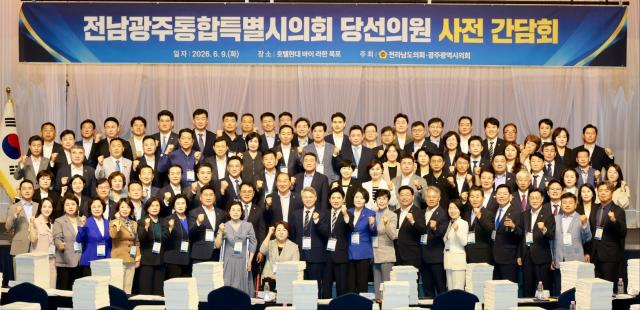
The expectations surrounding this integrated special city extend beyond mere size. The synergy created by combining Gwangju's human resources and advanced industries in artificial intelligence and future mobility with Jeonnam's world-class renewable energy potential is expected to be explosive. The unnecessary administrative waste and competitive rivalry that have plagued the two regions will now come to an end. With a combined population of 3.2 million and a gross regional product (GRDP) of 159 trillion won, the new entity has established a unique competitive edge to attract global capital and talent, marking a significant achievement.
However, the path ahead is fraught with challenges. The immediate priority is to integrate the two organizations' systems and administrative frameworks without causing adverse effects. It is crucial to address potential conflicts and concerns about decreased administrative efficiency during the integration of civil service organizations. A larger challenge lies in addressing potential regional imbalances that may arise post-integration. If infrastructure becomes overly concentrated in Gwangju's urban center, leaving Jeonnam's rural and island areas further marginalized, this integration could lead to a detrimental 'drain effect.'
Education is also a critical area that requires attention. Newly elected Superintendent Kim Dae-jung faces significant challenges in breaking down the long-standing administrative barriers between the two regions' educational systems. A new governance model must be established that effectively integrates urban excellence in education with specialized rural education. It is essential to proactively manage conflicts arising from school consolidations while ensuring students' educational choices and nurturing talent aligned with regional industries, making the 'K-Education Special City' a key to achieving true integration.
For this unprecedented experiment to succeed, robust and sophisticated support from the central government is essential. Fortunately, President Lee Jae-myung and Prime Minister Kim Min-seok's administration has pledged substantial financial backing, promising 5 trillion won annually for four years, totaling up to 20 trillion won. The remaining task is to ensure efficient execution of these funds. If bureaucratic barriers prevent timely budget allocation, the momentum for integration could quickly dissipate. The government must promptly activate the 'Jeonnam-Gwangju Integrated Special City Support Committee' under the Prime Minister's office to streamline execution processes. The National Assembly should also swiftly finalize the necessary subordinate legislation in line with the overarching goals of the already passed special law, without political contention.
The launch of the Jeonnam-Gwangju Integrated Special City should be elevated to a significant national project capable of transforming South Korea's industrial and energy landscape. In a global market where RE100 has become a critical standard for survival, the integration of Jeonnam's clean energy belt with Gwangju's advanced future industrial capabilities is the master key to South Korea's future viability. It is hoped that the Jeonnam-Gwangju Integrated Special City will dispel external concerns and become a perfect global model for the government's philosophy of 'basic society' and 'balanced development.'
* This article has been translated by AI.
Copyright ⓒ Aju Press All rights reserved.