

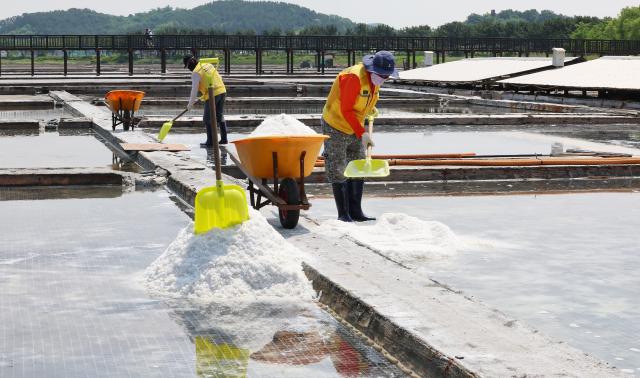
The government is activating a joint response system involving relevant ministries to prevent labor exploitation and human rights violations of salt farm workers. On July 2, the Ministry of Employment and Labor and the Ministry of Oceans and Fisheries announced the establishment and operation of this joint response system in collaboration with the National Police Agency and local governments.
Salt farms are often characterized by poor working conditions and isolated environments, making it difficult for external monitoring and protection to reach workers. Following a human rights violation incident involving salt farm workers in Sinan County in 2021, the government has been pursuing institutional improvements. However, the recurrence of similar incidents has prompted the development of proactive measures to prevent further occurrences.
The issue of labor exploitation in salt farms extends beyond mere violations of working conditions; it can involve assault, forced labor, wage theft, and violations of the rights of disabled individuals, necessitating a strict response. Particularly in isolated workplaces in rural and island areas, victims often find it challenging to seek help, making proactive inspections crucial.
In response, the Ministry of Labor has urgently distributed a notice requiring all 765 salt farm operations to conduct self-assessments regarding basic labor standards and compliance with labor laws. This measure aims to ensure that employers check for incidents of assault, the establishment of employment contracts, compliance with minimum wage laws, and the issuance of wage statements, and to make immediate improvements.
The Mokpo Employment and Labor Office, which oversees 80% of the salt farms located in Sinan County, will conduct unannounced patrol inspections at 55 salt farm operations. These inspections will verify compliance with labor laws, including wage arrears and assault.
Since May, the Ministry of Oceans and Fisheries has been conducting a comprehensive employment survey of all salt farms in collaboration with local governments. If any indications of illegal activities or human rights violations, such as assault, forced labor, or wage exploitation, are identified during this process, they will be promptly reported to the Ministry of Labor and the National Police Agency.
Cooperation with the police will also be strengthened. The existing hotline between the Ministry of Labor and the National Police Agency, which was established to address human rights violations against migrant workers, will now be expanded to include cases involving domestic workers. If the police identify labor rights violations in salt farms or isolated areas, they will immediately notify the Ministry of Labor and conduct joint investigations.
The core of this initiative is to ensure that various agencies work together seamlessly, linking field investigations, police patrols, and labor inspections. The structure involves identifying anomalies during employment surveys, confirming criminal suspicions by the police, and leading to labor inspections and criminal charges by the Ministry of Labor.
Strict measures will be taken against any identified violations. The Ministry of Labor plans to promptly initiate labor inspections at operations reported by the Ministry of Oceans and Fisheries and the police, and if assault or forced labor is confirmed, immediate criminal charges will be pursued.
The Ministry of Oceans and Fisheries and local governments will take actions such as revoking permits, restricting business participation, and recovering subsidies for salt farms where illegal activities, including forced labor, are confirmed. If victim protection is necessary, collaboration between relevant ministries and local governments will facilitate connections to protective facilities and support for victim recovery.
Training for employers will also be expanded. The Ministry of Labor and the Ministry of Oceans and Fisheries will conduct training for salt farm employers on compliance with labor laws to enhance awareness of labor rights protection and sensitivity to human rights, as well as to improve compliance within workplaces.
Kim Young-hoon, Minister of Labor, stated, "Labor exploitation that tramples on workers' rights, including assault and forced labor, is unacceptable under any circumstances. We will work closely with relevant agencies to thoroughly pursue labor exploitation and human rights violations, and we will respond strictly to any legal violations with a zero-tolerance policy."
Hwang Jong-woo, Minister of Oceans and Fisheries, emphasized, "Protecting the human rights and labor rights of salt farm workers is the most fundamental premise for a sustainable solar salt industry. We will strictly apply management measures such as permit revocation for operations where illegal activities are confirmed."
* This article has been translated by AI.
Copyright ⓒ Aju Press All rights reserved.