
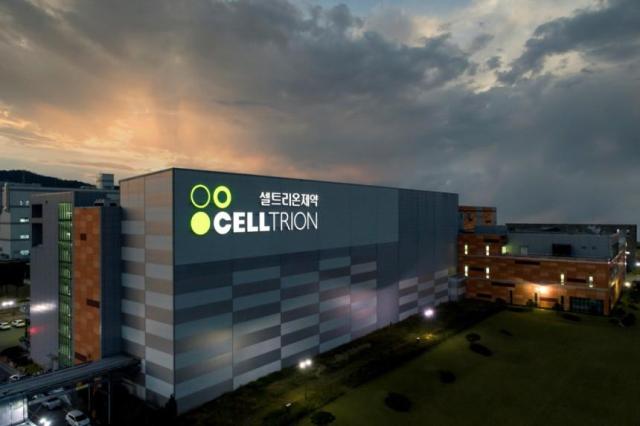
The company's chief executive, Yoo Young-ho, unveiled the plan Thursday at a government-hosted investment forum in Asan, South Chungcheong Province, themed around advanced industry growth in the Chungcheong region.
Celltrion Pharm will spend 1 trillion won in the first phase, targeting design and construction from 2028 with operations to begin in 2032.
A second 1 trillion won investment would follow after 2032, depending on global demand, to expand production capacity further.
"We decided to invest in North Chungcheong to efficiently share production infrastructure and skilled personnel, and to maximize logistics competitiveness by leveraging the region's transportation network," Yoo said, adding that the move would also tap synergies with the Osong bio-pharma cluster and nearby regulatory agencies.
Celltrion's announcement came alongside separate investment plans unveiled the same day by Samsung Electronics and SK hynix, as part of a combined 392 trillion won push into displays, semiconductors, batteries and artificial intelligence infrastructure across the Chungcheong region.
The Ministry of Trade, Industry and Resources said it would roll out a seven-pronged support package covering finance, regulation and infrastructure, and pledged to complete a comprehensive support plan within 100 days through a newly launched task force.
Kim Dong-young
Kim Dong-young is a bilingual journalist at AJU Press (AJP), covering Korean tech, energy, and bio/pharma.
He reports from the field at events like CES and APEC, runs AJP's YouTube channels,
and is pursuing a master's at Sogang's MOT program.
Copyright ⓒ Aju Press All rights reserved.
Related News
-
 Samsung, Lotte vie for CDMO supremacy as K-bio storms BIO USA
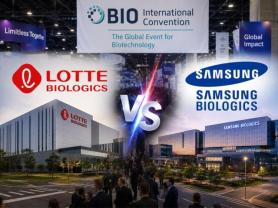
Graphics by AJP Song Ji-yoon SEOUL, June 22 (AJP) - South Korean chips are not the only hot-selling commodities in the United States. Biopharmaceutical heavyweights have descended on the Pacific coast city of San Diego, turning the world's largest biotech gathering into a proving ground for the country's fast-expanding contract manufacturing ambitions. The 2026 BIO International Convention, known as BIO USA, runs from Monday through Thursday at the San Diego Convention Center under the theme "Driven by Purpose," drawing some 20,000 industry figures from more than 70 countries. For the first time, the event features a dedicated session on Korea's bioindustry, titled "Korea Rising: Don't Be Late to Asia's Next Innovation Hub," underscoring the sector's growing global standing. The Korea Pavilion, run for a 23rd year by the Korea Biotechnology Industry Organization, hosts 51 domestic firms and institutions, with 29 set to present pipelines and platform technologies on an open stage. "BIO USA is a festival and a battleground where investment and partnering in the global bioindustry unfold most dynamically," said Lee Seung-gyu, vice chairman of the association. "This year we have significantly strengthened our linked programs, including an integrated Korea Night, and we will provide all-out support so that Korean firms can generate tangible business results with global big pharma and investors." Yet the fiercest contest on the show floor is a domestic one: a race between Samsung Biologics, the established titan, and Lotte Biologics, the upstart challenger, to win a larger share of a post-China manufacturing order. The timing may be unusually favorable. Washington's effort to reshape supply chains away from China has handed Korean contract development and manufacturing organizations, or CDMOs, a rare opening. Graphics by AJP Song Ji-yoon The U.S. Biosecure Act, enacted in December, alongside Section 232 tariff measures and a push to expand biosimilars through pharmacy-benefit reforms, is expected to redirect business toward suppliers in South Korea, Japan and India. Samsung Biologics arrives as the clear front-runner. The company is staging a solo booth for a 14th consecutive year, the only Korean company to have done so since its founding in 2011. Samsung is leveraging its growing global footprint to appeal to multinational drugmakers seeking to diversify production beyond a single geography. In December, it agreed to acquire a biologics plant in Rockville, Maryland, from GlaxoSmithKline for about $280 million, securing its first U.S. manufacturing base. The acquisition was completed in the first quarter. The strategy is already paying off. Samsung Biologics booked a record 6.8 trillion won ($4.4 billion) in new orders last year and now counts 17 of the world's 20 largest pharmaceutical companies among its clients. James Choi, executive vice president, is slated to appear as a panelist in the Korea Rising session, while Jeff Mason, sales director for the Americas, will discuss the company's manufacturing capabilities in an on-site presentation. For Celltrion, attending for a 17th consecutive year, the focus is artificial intelligence. The company secured a booth in the event's AI zone to showcase AI-driven drug discovery, multispecific antibody design and antibody-drug conjugate technologies. "Through this event, Celltrion plans to actively promote its future business vision and technological competitiveness as it grows beyond biosimilars into a global innovative-drug company," a company spokesperson said. If Samsung represents Korean CDMO at its most muscular, Lotte Biologics embodies its boldest gamble. The unit has emerged as a new growth engine for Lotte Group as the retail-heavy conglomerate grapples with liquidity strains elsewhere in its empire, a high-stakes bet on a future built around biologics. Visualization of Samsung Biologics' booth at the BIO USA/ Courtesy of Samsung Biologics The symbolism runs deep. In a November reshuffle, Shin Yoo-yeol, the eldest son of Chairman Shin Dong-bin, was named co-chief executive alongside James Park, taking direct command of a domestic affiliate for the first time. Park himself is a Samsung Biologics veteran who previously led global sales at the larger rival. Lotte has also recruited several former Samsung executives in an effort to import the market leader's playbook. The challenger arrives at BIO USA with fresh evidence of progress. On Monday, Lotte announced it had obtained occupancy approval for the first plant at its Songdo Bio Campus in Incheon, completing the main construction roughly two years after breaking ground. The 120,000-liter antibody facility, equipped with eight 15,000-liter stainless-steel bioreactors and a real-time monitoring system, will begin commissioning and validation work in the second half of the year. Lotte is pursuing a "dual-site" strategy that links the Songdo campus with its Syracuse facility in New York, with Syracuse handling early-stage and clinical work and Songdo dedicated to large-scale commercial production. That strategy is beginning to gain traction. Lotte signed three contracts last year and added more in 2026, including a January deal with Japan's Rakuten Medical to produce a head-and-neck cancer therapy and a May agreement expanding antibody production work for Britain's Ottimo Pharma. Graphics by AJP Song Ji-yoon Still, the stakes are considerable. Lotte Biologics remains in the red, and utilization at its lone revenue-generating Syracuse plant fell to about 14 percent in the first quarter from 74 percent a year earlier after a key customer contract expired. Winning marquee orders has become both a corporate imperative and a personal test for Shin, whose standing as heir apparent is increasingly tied to the venture's fortunes. Samsung, for its part, is positioning itself as the partner of choice in a reordered market, arguing that speed and scale will prove decisive as pharmaceutical companies diversify away from Chinese suppliers. For now, the two Korean firms are chasing the same prize from opposite ends of the field — one defending a hard-won lead, the other scrambling to close the gap.
-
 KOSPI opens lower as foreign selling hits chipmakers
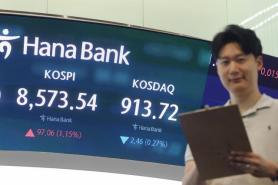
The trading room of Hana Bank's headquarters is seen in central Seoul, in this photo taken on July 1, 2026. Yonhap SEOUL, July 1 (AJP) - South Korea's benchmark KOSPI opened lower on Wednesday despite strong overnight gains in U.S. tech stocks, as foreign investors shrugged off a global semiconductor rally. With less than a couple of hours of trading, the index fell 1.62 percent to 8,339.34, while the junior KOSDAQ rose 2.84 percent to 942.21. The sluggish start came despite a strong performance on Wall Street overnight, with the Philadelphia Semiconductor Index surging 3.92 percent, while the Nasdaq Composite gained 1.52 percent and the S&P 500 advanced 0.79 percent, as investors piled back into technology shares. Foreign brokerages such as Citigroup and JPMorgan ranked among the top sellers of both Samsung Electronics and SK hynix stocks, suggesting foreign investors continued to take profits after the two South Korean chipmakers' strong run so far this year. Foreigners sold a net 430.4 billion won (US$315 million) worth of shares in early morning trade, while institutional investors bought a net 445.7 billion won. The bulk of the selling was concentrated in chip-related stocks, with foreigners offloading a net 299.5 billion won and retail investors selling 8.3 billion won, while institutions bought a net 323.2 billion won. The selling pushed Samsung Electronics down 2.02 percent to 327,250 won, after briefly trading higher at the open. SK hynix also reversed early gains, slipping 1.62 percent to 2.607 million won after rising as much as 2.75 percent. Investors appeared cautious, watching whether the National Pension Service would reduce its domestic stock holdings after resuming portfolio adjustments that had been paused through the end of June. At the same time, offshore cryptocurrency exchanges continued to roll out increasingly leveraged futures tied to South Korean stocks, allowing investors to make bigger bets on market moves. Some products offer effective leverage of up to 150 times the benchmark index's daily performance, raising concerns that even modest market swings could lead to outsized gains or losses. Because the products are offered through offshore exchanges, they remain beyond the direct oversight of South Korean financial regulators. Other heavyweight sectors were mixed. Battery and biotech shares were mixed. LG Energy Solution fell 1.66 percent to 356,000 won, while Samsung Biologics edged down 0.97 percent to 1.3775 million won. Celltrion gained 1.44 percent to 175,800 won. Auto-related stocks traded higher, with Hyundai Motor adding 0.81 percent to 499,000 won and Kia climbing 3.62 percent to 143,000 won. Financial stocks were mixed. KB Financial rose 0.75 percent to 160,200 won, while Shinhan Financial Group gained 2.51 percent to 98,200 won. Samsung Life Insurance fell 2.00 percent to 393,000 won. Industrial and defense shares outperformed. HD Hyundai Heavy Industries advanced 1.52 percent to 601,000 won, Doosan Enerbility gained 3.23 percent to 89,600 won, Hanwha Aerospace surged 8.34 percent to 1.078 million won, and LS ELECTRIC jumped 12.18 percent to 267,000 won. Hyundai Mobis rose 0.40 percent to 502,000 won. On the junior market, semiconductor equipment makers outperformed. Jusung Engineering, Wonik IPS and PSI, which manufacture chip production equipment, rose 15.67 percent to 232,500 won, 0.59 percent to 169,100 won and 8.62 percent to 213,000 won, respectively. Robotics developer Rainbow Robotics gained 3.47 percent to 537,000 won, while biopharmaceutical company HLB fell 2.31 percent to 50,800 won. The South Korean won strengthened against the U.S. dollar, trading at 1,549.4 won compared with 1,558.4 won the previous day. Elsewhere in the region, Japan's Nikkei 225 rose 1.13 percent to 70,851.19. China's Shanghai Composite slipped 0.06 percent to 4,091.89 in early trading. Hong Kong markets were closed for the Hong Kong Special Administrative Region Establishment Day, which commemorate the historic transfer of sovereignty. Hong Kong's bourse was closed for Hong Kong Special Administrative Region Establishment Day, which marks the historic transfer of sovereignty and commemorates the ending the British colonial rule.
-
 Celltrion's Truxima Becomes First Rituximab Biosimilar to Achieve Interchangeability Status in the U.S.
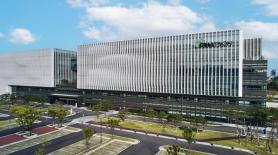
Celltrion Global Biopharmaceutical Research Center Celltrion has announced that its blood cancer treatment Truxima (active ingredient: rituximab) has become the first rituximab biosimilar to receive interchangeability status from the U.S. Food and Drug Administration (FDA). This achievement is expected to enhance its competitive edge in the local market alongside securing exclusivity rights. On July 1, Celltrion confirmed that it has obtained the interchangeability designation for Truxima from the FDA. Truxima is the first biosimilar of rituximab to achieve this status in the United States, and it has also secured exclusivity rights typically granted to the first interchangeable biosimilar. Truxima is a blood cancer treatment developed by Celltrion. It has received approval in the U.S. for all adult indications held by the original drug, including non-Hodgkin lymphoma (NHL), chronic lymphocytic leukemia (CLL), rheumatoid arthritis (RA), and microscopic polyangiitis (MPA). Interchangeability status recognizes the potential for switching between the original drug and the biosimilar. This designation presents an opportunity for domestic companies with U.S. approval and local sales experience to expand their access to pharmacies. With this approval, Truxima has been officially recognized as clinically equivalent to the original drug in terms of efficacy and safety, providing a stronger basis for prescriptions. Truxima has already captured a significant market share in the U.S. According to market research firm IQVIA, as of February this year, Truxima held a 35.8% share of U.S. prescriptions, ranking first. With the acquisition of this interchangeability status, Celltrion aims to strengthen its position in the U.S. rituximab market and continue expanding its portfolio of follow-up cancer biosimilars. A Celltrion representative stated, "Truxima has not only achieved the top prescription ranking in the U.S. market but has also secured interchangeability status. We will contribute to expanding treatment accessibility based on verified clinical data and prescription evidence."* This article has been translated by AI.