
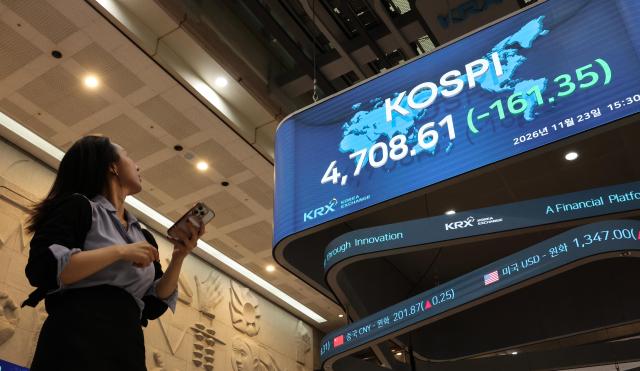
With leadership uncertainty over AI flagbearer Nvidia easing after Jensen Huang returned to the helm, Koreans are back in the Wall Street game.
But the ride has turned wilder.
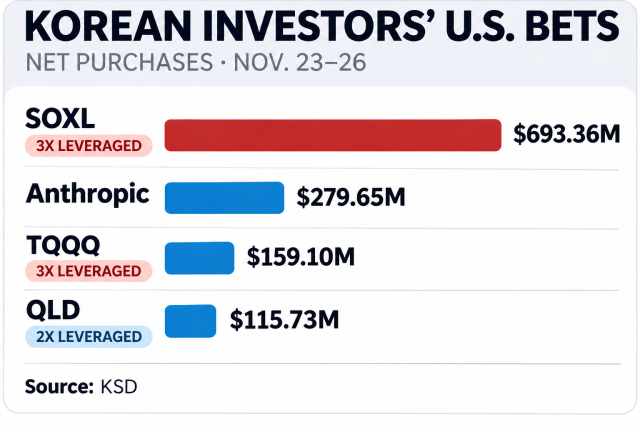
Korean investors made net purchases of $693.36 million in Direxion Daily Semiconductor Bull 3X Shares (SOXL) from November 23 to 26, making it their most heavily purchased U.S. security during the period, according to Korea Securities Depository (KSD) settlement data reviewed by AJP on Friday.
The ETF aims to deliver three times the daily return of the NYSE Semiconductor Index.
Anthropic, the AI developer behind the Claude chatbot, came second with net purchases of $279.65 million.
ProShares UltraPro QQQ (TQQQ), which targets three times the Nasdaq-100 Index’s daily return, ranked third with $159.10 million. ProShares Ultra QQQ (QLD), which targets twice the index’s daily return, followed with $115.73 million.
Three of the top four U.S. securities by Korean investors’ net purchases were leveraged ETFs.
The appetite for U.S. equities was also evident in the ETF market back home.
TIGER US S&P 500, which tracks 500 leading U.S. companies, ranked second among Korean-listed ETFs by retail net purchases over the past week, attracting 88.8 billion won. KODEX US Nasdaq 100, which tracks 100 leading non-financial companies listed on the Nasdaq, came third with 80.5 billion won, according to Koscom’s ETF CHECK data reviewed by AJP on Friday afternoon.
The buying comes amid a dizzying week for Seoul stocks.
The KOSPI fell 3.31 percent Monday before rebounding 6.32 percent Tuesday. It plunged another 6.16 percent Wednesday, with sidecars triggered in all three sessions to temporarily suspend program buy or sell orders. The benchmark edged up 0.3 percent Thursday after surrendering most of an intraday gain of more than 2 percent.
Friday brought another upswing. The KOSPI climbed 3.43 percent to 4,872.97 and the junior KOSDAQ surged 6.25 percent to 696.70 as of 12:59 p.m. Foreign investors drove the rally with net purchases of 710.2 billion won on the main bourse, while retail investors offloaded 1.05 trillion won worth of shares.
In a report Friday, Kiwoom Securities attributed the market’s difficulty sustaining early gains to declining trading value and shrinking investor deposits. With few buyers able to absorb foreign selling, the brokerage expects stocks to remain sensitive to negative headlines.
Wall Street, however, offers little refuge.
"It’s not a time to let our guard down," said Nam-hoon Kwon, a professor of economics at Konkuk University.
"The volatility is more pronounced here, but its source is the U.S. market."
Huang’s return to Nvidia sent the Nasdaq Composite and the S&P 500 soaring 6.51 percent and 4.73 percent, respectively, on Monday. Both indexes fell over the following two sessions as investors took profits and concerns over the profitability of AI infrastructure spending resurfaced.
Regulatory uncertainty is adding to those concerns. In a report Friday, iM Securities said suppliers of Nvidia chips had announced plans to halt sales to cloud providers renting computing power to Chinese companies. Prolonged restrictions could delay data center investment by firms heavily reliant on Chinese demand, the brokerage warned.
The outlook for memory chips is also under scrutiny. French banking group BNP Paribas cited the risk of future oversupply as it slashed its price target for U.S. memory chipmaker Micron Technology from $1,700 to $775.
Kwon cautioned against overreacting to the forecast.
"Concerns over a potential oversupply have been around for months," he said. "But given chipmakers' earnings and long-term supply agreements, I don't see any major problems for now."
"The market had become overheated, but the fundamentals have not changed," Kwon added.
An analyst at Yuanta Securities offered a similar assessment, saying concerns over an AI investment slowdown and a deterioration in the memory chip market from 2028 onward had largely been priced into stocks.
"Low valuations alone are still not enough to drive a sustained recovery," the analyst said.
The analyst advised against increasing stock exposure until U.S. interest rates stabilize, foreign buying recovers and semiconductor earnings estimates hold up.
“Volatility is likely to remain high without a clear market direction for the time being,” the Yuanta analyst added.
For leveraged ETF investors, volatility itself is a risk.
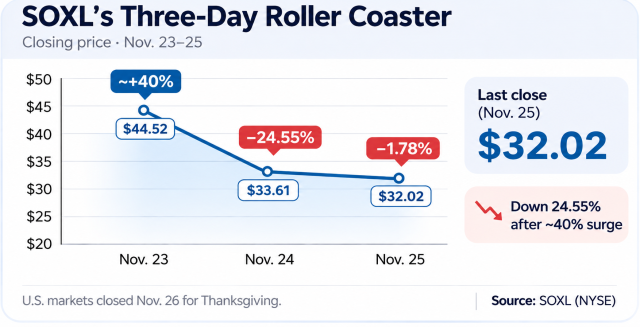
SOXL surged nearly 40 percent Monday, only to plunge 24.55 percent Tuesday and shed another 1.78 percent Wednesday, closing at $32.02. That is its latest available regular-session price, as U.S. markets were closed Thursday for Thanksgiving.
For some, the losses have gone far beyond money.
“A friend of mine lost his wedding savings trading SOXL and ended up breaking up with his partner,” said No G.H., in his 30s.
The mood is equally grim on Korean stock discussion boards, where some have called the fund an “online casino.”
“This is killing me,” one investor wrote on Naver’s discussion board for the fund.
“I've had enough. I'm getting out,” another said.
The numbers show how costly leveraged bets can be.
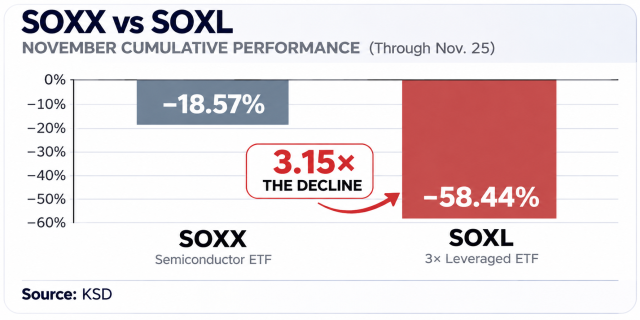
The iShares Semiconductor ETF (SOXX), which tracks the same semiconductor index without leverage, lost 18.57 percent in November through Wednesday. SOXL plunged 58.44 percent over the same period — more than three times SOXX’s decline.
The discrepancy lies in how leveraged ETFs work.
The threefold leverage applies to daily returns, not cumulative returns. Because leverage resets daily, repeated falls and rebounds can leave investors in the red even if the underlying index fully recovers. A steady rally can work in their favor, while repeated swings can eat into returns.
Averaging down lowers the average purchase price but leaves more money exposed to further losses. It does not remove the risks of daily compounding.
“There’s too much uncertainty right now to take on more risk,” Kwon said.
Still, faith in the AI industry’s long-term growth gives some investors a reason to hold on. For others, mounting losses have made selling harder to stomach.
“I’ve already lost so much that I don’t have any money left to average down. I’ll just have to hold on,” said Lee Ye-kyung, 28, a retail investor who works in Seoul’s Apgujeong neighborhood.
Kwon cautioned against trying to ride out the downturn with leveraged ETFs.
“You’d have to be very confident in the market to hold these funds for the long term," he said. "Given the uncertainty, it would be wiser to scale back leveraged positions.”
"Holding assets that volatile is almost like gambling,” he added.
Anthropic, another favorite among Korean investors, is not necessarily a safer bet.
The AI developer made its Nasdaq debut on November 19 and topped the KSD’s net purchase rankings on November 23, the first day it appeared in the settlement data, with $199.69 million in net buying.
Yet its shares have since slipped below their initial public offering (IPO) price of $83, closing at $82.79 on Wednesday.
Intensifying competition, the high costs of developing and running AI models, and uncertainty over future profitability remain key risks.
Kwon warned against treating the latest decline as a buying opportunity, saying further losses remained possible.
“There may be too much fear in the market, but it is not without reason,” he said.
Next week brings fresh tests. Korea’s November export figures and the U.S. Institute for Supply Management (ISM) manufacturing purchasing managers’ index (PMI) are due December 1. Korea’s consumer price data follow on December 2 and the U.S. jobs report on December 4, ahead of the Federal Reserve’s December 8–9 policy meeting.
The future of AI may be bright, but not everyone who bets on it can afford to wait.

Ryu Yuna
Yuna Ryu covers finance, capital markets and Southeast Asian affairs.
She is drawn to the questions that numbers raise and the stories that data alone cannot answer.
Prior to journalism, she worked at Hyundai Motor Company and the Singapore Chamber of Commerce, focusing on business strategy and international affairs. She has also hosted diplomatic receptions and international conferences as an MC.
Ryu holds a master's degree in Media and Communication from Korea University, where her research focused on neuroscience-based studies of media effects.
Copyright ⓒ Aju Press All rights reserved.
Related News
-
 KOSPI reclaims 4,900, KOSDAQ jumps
SEOUL, November 27 (AJP) - South Korean stocks rallied Friday, with the benchmark KOSPI closing above 4,900 for the first time in three trading sessions and the KOSDAQ jumping more than 8 percent. The KOSPI gained 204.47 points, or 4.34 percent, to close at 4,915.68 after opening at 4,728.80. It reached an intraday high of 4,922.94. The KOSDAQ surged 53.28 points, or 8.13 percent, to 708.99, closing above 700 for the first time since Nov. 11.
-
 KOSPI optimism returns despite widespread investor losses
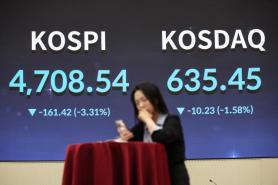
An electronic board at the Korea Exchange in Yeouido, Seoul, displays the KOSPI and KOSDAQ indexes on Nov. 23, 2026. The KOSPI closed down 161.42 points, or 3.31 percent, at 4,708.54, while the KOSDAQ fell 10.23 points, or 1.58 percent, to 635.45. AJP Yoo Na-hyun SEOUL, November 27 (AJP) - Nearly seven in 10 South Korean retail investors surveyed said they had lost money on domestic stocks or exchange-traded funds this year, but more respondents expected the benchmark KOSPI to rise over the next 12 months than to fall, a Gallup Korea poll released Friday showed. Among respondents who traded or held domestic stocks or ETFs this year, 69 percent reported losses, up 29 percentage points from August. Another 20 percent reported gains, and 11 percent said they broke even. The KOSPI has fallen to around 4,700, roughly half its June intraday peak of 9,385.59. Among all respondents, 37 percent expected the KOSPI to rise and 32 percent expected it to fall, reversing October’s readings of 30 percent and 36 percent, respectively. Among investors, 46 percent expected a rise and 32 percent expected a decline. Gallup Korea surveyed 1,000 adults nationwide from Nov. 24 to 26. The full sample had a margin of error of plus or minus 3.0 percentage points at a 95 percent confidence level.
-
KOSPI Falls to Half Its Peak: What Investors Need Now
Recent declines in the KOSPI index, which has fallen approximately 50% from its peak, are increasing investor anxiety. While investors previously worried about missing out on opportunities during a rising market, they are now looking at the market with fear of further declines.During asset management consultations with clients at the bank, a common refrain has emerged: "It's dropped so much that I'm really anxious now. I don't plan to redeem immediately, but will it go back up?" This statement reflects the complex psychology of investors. They do not want to realize losses but are uncertain about how long they should wait. Expectations of market recovery coexist with worries of further declines.When the stock market is rising, clients often ask if they should invest now. Conversely, when the market falls, they worry about whether it is okay to hold onto their funds and if they will recover. When stock prices rise, they fear missing opportunities, and when prices fall, they fear greater losses. Thus, investor judgment is influenced not only by market conditions but also by emotions of hope and anxiety.So, what do investors need in a market like this? From the perspective of a private banker (PB) responsible for managing clients' assets, it is more important to examine clients' investment goals and the composition of their overall financial assets than to predict the timing of a market rebound. Even if the same loss occurs, each client's situation is different. A client who invested with surplus funds for long-term management will respond differently than one who needs to use their funds in the near future.Additionally, clients with a high proportion of equity funds and those who hold sufficient stable assets like deposits and bonds should have different investment strategies. Therefore, when the market declines significantly, it is essential to assess the balance of the entire financial portfolio rather than just focusing on the products that have incurred losses. Particularly, if a client has significantly increased their investment proportion during a stock market upturn, they should reassess whether their current asset allocation aligns with their investment style and risk tolerance. Conversely, if they hold sufficient stable assets and have the capacity for long-term investment, they might consider the market correction as a new investment opportunity.However, just because stock prices have fallen significantly does not mean they have reached a bottom. Accurately predicting market lows is challenging even for experts. If there are surplus funds available for investment, it may be wise to consider dividing the investment into different amounts and timings rather than investing all at once. For investment products that have already incurred losses, waiting indefinitely is not necessarily the best course of action. It is important to verify whether the investment targets and management strategies of the held funds are still valid and suitable for the current financial plan.Above all, investors should remember that even if the KOSPI index rebounds, not all stocks and funds will recover to their previous prices. Therefore, when clients ask, "Will it go back up?" it is difficult to simply respond that waiting will lead to recovery. It is necessary to consider not only the market outlook but also the products held by the client, their investment duration, and their financial situation.The stock market has experienced multiple cycles of sharp declines and recoveries in the past. However, the causes of declines and the time taken for recovery have varied each time. Past recovery experiences do not guarantee future profits. Managing risks within a manageable range, preparing to use funds when needed, and adhering to long-term financial goals are crucial components of successful asset management. While it is easy for anyone to feel confident about investing when market conditions are favorable, one realizes the importance of their investment principles when the market behaves unexpectedly.What investors need now is neither hasty optimism nor excessive pessimism. They must calmly assess their held assets and maintain strategies that align with their investment capacity and goals. Ultimately, the key to successful long-term asset management lies not in the ability to hit the market bottom but in the strength to adhere to suitable investment principles even when the market is volatile.* This article has been translated by AI.