
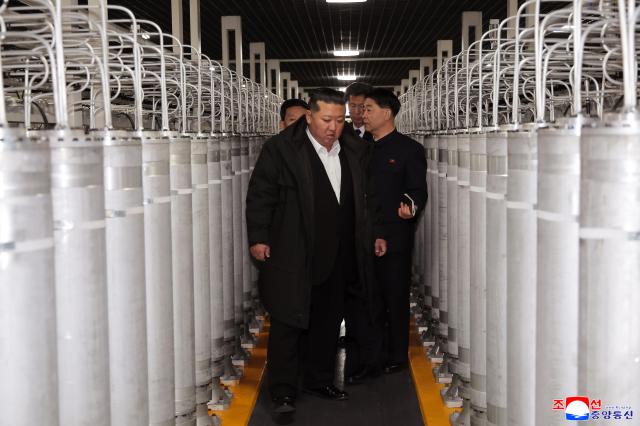
David Albright, president of the Institute for Science and International Security (ISIS), told Voice of America (VOA) that the facility could produce more than 100 kilograms of weapons-grade uranium per year, depending on its design and uranium supply.
Albright suggested that the new building could be used to further enrich existing low-enriched uranium to weapons-grade levels of around 90 percent, rather than simply increase production of low-enriched uranium.
However, the facility's exact purpose remains unclear, and there is no confirmation that uranium enrichment equipment has been installed or begun operating.
According to an ISIS satellite imagery analysis released Tuesday, the expansion, which began in September, includes an interior hall measuring approximately 95 meters long and 10 meters wide, potentially accommodating additional uranium enrichment centrifuges.
The International Atomic Energy Agency (IAEA) has also raised concerns about the expansion. Director General Rafael Grossi said on Nov. 18 that exterior construction had been completed by late October.
"The ongoing expansion of the DPRK's uranium enrichment programme remains a cause for serious concern," Grossi said.
The developments highlight concerns over North Korea's growing nuclear capabilities as Pyongyang continues expanding its nuclear infrastructure despite international sanctions.
Separately, North Korea is developing what it describes as an 8,700-ton nuclear-powered submarine, while South Korea is also pursuing its own nuclear-powered submarine program.
State media reported Thursday that leader Kim Jong-un had inspected a nuclear-powered equipment production facility, with analysts suggesting that some of the equipment shown could be intended for a submarine reactor. However, neither the equipment's purpose nor the submarine's nuclear propulsion capabilities has been independently verified.

Kim Hee-su
Kim Hee-su is a bilingual reporter at AJU Press, covering defense and foreign affairs. Before joining AJP in 2025, she worked at The Korea Times, where she wrote interview stories, including a profile of North Korean defector Kim Gum-hyok, and produced digital content. She also previously worked as a researcher for KBS News 9’s International News Department, supporting correspondents in 10 countries around the world. She graduated from the University of Toronto in Canada with a double major in Book and Media Studies and East Asian Studies.
Copyright ⓒ Aju Press All rights reserved.
Related News
-
 South Korea reviews progress on Czech nuclear plant
SEOUL, November 27 (AJP) - South Korea is stepping up efforts to accelerate the construction of a nuclear power plant in Dukovany, the Czech Republic, ahead of First Deputy Prime Minister Karel Havlíček’s visit next month. The Ministry of Trade, Industry and Resources has been holding weekly meetings with a team of state-run companies involved in the project including Korea Hydro and Nuclear Power (KHNP), KEPCO Engineering & Construction, KEPCO Nuclear Fuel, and KEPCO KPS. The ministry stressed the need to ensure the project stays on track. South Korea aims to reassure Czech officials about the project during next month's talks while deepening bilateral cooperation in the nuclear sector. Tags: Czech Republic, Dukovany, KHNP, nuclear power plant, energy cooperation
-
Defense Ministry: North Korea Must Immediately Halt Nuclear Development Justifications
The Defense Ministry stated on the 26th that North Korean leader Kim Jong-un revealed his intention to expand tactical nuclear operations during an inspection of nuclear facilities, urging that "attempts to justify nuclear development must be halted immediately and United Nations Security Council resolutions must be implemented."Defense Ministry spokesperson Jeong Bit-na emphasized during a regular briefing that the military is taking North Korea's declaration of intent to expand tactical nuclear operations on the Korean Peninsula very seriously.Jeong stated, "Our military is enhancing the execution capability of extended deterrence through the Korea-U.S. nuclear consultative group and further advancing the Korean three-axis system to maintain a robust military readiness posture against any nuclear threat from North Korea."Earlier, North Korea's Korean Central News Agency reported that Kim inspected the production of nuclear materials and research on nuclear weapons the previous day. Kim toured facilities for the production of weapon-grade nuclear materials, nuclear propulsion-related equipment, and nuclear weapons research institutes, assessing activities in the nuclear materials and weapons production sectors this year.During this visit, Kim noted, "We must focus on utilizing tactical nuclear weapons in various domains for the diverse missions in the nuclear weapons production sector." This indicates an intention to broaden the scope of tactical nuclear utilization while unveiling both nuclear material production and nuclear weapons research sites.Meanwhile, the newly released materials reportedly include uranium enrichment facilities with different structures from existing ones, various types of nuclear warheads, and nuclear propulsion-related production equipment. Analysts suggest that North Korea aimed to showcase its capabilities in expanding nuclear material production, diversifying nuclear warheads, and developing nuclear-powered submarines.Shin Jong-woo, secretary general of the Korea Defense Security Forum, estimated through analysis of the released materials that the enrichment facility is a new underground uranium enrichment facility. He also assessed that the unveiling of warheads with various names, including Hwasan-14, 21, 22, 23, 24, and 25, indicates a move to showcase hydrogen bomb diversification capabilities, with Hwasan-25 presumed to be a small hydrogen bomb.Regarding nuclear propulsion-related equipment, there is speculation that it could be a reactor to be mounted on an 8,000-ton nuclear-powered submarine currently under construction by North Korea.Shin analyzed that North Korea's intention in unveiling the uranium enrichment facility, hydrogen bomb diversification, and nuclear-powered submarine engine is to "increase pressure on the U.S. and South Korea."* This article has been translated by AI.
-
South Korea Accelerates Diplomatic Efforts for Vietnam's Ninh Thuan 2 Nuclear Project
The government is accelerating high-level diplomatic efforts to secure the Ninh Thuan 2 nuclear power project in Vietnam, following Japan's withdrawal. Ahead of the 35th anniversary of diplomatic relations between South Korea and Vietnam next year, the focus is not only on nuclear power but also on strengthening cooperation in advanced industries such as semiconductors and artificial intelligence (AI), while reviewing amendments to the free trade agreement (FTA).On November 27, Minister of Trade, Industry and Energy Kim Jeong-kwan met with Nguyen Thi Hoang Anh, Chairman of the Central Economic Commission of the Communist Party of Vietnam, at the Government Complex in Seoul to discuss strategic economic cooperation between the two countries.The Central Economic Commission of Vietnam is a key organization of the Communist Party that designs and oversees the direction of the country's economic and social development.Minister Kim emphasized that cooperation in building nuclear power plants, a stable source of electricity, is essential for fostering Vietnam's advanced industries. In particular, he requested the government's attention and support for nuclear power cooperation between the two countries, based on South Korea's nuclear technology and workforce training and localization capabilities, especially in light of Vietnam's recent official termination of cooperation with Japan on the Ninh Thuan 2 nuclear project.Earlier this year, in January, the Vietnamese government ended its investment cooperation with Japan regarding the Ninh Thuan 2 nuclear project. Korea Electric Power Corporation (KEPCO) has been pushing to enter the local nuclear market, having signed a memorandum of understanding with Vietnam's state-owned energy company, the Vietnam National Oil and Gas Group (PVN), for workforce training in the nuclear sector last August.Minister Kim also met with Minister of Science and Technology Huynh Thanh Dat on September 30 to discuss the current status and future procedures of the Ninh Thuan 2 nuclear project. With the completion of the termination process of the existing intergovernmental agreement between Japan and Vietnam this month, the South Korean government's support for securing the nuclear project is becoming more concrete.The two countries will also strengthen cooperation in key and advanced industries. The government plans to jointly establish a '2027-2030 Mid- to Long-Term Korea-Vietnam Industrial Development Action Plan' with the Vietnamese government to expand cooperation in sectors such as electronics, shipbuilding, steel, materials and components, and energy equipment.Discussions also included investment cooperation in AI transformation in manufacturing and semiconductor and AI data centers. There are plans to discover collaborative projects between companies and relevant institutions in both countries and to continue investment cooperation in AI infrastructure.To ensure sustainable trade growth between the two countries, the government will also review improvements to the market access environment for goods and services under the Korea-Vietnam FTA, which came into effect in December 2015. Vietnam is South Korea's third-largest trading partner after China and the United States. From January to October this year, trade between the two countries amounted to $112.1 billion, with South Korea's exports to Vietnam at $80 billion and imports at $32.1 billion. As of September this year, South Korea's cumulative investment in Vietnam reached $104.1 billion.Minister Kim requested institutional support for the smooth advancement of the liquefied natural gas (LNG) power generation project in Vietnam, in which South Korean companies are participating. There are also plans to strengthen cooperation in areas such as oil storage facility construction, clean energy, and high-value-added processing of key minerals.Minister Kim stated, "South Korea and Vietnam are optimal partners to lead supply chains and future industries together," adding, "We will closely communicate to ensure that the trade and investment expansion plans discussed today, along with cooperation in advanced technology and resource supply chains, lead to mutual prosperity and tangible results for both countries."* This article has been translated by AI.