
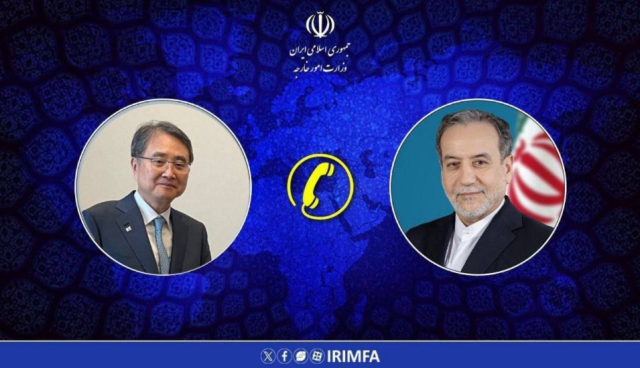
Iranian Foreign Minister Abbas Araghchi delivered the warning in a phone conversation with South Korean Foreign Minister Cho Hyun on Thursday — Tehran’s first response since Seoul announced plans to expand the unit’s operational area earlier this month.
The presence of foreign forces would undermine regional stability and security rather than help establish them, Araghchi said, and would instead "exacerbate tensions and expand the scope of the conflict," according to Iran’s semi-official Tasnim News Agency.
Cho reiterated that the mission is "a measure to protect our nationals and safeguard our economic interests," reaffirming Seoul’s principle of non-involvement in the war.
The two sides’ accounts of the conversation, however, differed in emphasis.
South Korea’s Ministry of Foreign Affairs explicitly referred to the expansion of the Cheonghae Unit’s mission. Iranian state media, including the Islamic Republic News Agency (IRNA), made no specific mention of the unit, instead highlighting Seoul’s assurances that it had no intention of participating in the war or deploying troops to the region.
It remains unclear whether Tehran regards the expansion of South Korea’s existing anti-piracy mission as a security concern or whether its warning was directed at potential involvement in U.S.-led military operations.
South Korea is far from alone in maintaining a naval presence in the wider region, where Japan, China, India and European countries have long conducted anti-piracy and maritime security operations.
Japan has conducted maritime information-gathering activities in the Gulf of Oman, the northern Arabian Sea and the Gulf of Aden since 2020. Earlier this month, Tokyo extended both its counter-piracy and Middle East information-gathering missions for another year.
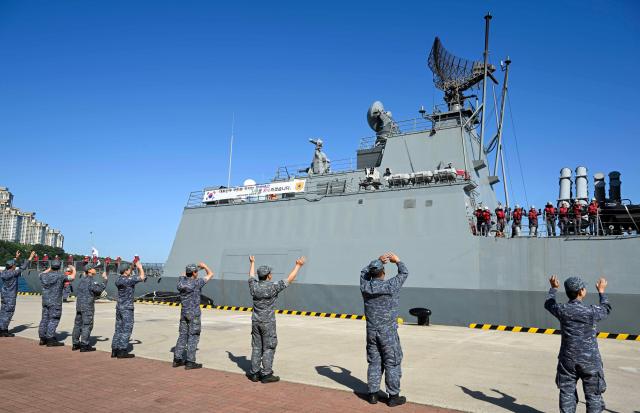
South Korea’s Cheonghae Unit has operated in the Gulf of Aden since 2009. Seoul’s plan would expand its operational area and reinforce its capabilities rather than send a new combat unit.
The National Assembly’s Defense Committee approved a revised motion Thursday to extend the unit’s deployment through the end of 2027, with additional assets including a maritime patrol aircraft, an explosive ordnance disposal team and unmanned mine-clearing equipment.
The motion still requires approval by the full National Assembly. Its supplementary provisions explicitly state that the unit must not intervene in wars or military operations between other countries.
"We plan to continue protesting to ensure the motion is voted down in the plenary session," a representative of one of the groups said.
South Korea’s Ministry of National Defense has repeatedly stressed that the expansion would be limited to offshore waters south of Oman, citing a more than threefold increase in piracy in the region.
"The operational area will be limited to offshore waters south of Oman," defense ministry spokesperson Jeong Bit-na said, adding that it would remain more than 650 kilometers from the Strait of Hormuz.
"We will carry out our mission under the principle that we will under no circumstances become involved in or intervene in the war."
Asked by AJP whether Tehran’s warning also applied to South Korea’s planned expansion and how it viewed similar maritime security operations by other countries, the Iranian Embassy in Seoul declined to elaborate.
"There is nothing further to add at this time," the embassy told AJP on Friday.

Kim Hee-su
Kim Hee-su is a bilingual reporter at AJU Press, covering defense and foreign affairs. Before joining AJP in 2025, she worked at The Korea Times, where she wrote interview stories, including a profile of North Korean defector Kim Gum-hyok, and produced digital content. She also previously worked as a researcher for KBS News 9’s International News Department, supporting correspondents in 10 countries around the world. She graduated from the University of Toronto in Canada with a double major in Book and Media Studies and East Asian Studies.
Copyright ⓒ Aju Press All rights reserved.
Related News
-
 Seoul reassures it has no intentions of deploying troops to Iran
SEOUL, November 27 (AJP) -South Korea has no intention of joining the war or deploying troops to the region, Foreign Minister Cho Hyun reassured his Iranian counterpart Abbas Araghchi in a phone call Thursday, according to Iran’s ISNA news agency. Araghchi warned that a foreign military presence would escalate tensions and widen the conflict rather than bring stability. He also outlined Tehran’s diplomatic efforts and its position on conditions for regional peace, ISNA reported. Cho reaffirmed Seoul’s support for regional peace and stability and expressed hope for a negotiated end to the war. The ministers also discussed bilateral issues, according to the Iranian account. Tags: South Korea, Iran, Cho Hyun, Abbas Araghchi, Iran war, Middle East, diplomacy
-
 Cyberattacks threaten global shipping as Iran war drags on
A naval vessel sails through coastal waters in a file photo illustrating maritime security risks in the Strait of Hormuz. Photo courtesy of NNPC Marine Insurance SEOUL, November 24 (AJP) - Cyberattacks are posing a growing threat to commercial sea routes as they become another weapon in prolonged conflicts, compounding pressure on shipping and global supply chains. The United States is investigating suspected cyberattacks against as many as 50 vessels carrying oil, gas and other hazardous cargo, The Wall Street Journal reported Monday. U.S. officials suspect possible Iranian involvement, while also considering Russia as a potential culprit. Some vessels received bomb threats, and U.S. Coast Guard cybersecurity teams were dispatched to at least four ships approaching American ports. Attribution remains unresolved: a Trump administration official said investigators had found no evidence linking Iran to the attacks. The incidents add to a sharp increase in reported maritime cyber threats. Courtesy of CYTUR South Korean maritime cybersecurity company CYTUR recorded 828 incidents across the global maritime industry in 2025, up 103 percent from 408 a year earlier. Ransomware incidents rose from 156 to 372, while distributed denial-of-service attacks, which overwhelm networks with traffic, increased from 185 to 386. Israeli cybersecurity company Cydome separately reported a 150 percent increase in incidents involving maritime operational technology — the systems that control or monitor physical equipment — in 2025. Electronic interference has also intensified around the Strait of Hormuz, a critical passage for global energy shipments. According to Lloyd’s List Intelligence, 2,694 vessels experienced GPS interference in the Persian Gulf and Gulf of Oman during the Iran war’s first eight days, from Feb. 28 to March 7. It recorded 3,719 interference incidents, with the number of vessels affected daily rising from 283 to 559 over that period. Incorrect positioning information could lead crews off course or into another country’s territorial waters. A vessel’s Automatic Identification System, which broadcasts its identity and location, can also be manipulated or disrupted, creating confusion over ship movements. The risks extend beyond navigation. “Ships are increasingly connected to the outside world through satellite communications and other wireless networks,” said Kim Ho-won, a professor at Pusan National University’s School of Computer Science and Engineering. “As those connections expand, the opportunities for cyberattacks also increase.” Attackers could manipulate onboard monitoring systems, potentially increasing fuel consumption, Kim said. More serious interference could affect a vessel’s operation. “If communication systems or sensor inputs are disrupted, the consequences can affect a ship's actual movement,” he said. “Interference with engines or other onboard systems could ultimately create physical safety risks.” The exposure matters particularly to South Korea, a major shipbuilding nation whose economy depends heavily on maritime trade. Ships carried 99.7 percent of its import and export cargo by weight in 2023, according to the Ministry of Oceans and Fisheries. Yet the country’s shipbuilding strength has not necessarily translated into equivalent capabilities in securing onboard electronics, Kim said. Korean shipyards have traditionally focused on vessel construction, while established European manufacturers supply many navigation, automation and control systems. Shipowners often specify the equipment, leaving yards to integrate products from different suppliers. Norway’s Kongsberg Maritime, for example, supplies systems ranging from integrated bridges and engine monitoring to digital fleet management, with maintenance and technical support throughout a vessel’s operating life. It has also developed cybersecurity protections and tested products against international cyber resilience requirements. Total container shipping capacity among South Korea’s 14 container lines is approximately 1.15 million TEUs, of which HMM contributes about 795,500 TEUs. Photo credit by Thorsten Schier / Shutterstock.com. The challenge extends to the infrastructure ashore. “Cybersecurity needs to be strengthened not only on ships but also at ports,” Kim said. “Ports operate a wide range of IT and operational systems, including cranes, and those systems also need protection.” Modern ports rely on interconnected networks to coordinate cargo movements and automated equipment. An attack could interrupt loading and unloading even when the vessels themselves remain operational. South Korea has been strengthening its defenses through a dedicated cybersecurity center under the Ministry of Oceans and Fisheries. In July, the ministry introduced specialized training with Korea Maritime and Ocean University, including simulated attacks on electronic navigation systems. “Cybersecurity capabilities among maritime workers are no longer optional but essential,” Lee Min-jung, acting director-general of the ministry’s Maritime Safety Bureau, said at the time. A ministry official nevertheless cautioned against assuming that hackers could readily seize control of a ship. “Ships still rely heavily on manual controls, and autonomous navigation has yet to be widely adopted. Unlike aircraft, this makes it more difficult for hackers to take control of a vessel through cyberattacks,” the official said. Comprehensive public data on how many existing Korean commercial vessels have adequate cybersecurity protection remains unavailable. Maritime cybersecurity is still developing worldwide. Satellite internet and remote monitoring have connected equipment that was once relatively isolated, expanding the potential points of attack. For shipping companies and ports, the danger need not involve a hacker taking the helm. Disrupted navigation, disabled monitoring or stalled cargo operations could be enough to interrupt trade.
-
FMs of South Korea, Iran hold phone talks
SEOUL, November 26 (AJP) - Foreign Minister Cho Hyun spoke by phone with his Iranian counterpart Seyed Abbas Araghchi, the Ministry of Foreign Affairs said Thursday. During their roughly 15-minute phone conversation, Cho explained that South Korea's recent decision to expand the overseas mission of the country's Cheonghae naval unit is aimed at protecting its citizens, while reaffirming Seoul's commitment to staying out of the prolonged conflict involving the U.S. and Middle Eastern countries. The two also discussed bilateral relations and the safety of South Korean nationals in the region. The ministry said the two ministers agreed to maintain close communication. Tags: Cho Hyun, Iran, Middle East, Strait of Hormuz, Cheonghae, naval mission