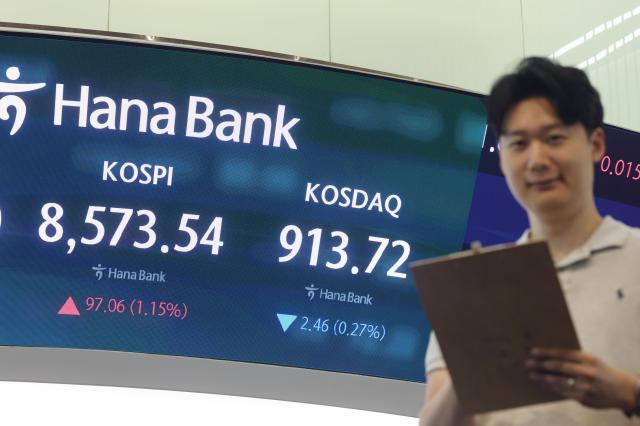
With less than a couple of hours of trading, the index fell 1.62 percent to 8,339.34, while the junior KOSDAQ rose 2.84 percent to 942.21.
The sluggish start came despite a strong performance on Wall Street overnight, with the Philadelphia Semiconductor Index surging 3.92 percent, while the Nasdaq Composite gained 1.52 percent and the S&P 500 advanced 0.79 percent, as investors piled back into technology shares.
Foreign brokerages such as Citigroup and JPMorgan ranked among the top sellers of both Samsung Electronics and SK hynix stocks, suggesting foreign investors continued to take profits after the two South Korean chipmakers' strong run so far this year.
Foreigners sold a net 430.4 billion won (US$315 million) worth of shares in early morning trade, while institutional investors bought a net 445.7 billion won. The bulk of the selling was concentrated in chip-related stocks, with foreigners offloading a net 299.5 billion won and retail investors selling 8.3 billion won, while institutions bought a net 323.2 billion won.
The selling pushed Samsung Electronics down 2.02 percent to 327,250 won, after briefly trading higher at the open. SK hynix also reversed early gains, slipping 1.62 percent to 2.607 million won after rising as much as 2.75 percent.
Investors appeared cautious, watching whether the National Pension Service would reduce its domestic stock holdings after resuming portfolio adjustments that had been paused through the end of June.
At the same time, offshore cryptocurrency exchanges continued to roll out increasingly leveraged futures tied to South Korean stocks, allowing investors to make bigger bets on market moves. Some products offer effective leverage of up to 150 times the benchmark index's daily performance, raising concerns that even modest market swings could lead to outsized gains or losses. Because the products are offered through offshore exchanges, they remain beyond the direct oversight of South Korean financial regulators.
Other heavyweight sectors were mixed. Battery and biotech shares were mixed. LG Energy Solution fell 1.66 percent to 356,000 won, while Samsung Biologics edged down 0.97 percent to 1.3775 million won. Celltrion gained 1.44 percent to 175,800 won.
Auto-related stocks traded higher, with Hyundai Motor adding 0.81 percent to 499,000 won and Kia climbing 3.62 percent to 143,000 won.
Financial stocks were mixed. KB Financial rose 0.75 percent to 160,200 won, while Shinhan Financial Group gained 2.51 percent to 98,200 won. Samsung Life Insurance fell 2.00 percent to 393,000 won.
Industrial and defense shares outperformed. HD Hyundai Heavy Industries advanced 1.52 percent to 601,000 won, Doosan Enerbility gained 3.23 percent to 89,600 won, Hanwha Aerospace surged 8.34 percent to 1.078 million won, and LS ELECTRIC jumped 12.18 percent to 267,000 won. Hyundai Mobis rose 0.40 percent to 502,000 won.
On the junior market, semiconductor equipment makers outperformed. Jusung Engineering, Wonik IPS and PSI, which manufacture chip production equipment, rose 15.67 percent to 232,500 won, 0.59 percent to 169,100 won and 8.62 percent to 213,000 won, respectively. Robotics developer Rainbow Robotics gained 3.47 percent to 537,000 won, while biopharmaceutical company HLB fell 2.31 percent to 50,800 won.
The South Korean won strengthened against the U.S. dollar, trading at 1,549.4 won compared with 1,558.4 won the previous day.
Elsewhere in the region, Japan's Nikkei 225 rose 1.13 percent to 70,851.19. China's Shanghai Composite slipped 0.06 percent to 4,091.89 in early trading. Hong Kong markets were closed for the Hong Kong Special Administrative Region Establishment Day, which commemorate the historic transfer of sovereignty.
Hong Kong's bourse was closed for Hong Kong Special Administrative Region Establishment Day, which marks the historic transfer of sovereignty and commemorates the ending the British colonial rule.

Copyright ⓒ Aju Press All rights reserved.