
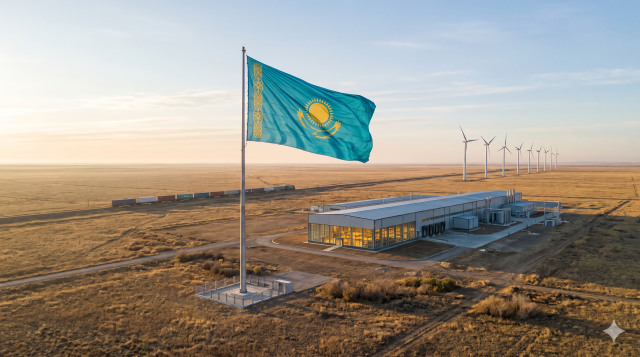
SEOUL, November 27 (AJP) - Kazakhstan's state investment agency is supporting nine South Korean projects as the country shifts its investment drive from attracting more foreign money to turning that money into working factories.
The projects are worth a combined $2.8 billion, according to an investment review the Kazakh government provided to AJP through its embassy in Seoul. They are supported by Kazakh Invest National Company, which guides foreign investors from first negotiations through commissioning.
South Korea's share comes to about 4 percent of the value of the agency's portfolio of 166 projects worth $69.5 billion, which is expected to create more than 59,000 jobs.
China leads the portfolio by number of projects with 33 worth $25.9 billion, followed by Türkiye with 29 worth $4.4 billion and the United States with 15 worth $6.2 billion. South Korea ranks fourth, ahead of Qatar, whose eight projects are worth $12 billion, and Russia, with five worth $5.8 billion.
Of the 166 projects, 58 worth $20.5 billion are under way and 108 worth $49 billion are still being developed. Agriculture and food processing has the most projects, 41 worth $5.3 billion. Mining and metallurgy has 20 worth $23.4 billion, and energy has 17 worth $19.4 billion.
In September, Kazakhstan announced agreements with South Korean partners in gas processing, petrochemical expansion, power generation and rare-earth processing technologies. Hyundai Engineering, Samsung E&A, Doosan Enerbility and POSCO Holdings were among the companies involved.
Kia opened a $310 million vehicle plant in Kostanay in October 2025 that can build up to 70,000 vehicles a year. This year, Kazakhstan held business forums and investment roundtables in Seoul and in Chennai, India.
President Kassym-Jomart Tokayev said in his State of the Nation Address that investment should be judged by the number and quality of new production facilities brought into operation and by their real contribution to the economy.
Manufacturing's share of foreign direct investment (FDI) in Kazakhstan rose from 14.2 percent in 2019 to 21.3 percent in 2025, government figures show.
Over the same period, investment in the chemical industry grew 12.6-fold, from $98.8 million to $1.2 billion, and investment in communications grew 12.4-fold, from $105 million to $1.3 billion. Finance and insurance drew $4.2 billion, up from $1 billion.
Kazakhstan led the Eurasian Economic Union, a Russia-led trade bloc that also includes Armenia, Belarus and Kyrgyzstan, in plans for new projects. Announced greenfield projects in the country, which build new facilities or operations from the ground up, were worth about $24 billion in 2025, up 34 percent from a year earlier.
The figure came to 93 percent of the value of all greenfield projects announced across the bloc, according to the Eurasian Economic Union Investment Report 2026 by the United Nations Conference on Trade and Development (UNCTAD). The report was published Oct. 25 at the World Investment Forum in Doha.
The same report recorded negative net FDI inflows of $860 million for Kazakhstan in 2025. Net figures subtract money leaving a country from money coming in, and UNCTAD said negative flows can reflect repayments or divestments alongside new projects. Gross inflows, which count only money coming in, totaled $20.5 billion in 2025, according to the Kazakh government.
The government said Kazakhstan has drawn nearly $500 billion in FDI since independence in 1991, including $155 billion over the past seven years. That figure counts every dollar invested over 35 years.
FDI stock, a narrower measure, is the value of foreign investment still held in a country at a given point, after investors have withdrawn capital, repaid loans or sold holdings. Kazakhstan's FDI stock stood at $156.4 billion at the end of 2025, roughly two-thirds of the Central Asian total.
According to the National Bank of Kazakhstan, gross inflows reached $9.4 billion in the first half of 2026 and $29.8 billion since the start of 2025. That is nearly 30 percent of the goal in the country's investment policy concept, which calls for at least $100 billion in FDI from 2025 to 2030.
Outside oil and gas extraction and metallurgy, FDI rose 12.3 percent, while investment in manufacturing other than metallurgy grew nearly 40 percent. Non-metallurgical industries' share of manufacturing FDI climbed from 56.8 percent to 91.9 percent.
Foreign investment in food, beverage and tobacco production rose nearly fivefold in the first quarter of 2026 to $405 million. Investment in construction, warehousing and logistics infrastructure grew more than fivefold.
Kazakhstan's traditional investors include Russia, China, the United States, the Netherlands, Switzerland and France, and money from the Gulf and Asia is growing alongside them. Investment from the United Arab Emirates rose from $158.2 million in 2019 to $1.6 billion in 2025. Qatar invested $1.3 billion and Singapore $1.4 billion.
In the first quarter, investment from the United States climbed to $485.3 million, investment from Switzerland grew 2.3-fold and investment from Singapore rose 70.4 percent.
The government expects around 45 projects with foreign participation to start operating in 2026, and 32 already have. They include a soft drink plant in Almaty Region, a combined heat and power plant in Kyzylorda Region and a mining equipment service center in Karaganda.
Construction is under way on 33 more, from wind farms to cable production, and work on more than 40 others is due to begin by year-end.
Projects worth more than 32 billion tenge ($69.7 million) can sign an investment agreement with the government, a tool introduced in 2021. Each agreement sets out commitments for both sides and fixes key conditions for the life of the project.
Kazakhstan has signed 72 of them, including 31 this year. It signed 30 in 2025, up from a handful a year in 2022 and 2023.
Seven of this year's agreements cover pharmaceutical projects worth roughly 287.5 billion tenge ($626.6 million), including four new plants that will produce 356 medicines locally. Kazakhstan imports more than 80 percent of its medicines, and President Tokayev has tasked the government with raising domestic production to half the market.
President Tokayev declared 2026 the Year of Digitalization and Artificial Intelligence, and the government has made digital infrastructure a priority for foreign investment. In the northeastern city of Ekibastuz, it is developing Data Center Valley, an international cluster for data centers, cloud services and AI infrastructure.
In June, Kazakhstan signed a $10 billion package of agreements with U.S.-based AI infrastructure company Firebird and chipmaker NVIDIA, according to the prime minister's office. The package envisions a computing cluster with up to 100,000 next-generation graphics processing units, the chips used to train and run AI models. NVIDIA co-founder Jensen Huang has also visited Astana.
Two supercomputers came online in Kazakhstan this year, and a third is due by year-end. Kazakhtelecom and AzerTelecom International have finished laying a fiber-optic cable along the bed of the Caspian Sea.
The $600 million Ertis Hydrometallurgical Plant, under construction in Pavlodar Region, will let Kazakhstan refine pure gold at home. An agreement was also signed this year for a metallurgical coke plant in Karaganda Region that will produce 1 million tons a year.
More than 100 agricultural projects are under way, from farms to advanced processing. Fufeng Group, Dalian Hesheng Holdings, Lihua Group and Tiryaki Agro are building processing clusters. Carlsberg has opened a beverage plant, PepsiCo is preparing to launch a snack factory and Mars is building a pet food facility.
The ninth Kazakhstan Global Investment Roundtable, held Oct. 22 in Shymkent under the theme "From Stability to Growth: Kazakhstan's New Investment Cycle," drew more than 500 investors and business representatives from over 40 countries. The roundtable moved to the country's regions this year. Executives from The Boeing Company, the Islamic Development Bank, Masdar, Sarens Kazakhstan and Lasselsberger Group spoke at its plenary session.
Participants signed 22 documents worth $4.8 billion. Investment agreements covered a $730 million, 1,000-megawatt wind farm with energy storage in Kostanay Region and a $150 million glass container plant in Aktobe. Memorandums were signed for a $500 million, 250-megawatt data center in Data Center Valley and the $650 million Kazakhstan International Medical City.
Many of Kazakhstan's investment deals are signed during President Tokayev's foreign visits and talks. Summit-level meetings led to projects by Stadler in 2021, Alstom in 2022 and Wabtec in 2025, and Stadler Rail now builds new-generation passenger carriages in Astana.
President Tokayev's working visit to Shanghai this year produced more than 88 commercial documents worth over $15 billion. They include a supercomputing cluster with Huawei, optical components for Data Center Valley to be made by Kazakhtelecom and Hengtong Group, lithium-ion battery production, wind farms of up to 1 gigawatt, a terminal at Kuryk port and a container hub in Aktau.
President Tokayev has said more than 400 bilateral documents have been signed since the start of the year.
About 85 percent of freight shipped from China to Europe passes through Kazakhstan. Construction of the Aral-Caspian railway began in August and is expected to cut roughly 1,000 kilometers from the Trans-Caspian route, which carries goods between China and Europe across the Caspian Sea. The Bakhty-Ayagoz line, due to open in 2027, will add 20 million tons of freight capacity toward China.
S&P Global Ratings raised Kazakhstan's sovereign credit rating to BBB with a stable outlook in August, the first time the country has held that rating since 2016. Moody's affirmed its Baa1 rating with a stable outlook in September. Kazakhstan also climbed 17 places to 53rd in the Global Investment Risk and Resilience Index.
Foreign investors can use the English common law framework of the Astana International Financial Centre, and Kazakhstan is introducing an Altyn Visa regime for them. The Prosecutor General serves as investment ombudsman.
Kazakhstan also plans to set up an Investment Court in the city of Alatau to hear commercial disputes under the English common law model.
Park Sae-jin
Experienced journalist and editor at AJU PRESS specializing in multilingual news. I cover international diplomacy, geolpolitics, and policy, consistently delivering highly accurate, compelling reporting for a worldwide audience.
Copyright ⓒ Aju Press All rights reserved.
Related News
-
 Kazakh minister honors independence hero Hong Beom-do
Kazakhstan's Minister of Culture and Information Arman Kyrykbayev burns incense at the grave of Korean independence hero Hong Beom-do at Daejeon National Cemetery on Sept. 16, 2026. AJP Park Sae-jin SEOUL, September 16 (AJP) - Kazakhstan's culture minister burned incense on Wednesday at the grave of Hong Beom-do, the Korean independence commander who died in exile in Kazakhstan. The visit came a day after he signed an agreement with South Korea to preserve sites linked to the Korean independence movement. Arman Kyrykbayev, Kazakhstan's Minister of Culture and Information, signed the memorandum of understanding on Sept. 15 with Kwon Oh-eul, South Korea's Minister of Patriots and Veterans Affairs. The signing took place at Cheong Wa Dae in Seoul, with President Lee Jae Myung and Kazakh President Kassym-Jomart Tokayev looking on. At their summit the same day, Lee told President Tokayev that the return of Hong's remains in 2021 had deepened trust between the two countries. Kyrykbayev is in South Korea as part of President Tokayev's state visit. On arriving at Daejeon National Cemetery, about 160 kilometers south of Seoul, he went first to the Memorial Tower and burned incense. He then moved to Hong's grave in the cemetery's third section for independence patriots and burned incense there as well. Kazakhstan's Minister of Culture and Information Arman Kyrykbayev walks toward the Memorial Tower to burn incense at Daejeon National Cemetery on Sept. 16, 2026. AJP Park Sae-jin At the grave, Na Chi-man, Deputy Minister for Patriots and Veterans Culture Policy at the Ministry of Patriots and Veterans Affairs, thanked Kazakhstan for its role in bringing Hong home. He said the ministry would keep caring for the grave and would also look after the Hong Beom-do Memorial Park in Kyzylorda, the Kazakh city where Hong had been buried. Na called Hong "a symbol of friendship between Kazakhstan and the Republic of Korea." "May the spirits of the ancestors be pleased," Kyrykbayev replied. He said Hong's heroic deeds should serve as an example of patriotism for "all the youth of the Korean people, and not only Koreans, but youth of other nations as well." He described the visit as part of President Tokayev's official program. "Within this framework, of course, we pay homage to such sacred figures," he said, and wished on behalf of President Tokayev and the Kazakh people that "the friendship and brotherhood between our two countries continue to flourish." Kyrykbayev spoke to AJP in Kazakh that Hong had fought for his homeland's freedom and later came to Kyzylorda along with many other Koreans, living and working there until his death. "On one hand, it is paying tribute to the past," he said of the return of Hong's remains. "On the other hand, it signifies how both Koreans and we Kazakhs love our history, our people, and our homeland." He then cited a Kazakh saying that calls for honoring the past. "Great historical figures like him will continue to further strengthen the friendship between our two countries," he said. Kazakhstan's Minister of Culture and Information Arman Kyrykbayev observes a moment of silence in front of the Memorial Tower at Daejeon National Cemetery on Sept. 16, 2026. AJP Park Sae-jin Hong is one of the most revered figures in South Korea's struggle against Japanese colonial rule, which lasted from 1910 to 1945. In Kazakhstan, he became a symbol of identity for a Korean community that Soviet authorities had uprooted and sent to Central Asia. He was born into a poor family in 1868, in Pyongyang, by his own account, and lost both parents as a child. He joined the army in Pyongyang as a young man and later made his living as a hunter in the mountains of northern Korea. In September 1907, Japan issued a law to confiscate guns held by civilians, including hunting rifles. That November, Hong gathered fellow hunters into a militia and began attacking Japanese troops in guerrilla raids across the northern provinces. The fight cost him his family. Japanese authorities seized his wife to pressure him into surrendering, and she died in prison after torture. His eldest son was later killed in battle. After Japan annexed Korea in 1910, Hong moved his base to Manchuria and the Russian Far East. In June 1920, as commander of the Korean Independence Army, he led an ambush against a Japanese battalion at Fengwudong, known in Korean as Bongo-dong, in northeastern China. It was the first large-scale victory by Korean independence forces. That October, his troops fought alongside Kim Jwa-jin's units in the Battle of Qingshanli, another defeat for the Japanese army. The grave of Korean independence hero Hong Beom-do at Daejeon National Cemetery. AJP Park Sae-jin Hong later settled in the Soviet Far East, where he led Korean farming communities, and joined the Soviet Communist Party in 1927. In 1937, Soviet leader Joseph Stalin ordered the forced relocation of 171,781 ethnic Koreans from the Far East to Central Asia. Hong, then 69, was among them and was sent to Kazakhstan. In Kyzylorda, he worked as a guard at the Korean Theater and later at a rice mill. He died there on Oct. 25, 1943, at age 75, two years before Korea won its independence. The deported Koreans and their descendants in the former Soviet Union call themselves Koryo-saram. For about 40 years, the Korean community in Kyzylorda tended Hong's grave and kept it as a place to honor him. After Kazakhstan gained independence in 1991, both South Korea and North Korea sought his remains. Pyongyang argued that he belonged in his birthplace. Seoul pressed the case at the presidential level, and Kazakhstan agreed. The remains arrived at Seoul Air Base on Aug. 15, 2021, South Korea's Liberation Day, escorted by six fighter jets. Two days later, Hong was posthumously awarded the Republic of Korea Medal, the highest grade of the Order of Merit for National Foundation, at a ceremony President Tokayev attended. President Tokayev also handed over Hong's death certificate and his letter of resignation from the Korean Theater. In November 2023, South Korea's veterans ministry opened a memorial park on the site of Hong's former grave in Kyzylorda. Hong was buried in Daejeon on Aug. 18, 2021, 78 years after his death. The funeral wreath combined carnations, Kazakhstan's flower of mourning, with chrysanthemums, South Korea's. Soil from his grave in Kyzylorda, which President Tokayev had brought to Seoul, was mixed with Korean soil and scattered over his coffin. AJP Takeaways - Kazakhstan's Minister of Culture and Information Arman Kyrykbayev burned incense at the Memorial Tower and at the grave of Korean independence hero Hong Beom-do at Daejeon National Cemetery on Sept. 16, a day after signing an agreement with South Korea to preserve independence movement sites. - Kwon Oh-eul, South Korea's Minister of Patriots and Veterans Affairs, signed that memorandum of understanding with Kyrykbayev at Cheong Wa Dae on Sept. 15, with President Lee Jae Myung and Kazakh President Kassym-Jomart Tokayev looking on. - Kyrykbayev said the return of Hong's remains in 2021 was both a tribute to the past and a sign that Koreans and Kazakhs love their history, their people and their homeland. He made the remarks in Kazakh at the grave in response to a question from AJP.
-
 Ruling Adilet sweeps first vote for new Kazakh parliament
Ballots are seen inside a ballot box at a polling station in Astana, Kazakhstan, August 23, 2026. AJP Han Jun-gu Almaty, August 24 (AJP) -Kazakhstan's ruling Adilet party swept to a landslide victory with 71.17 percent of the vote in preliminary results from Sunday's parliamentary election, far ahead of its rivals in the country's first vote for the new single-chamber Kurultai. The Central Election Commission said Monday that Adilet received 6,528,948 votes. Auyl came a distant second with 6.26 percent, followed by Respublica with 5.56 percent, Ak Zhol with 5.21 percent and the Nationwide Social Democratic Party with 5.11 percent. The five cleared the 5 percent threshold required to win representation in the 145-member Kurultai. The People's Party of Kazakhstan received 3.11 percent and the Baitaq Green Party 1.0 percent, falling below the threshold. Another 2.51 percent of voters chose the "against all" option. Preliminary results of Kazakhstan's first election to the new single-chamber Kurultai are shown in a graphic released by the Central Election Commission on Aug. 24, 2026. Adilet led with 71.17 percent of the vote, while preliminary turnout stood at 74.08 percent. Courtesy of Kazakhstan's Central Election Commission. Adilet finished 64.91 percentage points ahead of Auyl. The other four parties that crossed the threshold were grouped closely between 5.11 percent and 6.26 percent. The final distribution of the Kurultai's 145 seats has yet to be announced. Turnout stood at a preliminary 74.08 percent, with 9,351,539 of 12,623,289 registered voters taking part, according to the CEC. That was nearly 20 percentage points higher than the 54.21 percent turnout in Kazakhstan's 2023 parliamentary election. A new parliament Citizens gather to receive ballots at a polling station in Astana, Kazakhstan, August 23, 2026. AJP Han Jun-gu Sunday's election was the first parliamentary vote under Kazakhstan's new Constitution, approved in a nationwide referendum on March 15. It took effect on July 1. The change ended about three decades of a two-chamber parliament under the system established in 1995. The former Senate and lower-house Mazhilis have been replaced by the Kurultai, a single chamber with 145 deputies serving five-year terms. The way lawmakers are elected has also changed. In 2023, 69 Mazhilis members were elected through party lists and 29 from individual districts, where independent candidates could also run. This time, all Kurultai members are elected through party lists under proportional representation in one nationwide constituency. Kazakhstan's party system also changed ahead of the election. Adilet was established earlier this year and absorbed Amanat, the country's long-dominant ruling party, in June. Amanat won 53.90 percent of the party-list vote in the 2023 election. Election officials wait for voters at a polling station in Astana, Kazakhstan, August 23, 2026. AJP Han Jun-gu The two results cannot be directly compared because both the election system and the parties have changed. But the merger meant Adilet entered its first national election with much of Amanat's existing political base behind it. The seven parties differed over what to focus on, but their campaigns broadly shared promises of economic growth, national development and better living standards. Adilet focused on stronger government institutions, law and order and economic growth. Auyl emphasized farming, food security and rural development. Respublica focused on entrepreneurs and private business, while Ak Zhol stressed business conditions and stronger parliamentary oversight. The Social Democrats put more weight on labor rights and social protection. For some voters, however, the question was much simpler - whether the new parliament could make daily life better. "I voted with the hope that the incoming parliament would put jobs and the cost of living at the top of its agenda," said Anastassia Akhmetova, a 25-year-old office worker. Akhmetova said people wanted to see and feel real change in their everyday lives. Yerjan, a 27-year-old taxi driver, said he did not vote because his work schedule left him little time to go to a polling station. He said he nevertheless hoped the election would help Kazakhstan move in a better direction. Regional observers back election process International election observers attend a briefing at the Assistance Center for International Observers and Foreign Media in Astana on Aug. 23, 2026, as Kazakhstan held its first parliamentary election for the new single-chamber Kurultai. Journalists are seen in the foreground. AJP Han Jun-gu Regional election observers gave largely positive assessments of how voting was carried out. The Parliamentary Assembly of Turkic States, or TURKPA, called the election an important step in Kazakhstan's political development, noting that it was the first parliamentary vote under the new single-chamber system. Its observers said voting was orderly at the polling stations they visited and that voters were able to cast their ballots in secret and without interference. TURKPA also praised steps taken to make voting easier for people with disabilities and Kazakh citizens living abroad. Its representatives highlighted the use of technology, including artificial intelligence, saying some of Kazakhstan's practices could be useful for other Turkic states. International election observers attend a briefing at the Assistance Center for International Observers and Foreign Media in Astana on Aug. 23, 2026, during Kazakhstan's first parliamentary election for the new single-chamber Kurultai. AJP Han Jun-gu The Shanghai Cooperation Organization also gave a positive assessment. The SCO said its 17 observers from six member states visited 120 polling stations in Astana and the nearby Akmola Region before and during election day. The mission said it received no complaints or objections on election day and saw no violations that it believed could have affected the result. Observers also noted families and younger voters arriving at polling stations despite periods of rain on Sunday. The election has also drawn attention from Kazakhstan's neighbors. Kyrgyz President Sadyr Japarov congratulated President Kassym-Jomart Tokayev and the Kazakh people on the election, saying he was confident the new Kurultai would help strengthen Kazakhstan's state institutions and support its economic and social development. Japarov also expressed hope that the Kyrgyz-Kazakh strategic partnership would continue to deepen in the interests of peace, stability and development across Central Asia. The comments come as Central Asian countries work more closely on trade, transport, energy and water. Kazakhstan plays a major role in many of those efforts because of its size, economy and location between China, Russia and the rest of Central Asia. Kazakhstan's foreign policy remains largely led by the presidency. A child waits while his father votes at a polling station in Astana, Kazakhstan, August 23, 2026. AJP Han Jun-gu The Kurultai, however, will vote on laws and budgets that can support trade, infrastructure and agreements with other countries. That gives the new parliament a role in how Kazakhstan carries out both its domestic plans and its cooperation with neighboring countries. For now, the first test will be at home. Adilet enters the new system with an overwhelming lead, while four much smaller parties have also crossed the threshold for seats. One question will be whether those parties can turn their different priorities into real debate inside the Kurultai.
-
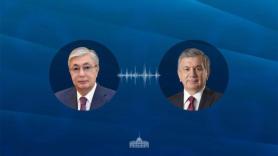 Kazakh and Uzbek leaders discuss strengthening bilateral relations
This file image shows Kazakh President Kassym-Jomart Tokayev (left) and the Uzbek President Shavkat Mirziyoyev (right). Courtesy of the Press Office of the President of Kazakhstan SEOUL, June 25 (AJP) - To strengthen their decades-old close friendship and bilateral relations, the leaders of the two largest countries in Central Asia have engaged in a meeting via a phone call on Wednesday (local time) that extends from their April Bukhara meeting, where strategic cooperation in trade, logistics, and energy sectors was discussed. Kazakhstan's Presidential Office said that the Kazakh President Kassym-Jomart Tokayev and the Uzbek President Shavkat Mirziyoyev spoke on the phone to discuss issues regarding the enhancement of the bilateral cooperation and expressed satisfaction with the development momentum that the Kazakh-Uzbek relations have gained. Built on a shared history and deep mutual trust, the two largest countries in Central Asia are accelerating their partnership to become much closer and stronger. Kazakhstan and Uzbekistan established their modern diplomatic relations in November 1992, and their friendship was fortified by a series of events, including the historic Treaty of State Border Delimitation in 2022. Since 2023, both informal and formal meetings between the leaders have been held frequently, providing opportunities for the Kazakhstan President Kassym-Jomart Topkayev and the Uzbekistan President Shavkat Mirziyoyev to discuss various issues, while working-level engagements also took place on the sidelines of the high-level meetings. Kazakhstan and Uzbekistan, the countries that rely heavily on exports of natural resources such as gas, oil, and mined minerals to make money, are also working fast to transform into modern, technology-driven economies. Astana named 2026 the "Year of Digitalization and Artificial Intelligence," while its neighbor is pushing the "Uzbekistan 2030" plan to bring together online services, digital banking, and tech jobs. In March, Kazakhstan's foreign minister Yermek Kosherbatev met with his Uzbek counterpart Bakhtiyor Saidov in Tashkent and agreed to increase bilateral trade to $ 10 billion by 2030 from last year's $ 5 billion. The two countries also chose cooperation over competition. They have teamed up on big practical projects such as road infrastructure establishment, sharing of water supplies during hot summers, and providing support for businesses that operate across both borders.