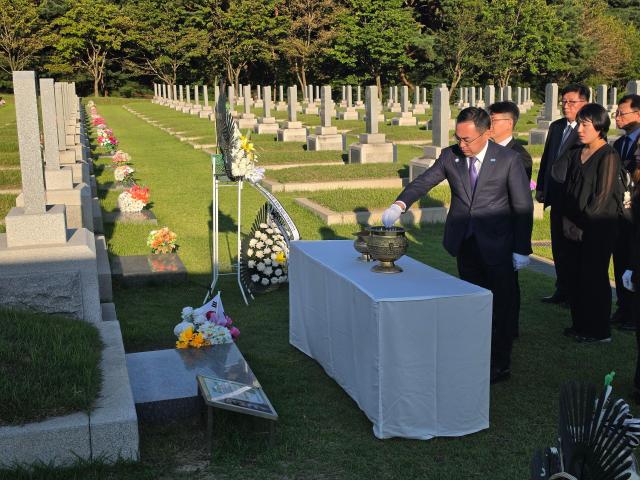
SEOUL, September 16 (AJP) - Kazakhstan's culture minister burned incense on Wednesday at the grave of Hong Beom-do, the Korean independence commander who died in exile in Kazakhstan. The visit came a day after he signed an agreement with South Korea to preserve sites linked to the Korean independence movement.
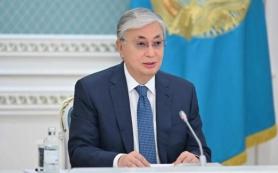
Arman Kyrykbayev, Kazakhstan's Minister of Culture and Information, signed the memorandum of understanding on Sept. 15 with Kwon Oh-eul, South Korea's Minister of Patriots and Veterans Affairs. The signing took place at Cheong Wa Dae in Seoul, with President Lee Jae Myung and Kazakh President Kassym-Jomart Tokayev looking on. At their summit the same day, Lee told President Tokayev that the return of Hong's remains in 2021 had deepened trust between the two countries.
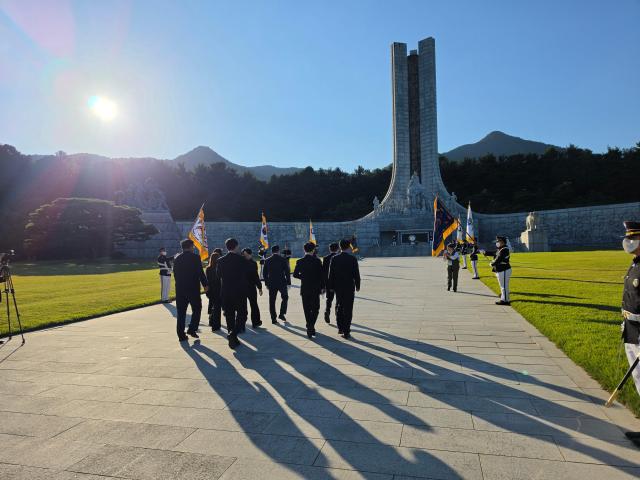
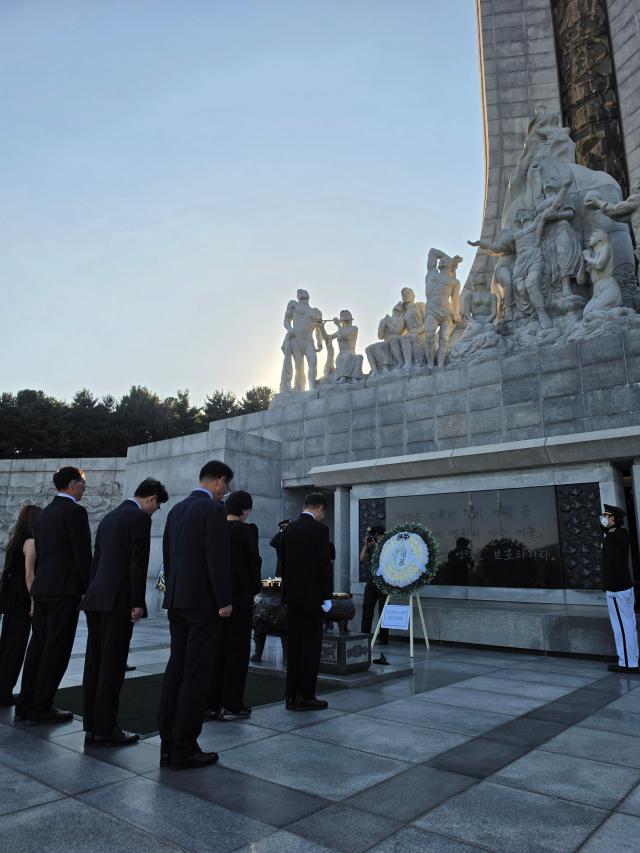
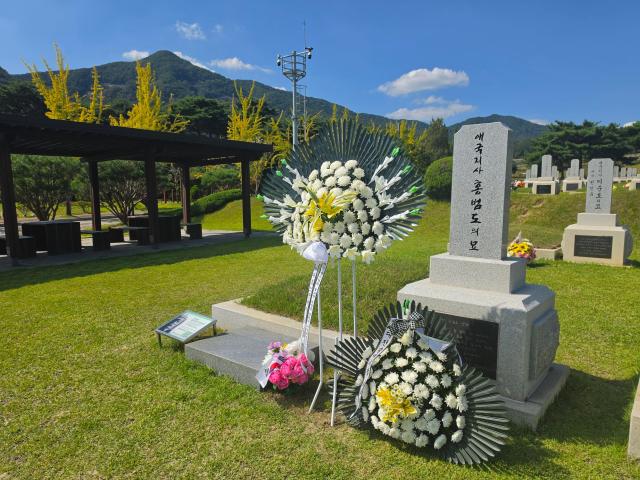
Kyrykbayev is in South Korea as part of President Tokayev's state visit. On arriving at Daejeon National Cemetery, about 160 kilometers south of Seoul, he went first to the Memorial Tower and burned incense. He then moved to Hong's grave in the cemetery's third section for independence patriots and burned incense there as well.
At the grave, Na Chi-man, Deputy Minister for Patriots and Veterans Culture Policy at the Ministry of Patriots and Veterans Affairs, thanked Kazakhstan for its role in bringing Hong home. He said the ministry would keep caring for the grave and would also look after the Hong Beom-do Memorial Park in Kyzylorda, the Kazakh city where Hong had been buried. Na called Hong "a symbol of friendship between Kazakhstan and the Republic of Korea."
"May the spirits of the ancestors be pleased," Kyrykbayev replied. He said Hong's heroic deeds should serve as an example of patriotism for "all the youth of the Korean people, and not only Koreans, but youth of other nations as well."
He described the visit as part of President Tokayev's official program. "Within this framework, of course, we pay homage to such sacred figures," he said, and wished on behalf of President Tokayev and the Kazakh people that "the friendship and brotherhood between our two countries continue to flourish."
Kyrykbayev spoke to AJP in Kazakh that Hong had fought for his homeland's freedom and later came to Kyzylorda along with many other Koreans, living and working there until his death. "On one hand, it is paying tribute to the past," he said of the return of Hong's remains. "On the other hand, it signifies how both Koreans and we Kazakhs love our history, our people, and our homeland."
He then cited a Kazakh saying that calls for honoring the past. "Great historical figures like him will continue to further strengthen the friendship between our two countries," he said.
Hong is one of the most revered figures in South Korea's struggle against Japanese colonial rule, which lasted from 1910 to 1945. In Kazakhstan, he became a symbol of identity for a Korean community that Soviet authorities had uprooted and sent to Central Asia.
He was born into a poor family in 1868, in Pyongyang, by his own account, and lost both parents as a child. He joined the army in Pyongyang as a young man and later made his living as a hunter in the mountains of northern Korea.
In September 1907, Japan issued a law to confiscate guns held by civilians, including hunting rifles. That November, Hong gathered fellow hunters into a militia and began attacking Japanese troops in guerrilla raids across the northern provinces.
The fight cost him his family. Japanese authorities seized his wife to pressure him into surrendering, and she died in prison after torture. His eldest son was later killed in battle.
After Japan annexed Korea in 1910, Hong moved his base to Manchuria and the Russian Far East. In June 1920, as commander of the Korean Independence Army, he led an ambush against a Japanese battalion at Fengwudong, known in Korean as Bongo-dong, in northeastern China.
It was the first large-scale victory by Korean independence forces. That October, his troops fought alongside Kim Jwa-jin's units in the Battle of Qingshanli, another defeat for the Japanese army.
Hong later settled in the Soviet Far East, where he led Korean farming communities, and joined the Soviet Communist Party in 1927. In 1937, Soviet leader Joseph Stalin ordered the forced relocation of 171,781 ethnic Koreans from the Far East to Central Asia. Hong, then 69, was among them and was sent to Kazakhstan.
In Kyzylorda, he worked as a guard at the Korean Theater and later at a rice mill. He died there on Oct. 25, 1943, at age 75, two years before Korea won its independence.
The deported Koreans and their descendants in the former Soviet Union call themselves Koryo-saram. For about 40 years, the Korean community in Kyzylorda tended Hong's grave and kept it as a place to honor him.
After Kazakhstan gained independence in 1991, both South Korea and North Korea sought his remains. Pyongyang argued that he belonged in his birthplace. Seoul pressed the case at the presidential level, and Kazakhstan agreed.
The remains arrived at Seoul Air Base on Aug. 15, 2021, South Korea's Liberation Day, escorted by six fighter jets. Two days later, Hong was posthumously awarded the Republic of Korea Medal, the highest grade of the Order of Merit for National Foundation, at a ceremony President Tokayev attended.
President Tokayev also handed over Hong's death certificate and his letter of resignation from the Korean Theater.
In November 2023, South Korea's veterans ministry opened a memorial park on the site of Hong's former grave in Kyzylorda.
Hong was buried in Daejeon on Aug. 18, 2021, 78 years after his death. The funeral wreath combined carnations, Kazakhstan's flower of mourning, with chrysanthemums, South Korea's. Soil from his grave in Kyzylorda, which President Tokayev had brought to Seoul, was mixed with Korean soil and scattered over his coffin.
AJP Takeaways
- Kazakhstan's Minister of Culture and Information Arman Kyrykbayev burned incense at the Memorial Tower and at the grave of Korean independence hero Hong Beom-do at Daejeon National Cemetery on Sept. 16, a day after signing an agreement with South Korea to preserve independence movement sites.
- Kwon Oh-eul, South Korea's Minister of Patriots and Veterans Affairs, signed that memorandum of understanding with Kyrykbayev at Cheong Wa Dae on Sept. 15, with President Lee Jae Myung and Kazakh President Kassym-Jomart Tokayev looking on.
- Kyrykbayev said the return of Hong's remains in 2021 was both a tribute to the past and a sign that Koreans and Kazakhs love their history, their people and their homeland. He made the remarks in Kazakh at the grave in response to a question from AJP.
Copyright ⓒ Aju Press All rights reserved.