

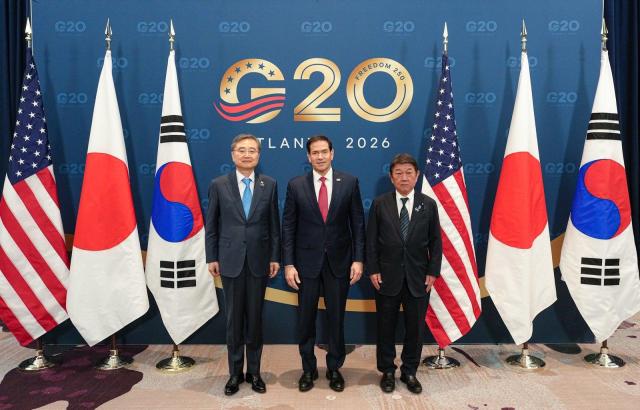
SEOUL, October 31 (AJP) - South Korea, the United States and Japan reaffirmed their commitment to the complete denuclearization of North Korea and agreed to expand maritime and economic cooperation in the Pacific Arctic during trilateral talks in Atlanta on Friday (local time), amid heightened tensions following Pyongyang's latest ballistic missile launches.
South Korean Foreign Minister Cho Hyun met with U.S. Secretary of State Marco Rubio and Japanese Foreign Minister Toshimitsu Motegi on the sidelines of the Group of 20 (G20) foreign ministers' meeting in Atlanta, Georgia.
The meeting marked the fourth gathering of the three countries' foreign ministers this year, following talks in Türkiye on July 7, the Philippines on July 22 and New York on Sept. 21.
The latest meeting came one day after North Korea launched around 10 short-range ballistic missiles from the Wonsan area toward the East Sea, according to South Korea's Joint Chiefs of Staff (JCS).
The missiles, fired at approximately 12:30 p.m. on Thursday, traveled about 250 kilometers. The launch was Pyongyang's first ballistic missile test in 17 days and followed Seoul's proposal for military talks aimed at easing tensions along the heavily fortified inter-Korean border.
The three foreign ministers reiterated their shared position on North Korea's nuclear weapons program and called for the full implementation of United Nations Security Council resolutions.
"The Secretary and Foreign Ministers reaffirmed their resolute commitment to the complete denuclearization" of North Korea, the State Department said in a statement released on Friday.
The ministers also reaffirmed their commitment to enforcing U.N. sanctions prohibiting activities that generate revenue for Pyongyang's nuclear and ballistic missile programs.
They commended the work of the Multilateral Sanctions Monitoring Team (MSMT), an international mechanism established to monitor North Korea's sanctions violations and efforts to circumvent U.N. restrictions.
The three countries also agreed to maintain a robust deterrence posture against North Korea while continuing diplomatic efforts to achieve lasting peace and stability on the Korean Peninsula, according to South Korea's Foreign Ministry.
Cho emphasized Seoul's intention to serve as a "pacemaker" in efforts to resume dialogue between Washington and Pyongyang, stressing that such efforts would proceed in close coordination with the United States.
Japan's Foreign Ministry said the ministers also agreed to strengthen cooperation against North Korea's malicious cyber activities, which help finance its nuclear and missile programs. Tokyo additionally welcomed continued support from Seoul and Washington for resolving the issue of Japanese nationals abducted by North Korea.
Beyond security issues on the Korean Peninsula, the three ministers signed a memorandum of cooperation establishing the Trilateral Arctic Pacific Partnership (TAPP), a new framework intended to explore maritime cooperation and economic opportunities in the Pacific Arctic.
Under the agreement, the three countries plan to establish a trilateral working group to identify potential areas of cooperation, including maritime safety, emergency response and economic partnerships.
The initiative reflects efforts to broaden trilateral cooperation beyond traditional military and diplomatic coordination into maritime and economic security.
Separately, Cho held bilateral talks with Rubio on the sidelines of the G20 gathering, discussing bilateral relations, high-level exchanges and visa-related issues, according to Seoul's Foreign Ministry.
The bilateral meeting followed controversy in South Korea over U.S. visa complications involving two ruling Democratic Party lawmakers, including National Assembly National Defense Committee Chairman Jin Seong-joon, whose planned visit to U.S. military commanders in Hawaii was disrupted by difficulties obtaining an official visa.
Jin announced on Saturday that he had received his official A-2 visa from the U.S. Embassy in Seoul, following an earlier refusal that had raised concerns over his planned visit to Hawaii.
"I am relieved that the U.S. State Department has issued the official A-2 visa to the chairman of South Korea's National Assembly Defense Committee, albeit belatedly," Jin said in a statement.
"I will depart as scheduled and hold substantive discussions with the commander of U.S. Indo-Pacific Command and other senior U.S. military officials on strengthening bilateral security cooperation and developing a future-oriented alliance, with South Korea's national interests at the forefront," he added.
Copyright ⓒ Aju Press All rights reserved.


