

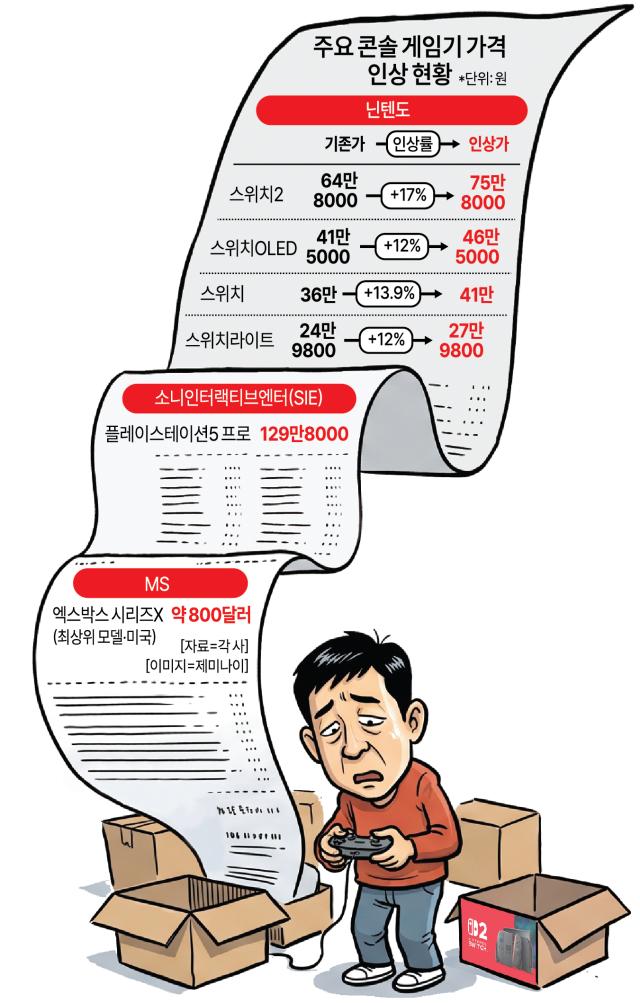
Rising prices for semiconductors and other electronic components are driving up the cost of game consoles, following similar trends in smartphones and laptops. The surge in memory semiconductor prices, along with currency fluctuations, tariffs, and manufacturing costs, has led global console makers Sony, Nintendo, and Microsoft to raise prices, marking the onset of what is being termed 'console inflation.'
According to Nintendo Korea, the price of the Nintendo Switch 2 will increase from 648,000 won to 758,000 won starting September 1, reflecting an approximate 17% hike. Nintendo had already adjusted prices for its existing Switch models in May, with the OLED model rising from 415,000 won to 465,000 won, the standard model from 360,000 won to 410,000 won, and the Switch Lite from 249,800 won to 279,800 won.
Sony Interactive Entertainment (SIE) and Microsoft have also raised prices for their major consoles. The PlayStation 5 Pro is currently the most expensive console on the market in South Korea, priced at 1,298,000 won. Microsoft has similarly increased prices for its Xbox Series X and other consoles, with the top model in the U.S. now costing $799.99.
Consoles are specialized devices designed to run high-performance games. Many recently released blockbuster titles exceed 50 to 100 GB in size, making the standard storage insufficient for many users.
As a result, PlayStation 5 users are increasingly adding SSDs to their systems to secure enough game installation space. The initial costs of starting to game are rising as the console price is now compounded by the costs of additional storage, controllers, and game titles.
The increase in console prices is primarily attributed to the rise in semiconductor costs. In the first quarter of this year, a shortage of inventory among PC original equipment manufacturers (OEMs) led to a staggering 90-95% increase in general DRAM prices compared to the previous quarter, marking the highest quarterly increase on record. In May, the price of general-purpose DDR4 DRAM for PCs crossed the $20 threshold for the first time. According to market research firm TrendForce, while the price increase has somewhat stabilized in June, DRAM prices are expected to rise by up to 20% again in the third quarter.
NAND flash, a key component used in SSDs for PCs and consoles, is also experiencing continuous price hikes due to supply shortages and manufacturers shifting production lines. As of June, the average fixed transaction price for general-purpose NAND flash (128Gb MLC) used in memory cards and USB drives was $28.82, an 8.72% increase from the previous month. This marks 18 consecutive months of price increases. The supply shortage is expected to worsen in the second half of the year, extending the longest streak of price increases on record.
The root cause of the semiconductor supply shortage is that major memory chip manufacturers are prioritizing production lines for high-margin AI server products. This means that the supply of lower-margin products for consoles and personal computers is being increasingly restricted.
The gaming industry anticipates that console prices may continue to rise next year. Additionally, the impacts of war have led to increases in exchange rates and logistics costs, prompting remarks that "today is the cheapest day." The same trend is evident in the PC market, which is a key platform for domestic game companies. As semiconductor prices have caused the prices of complete PCs to more than double, sales of gaming PCs have also sharply declined.
* This article has been translated by AI.
Copyright ⓒ Aju Press All rights reserved.