

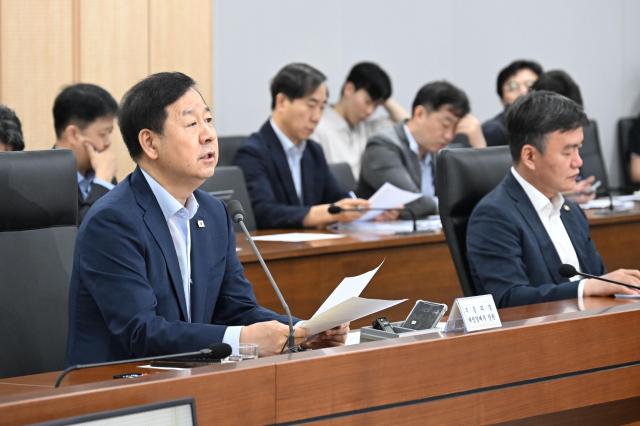
On July 3, Deputy Prime Minister and Minister of Finance Koo Yun-cheol announced these measures during a meeting of the Emergency Economic Headquarters and the Economic Relations Ministers' Meeting, detailing the "Emergency Support Plan for SMEs Facing Management Challenges Due to High Exchange Rates."
To assist SMEs and mid-sized companies impacted by high exchange rates, the government will provide 14.9 trillion won in emergency management funds. This funding will focus on companies facing management difficulties due to high exchange rates, utilizing 13.8 trillion won remaining from the 23.7 trillion won allocated for businesses affected by the Middle East situation. An additional 1.1 trillion won will be supplied, with plans to increase support as needed.
A dedicated track for SMEs facing management challenges will be established within the emergency management stabilization fund, easing the eligibility requirements for support. Under this plan, SMEs that import raw materials accounting for more than 20% of their sales will be eligible for emergency management stabilization funds, even if they do not meet the criteria of declining sales or operating profits.
The Export-Import Bank's crisis response special program will be expanded by an additional 1 trillion won, bringing the total to 8 trillion won, with interest rate benefits strengthened from a 2.0 percentage point reduction to 2.2 percentage points. Furthermore, a new "Ultra-Low Interest Coexistence Loan for Overcoming High Exchange Rates" will be introduced, allowing loans at the bank's procurement cost rate.
SMEs that have not previously exported will now be able to enroll in import insurance, with a 50% discount on premiums available until April of next year. For SMEs facing increased costs for key raw material imports, the trade insurance loan guarantee limit will be doubled.
The Korea Trade Insurance Corporation will increase the supply of foreign exchange fluctuation insurance from 1.2 trillion won to 1.3 trillion won, and the discount on premiums for SMEs will be doubled from the current 15%.
Other measures include advance payment of trade insurance premiums, temporary expansion of the support limit for trade insurance premiums within export vouchers, and the provision of loan currency conversion rights.
Finally, tax and fiscal support for SMEs will be strengthened. For SMEs facing management crises, deadlines for corporate tax, value-added tax, income tax, and customs duties will be extended. Additionally, the Export Support Center will manage high exchange rate-related management challenges comprehensively.
Koo Hwan-wook, policy coordination officer at the Ministry of Finance, stated, "We will implement the key tasks of this plan without delay to alleviate the management burden on SMEs suffering from high exchange rates, and we will carefully examine the challenges faced by businesses to prepare additional support measures if necessary."
* This article has been translated by AI.
Copyright ⓒ Aju Press All rights reserved.